MALTA – THE LAND OF KNIGHTS
written by Ana Boneva




Most people associate September with autumn, but for me it was the beginning of the summer break. So in its first days we headed to the warm knightly tale Malta. For centuries, people have fought wars for this important and strategic island, and today the invasions are by tourists wishing to explore this historical treasure. The distance by plane from Sofia is only 2 hours, with regular flights by Ryanair. While flying I found it strange how could the outside temperature at 7772 meters, so close to the sun, be only -44 C! In the evening the island welcomed us very warm with moist air, to which, however, we quickly adapted. September is an excellent time to relax and explore the island, with an average temperature of 28 C and a minimum of 22 C. At the beginning of the month, on September 8, the Maltese celebrated Victory Day. This date represents 4 historical events: 1) The Great Siege – September 8 commemorates the victory over the Ottoman Empire by the Knights of St. John back in 1565. 2) Liberation from the French – after several months of possession, in September 1800 the Maltese, with the help of Britain, blocked the French garrison and the French surrendered; 3) World War II – On this date in 1943, the Italian Navy handed over Malta back to the British. 4) Maria Bambina – on this day the Maltese also celebrate the Little Virgin Mary. So all these “coincidences” make September 8 a holiday on which everyone celebrates, especially the inhabitants of Valletta. On this day, a wreath is solemnly placed in front of the fortress of St. Angelo in Vittoriosa. The Victory Monument was built in 1705 and represents Malta as a beautiful and armed woman. Another wreath is placed in Valletta in front of the monument to the Great Siege, erected in 1927. On September 8, the largest maritime event in Malta is held – a frigate race. Exactly at 14:00 from the Grand Port in Valletta depart the colorful frigates, which compete one mile. In the afternoon, Valletta becomes an open cultural center, where shops are open until late in the evening and the streets full of musicians and artists make performances.
Our holiday in Malta began with a sunny Sunday – this day of the week since ancient times is dedicated to the sun (Sunday = sun + day). Here in Malta, however, it seems that every day is a greeting to the sun, as sunny days are over 300 per year. Interesting how so much sunlight can fit on such a small island. Small, because it is only 316 square kilometers. It is 27 km long and 14 km wide. In fact, the Republic of Malta consists of 3 inhabited islands Malta, Gozo and Comino, and several more uninhabited. This island nation is located in the center of the Mediterranean Sea 90 km south of the Italian island of Sicily and 250 km from the African coast.
On our first day on the island, we decided to tour it with the double-decker tourist bus, with which we could get off and board each of the stops, and for only 15 euros to make a tour of all the sights. In Malta there are 3 tourist lines – the Red Buses that go around the southern part of the island of Malta, the Blue Buses – for the northern part of the island and Green Buses, which are touring the island of Gozo.

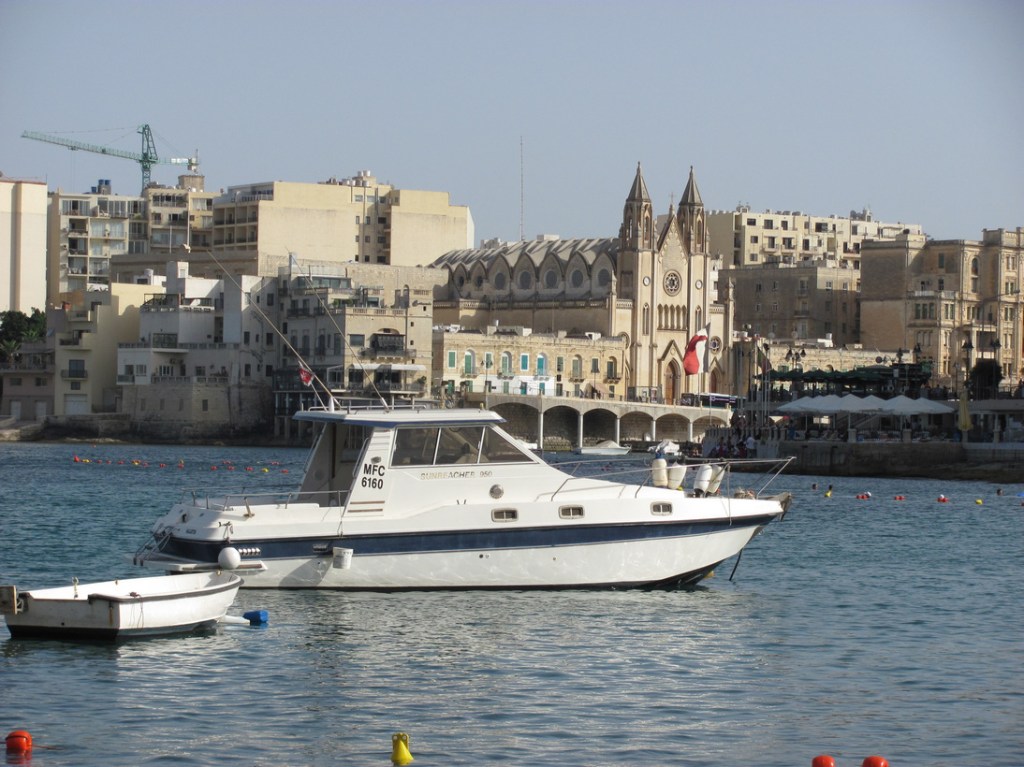


We started with the Blue or Northern Line, beginning from the resort of Sliema. Sliema was a famous resort back in the 1850s, and since then it has grown so much that it has acquired the status of a city. The guidebooks say that the promenade of Sliema is the busiest place on the island, which, however, was not the case early in the morning. The bus was late, which confirmed our initial impressions of the Maltese accuracy, which was simply missing. People here were not in a hurry, even when a client was waiting for them and hanging on their heads. Only the tourist buses were in a hurry, and we realized this as soon as we got on and sat on the open second floor. The bus was moving very fast and it was quite difficult to focus the landscapes. Even the photos from the plane seemed to be clearer and better!
Riding the bus we passed the island of Manuel, which is very close and is actually located in the bay of Sliema and connected to it by land by a stone bridge. At the time the island was well fortified by the knights, and today it is used as a luxury residential complex.
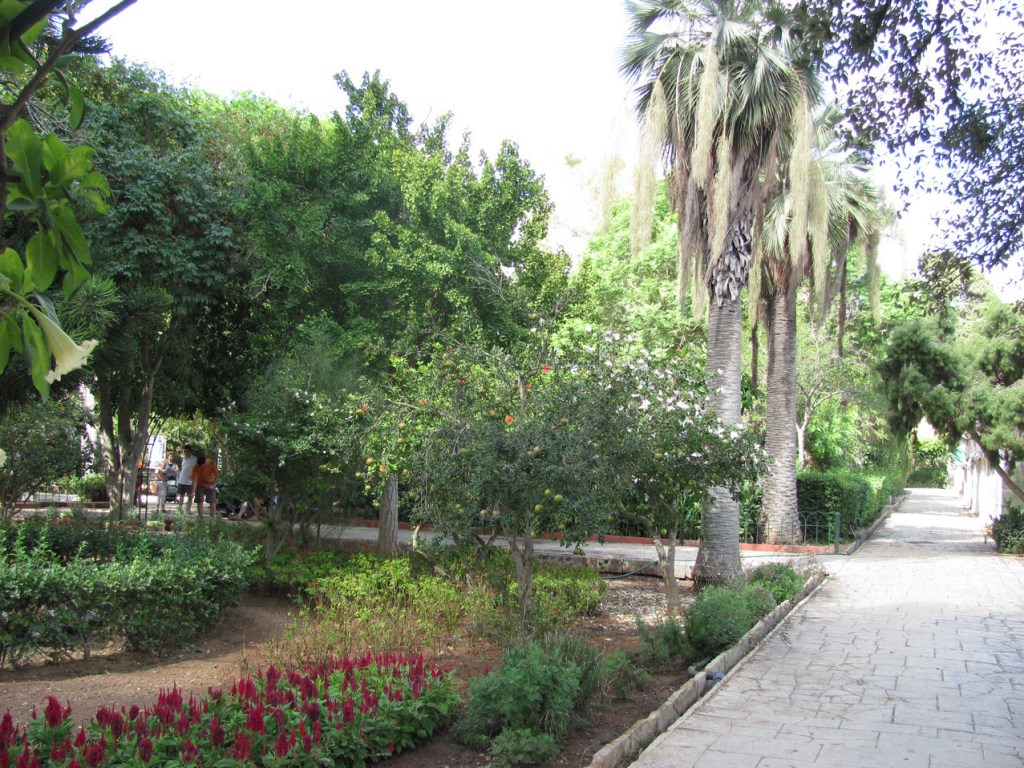
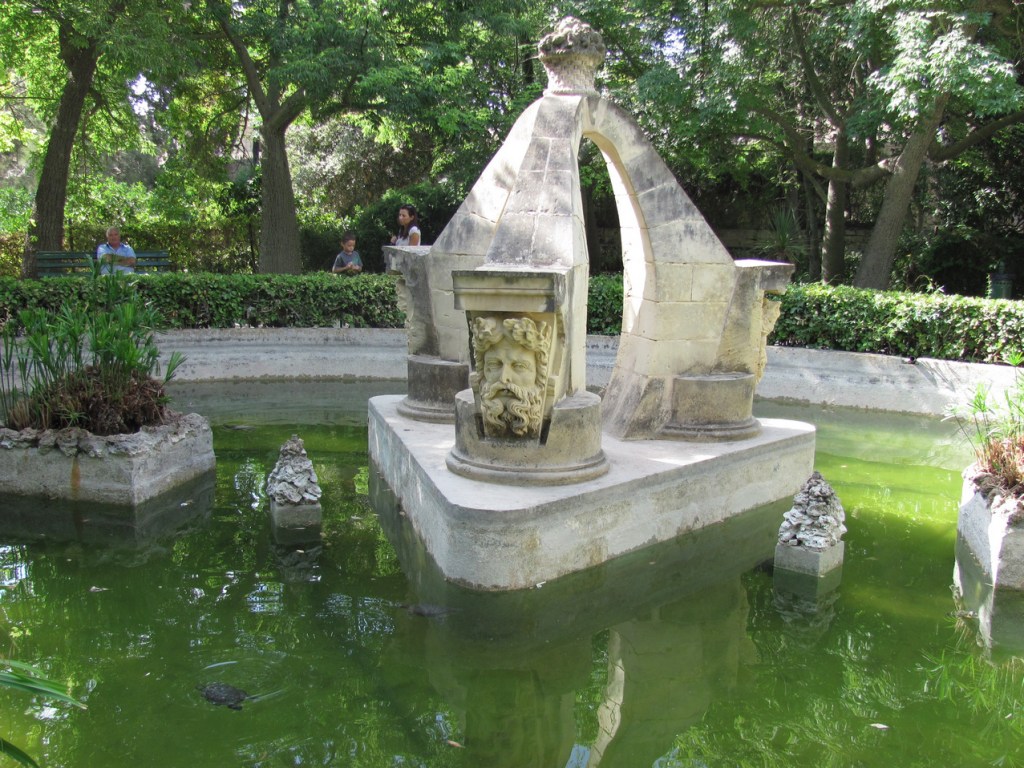
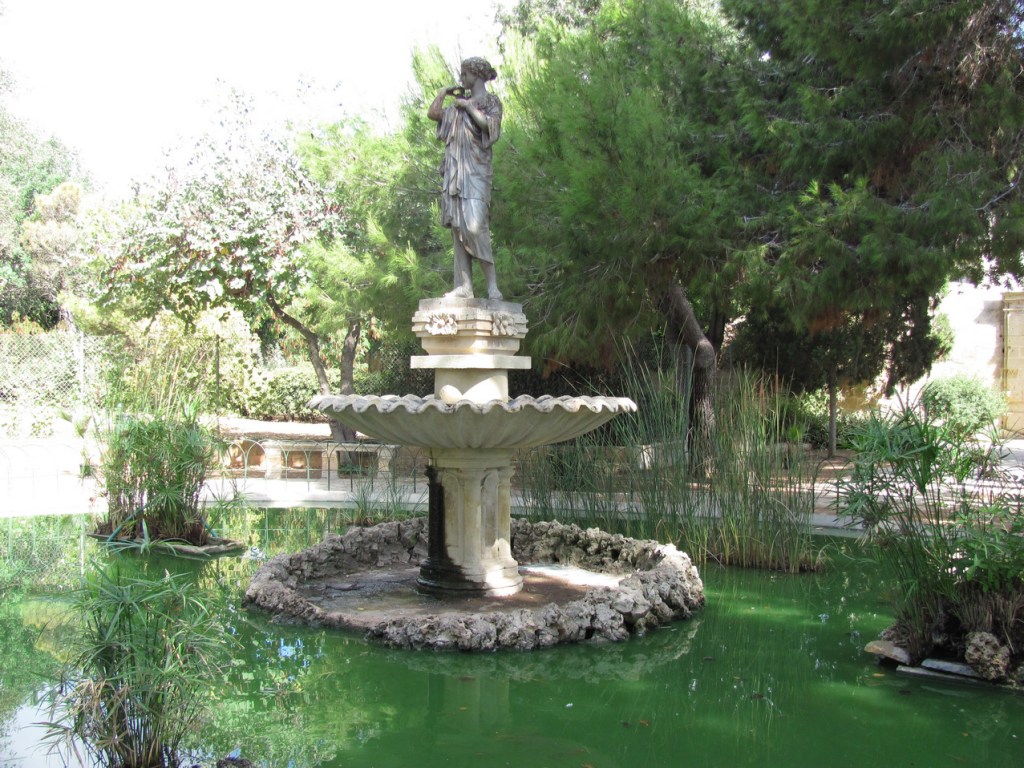
From here our tour continued along the port with the beautiful yachts. There was a stop in Valletta, where we decided not to get off, but to leave the tour of the capital city for the festive September 8 and accordingly we continued to the next stop – the gardens of San Antonio. The same deservedly bear their fame as the most beautiful gardens in Malta. Here, besides palm trees, old trees and many flowers, I was impressed by birds and turtles. There were swans, ducks and newly hatched chickens, beautiful pheasants and even caged parrots. In several fountains turtles and swans were swimming – everything was very beautiful.

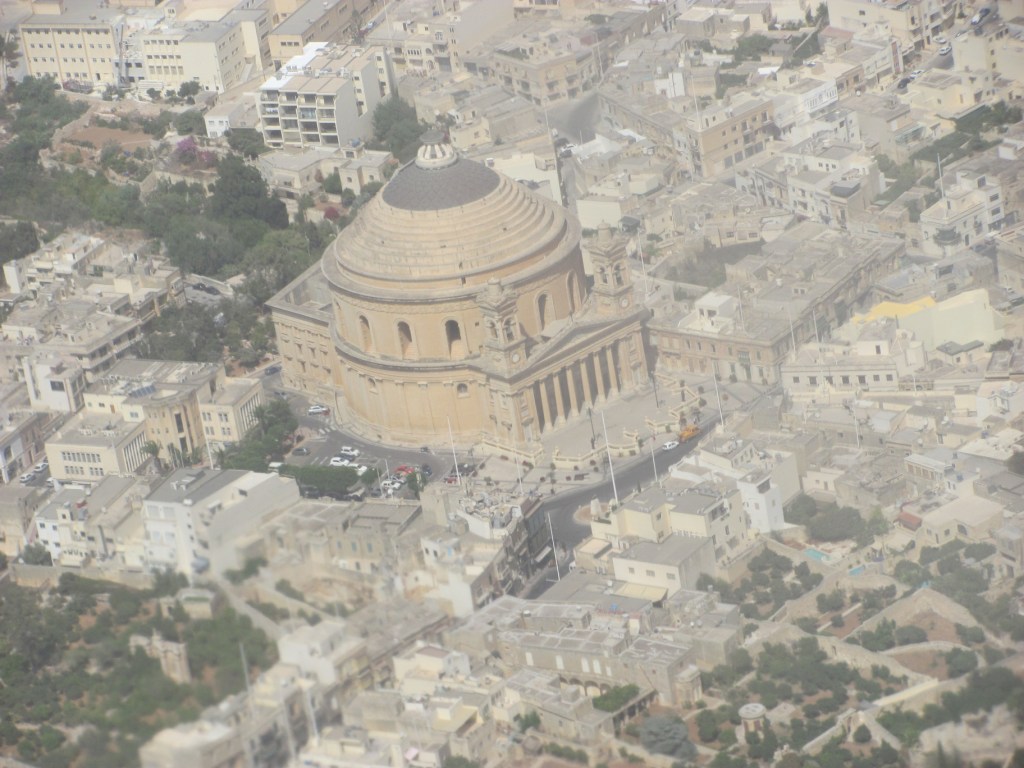
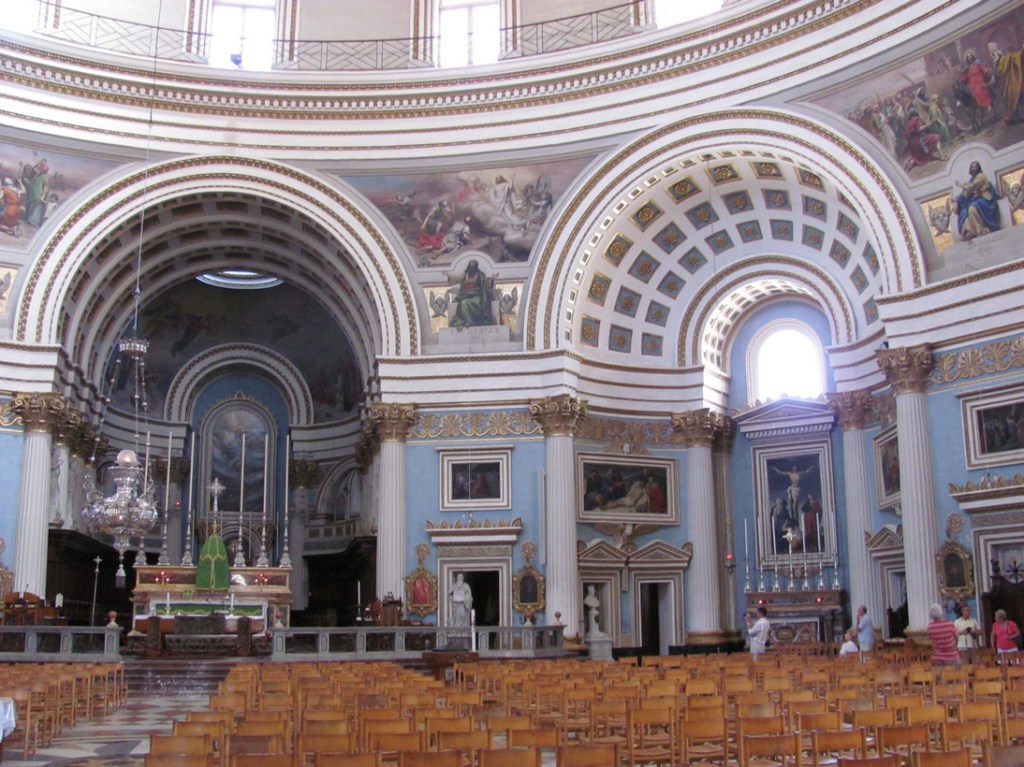
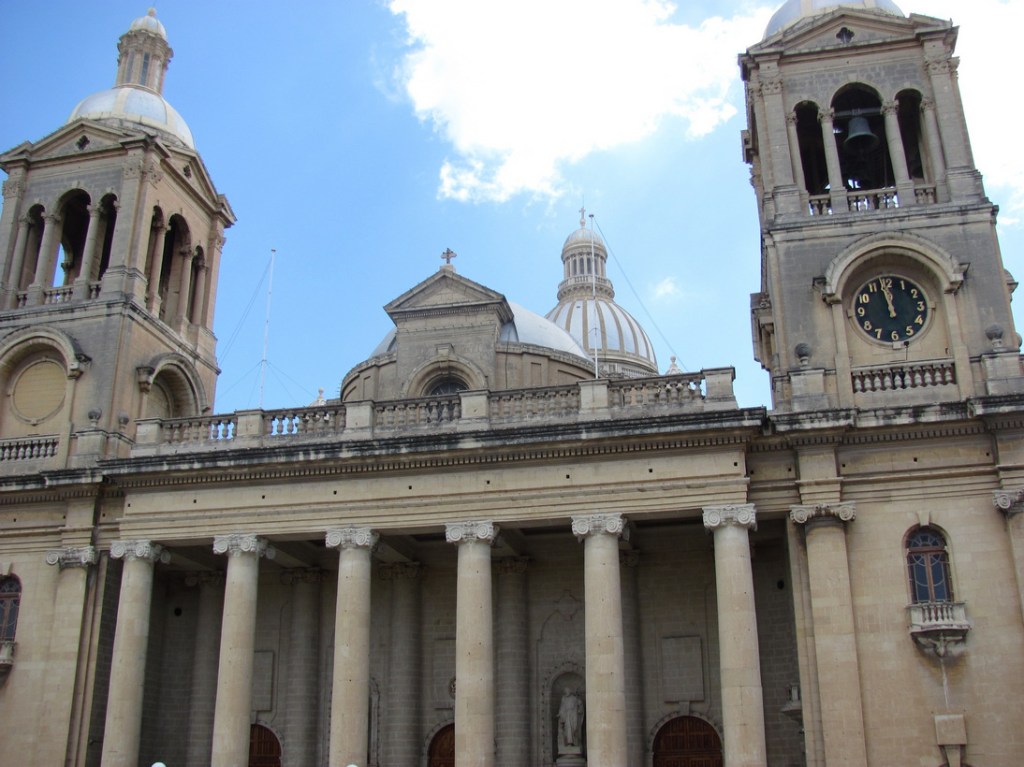
After the walk of the green gardens we boarded the next double-decker bus (the same pass every 30 minutes, which of course in Maltese times are a bit longer). Our bus passed by the village of crafts and the aviation museum, but we went down in the town of Mosta, right next to the beautiful church with the big dome that I had managed to photograph from the plane. The Church of the Virgin Mary has the third largest dome in Europe (after the one in Rome and London). The church itself is a copy of the Pantheon in Rome. Its construction began in 1833 on the remains of an old church and was completed in 1871. During World War II, a German bomb fell on the church and broke the wall, but miraculously did not explode. This bomb is kept to this day, being displayed in a small room in the church, and inside it is forbidden smoking and lighting candles…
The next bus stop was Malta’s old capital, Medina, also known as the Noble City. Our walk started from its fortress walls, stepping along the winding cobblestone medieval streets. In fact, this city was founded by the Romans, who called it Melita, but the Arabs then divided it into two parts Mdina (the old town) and Rabat (the outskirts outside the citadel). We looked at both parts, boarding a tourist train. The same did an 8-kilometer panoramic tour in 30 minutes. The trip cost only 4 euros, but it was an unforgettable experience – not because of the landscapes and ancient buildings we saw, but because of the shaking and high speed. In fact, I liked a lot the tour as well as the comments of the tour guide.
What we learned is that when the knights came to the island, they preferred to fortify themselves around the port, where their ships dropped anchors and moved the capital to the town of Valletta. After the victory of the Great Siege in 1571, the town of Valletta became the official capital, and the old capital received its new one has Citta Vecchia (Old Town). Some of the inhabitants of Mdina moved to the new capital, but some of the aristocrats stayed with their families here, which helped preserve many buildings from the 14th-15th centuries.



After Mdina followed one of the most pleasant stops: the Golden Bay – this is one of the best Maltese sandy beaches. In fact, the sandy beaches of Malta are not many, so this one was not to be missed, especially after the all-day warm tour of the island. We had swimsuits and although there were no changing rooms, we managed to put them on and eagerly headed to the sea water, which turned out to be blissfully warm. Unfortunately, there were many waves and it was not easy to swim, but the refreshment was amazing.


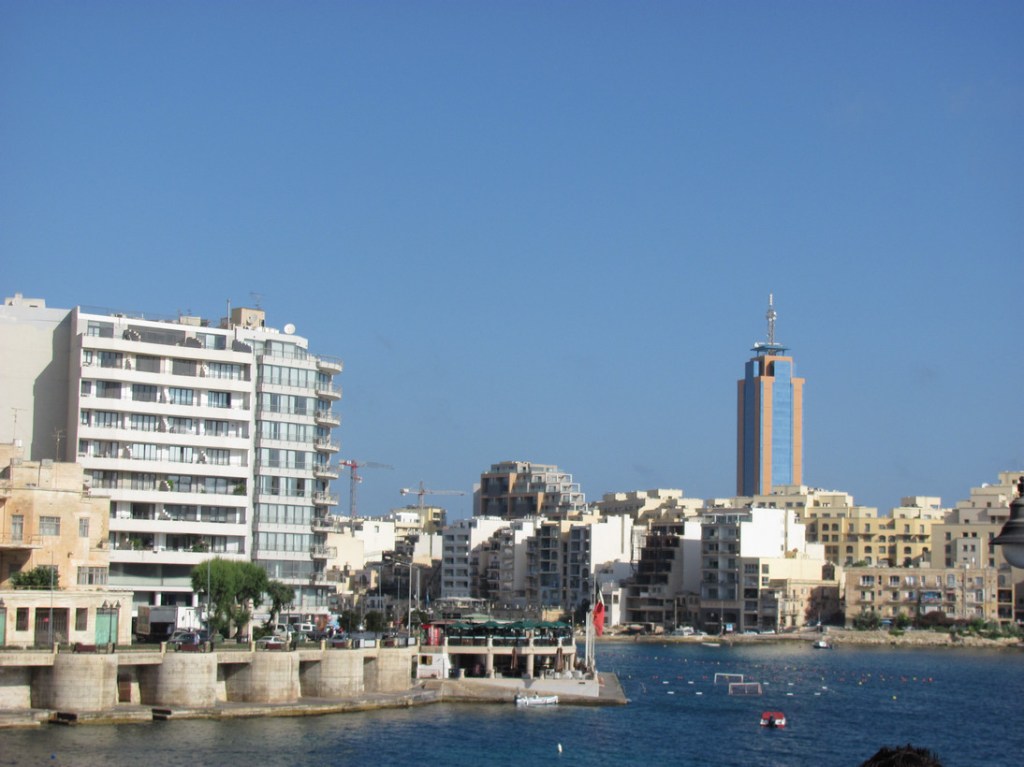
In the evening we walked around the most famous resort on the island St. Julians and visited the Bay Street mall. We also passed the Portomaso Tower, but we were not allowed to go inside on its panoramic platform. The tall skyscraper has business offices, and the top floor is a nightclub, which, however, opens after 22:00. We had dinner in a small restaurant, where I especially liked the octopus pizza.
After sunny Sunday (dedicated to the sun) came Monday – the day dedicated to the moon (Monday – in English comes from the word moon and Lundi – in French comes from lune / moon). Again from dawn the sun showered us with its rays, accompanied by the wind, which was also an integral part of the island of Malta.
That day we decided to explore the southern part of the island. Again on the double-decker tourist buses, but this time on the so-called South Tour or the Red Line. Here, however, the buses come not in 30 minutes, but in every hour, which in Maltese time again took longer. In that way we caught better tan, waiting at the bus stops, as the shadows of this island are very rare.
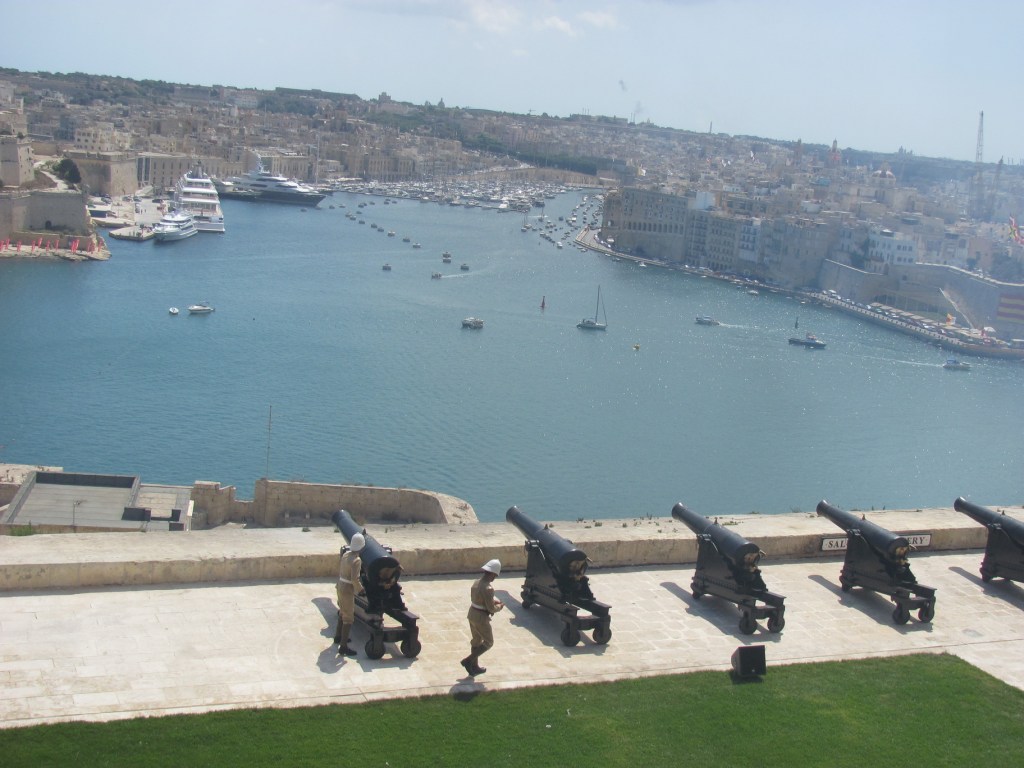
The waiting started in the morning, and instead of starting at 09:00, the first bus came at 10:15 am. There was no additional information about the stops and sightseeing, so we missed the 6th stop – Upper Barrakka Garden – the botanical garden, from where an incredibly beautiful panoramic view of the Grand Port and the three cities is revealed.
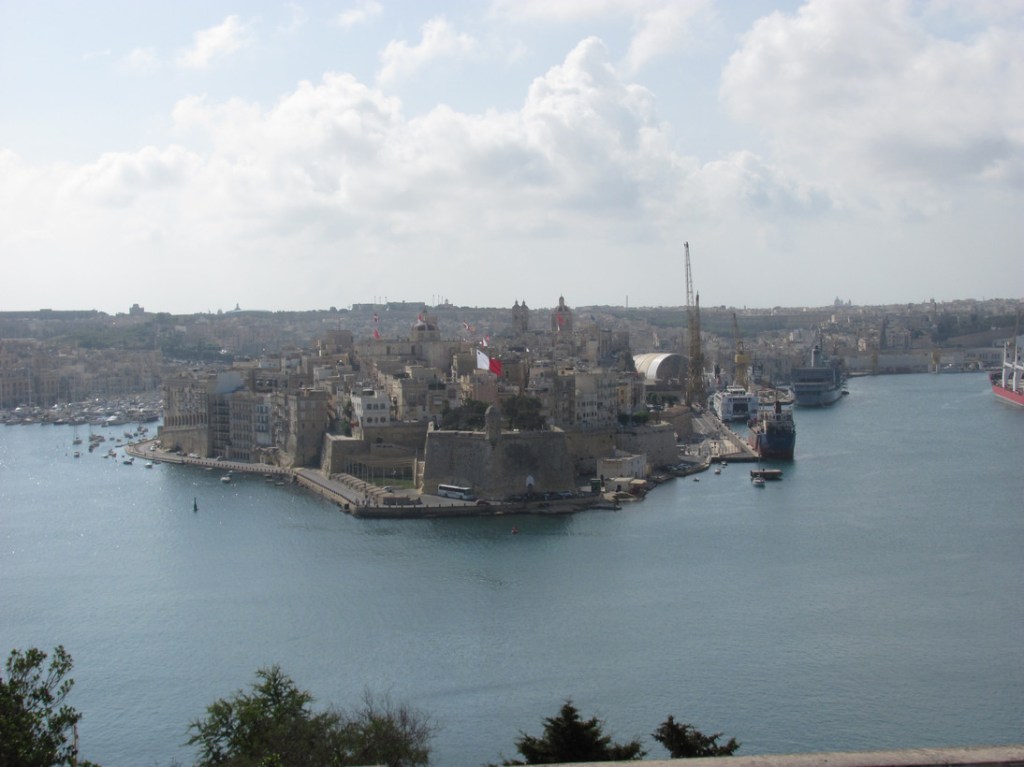
The three cities are actually the three peninsulas around the great port that managed to withstand the Great Maltese siege, when the Turks numbered thousands of times more than the inhabitants and knights of Malta, but in 1565 the knights managed for months to withstand the siege until reinforcements came from Sicily and the Turks were expelled (on September 8, 1565). which at the time had the status of cities, acquired the common name of the Three Great Cities or Cities of Victory. Their individual names are respectively Vittoriosa, Senglea and Cospicca – and they keep the memory of the Knights of Malta.
The red buses passed through all of them, but since the bus was full and we were standing, we could not listen to the tour guide talking through the headphones. We passed Fort St. Elmo without being able to learn more about it. Later I learned from the booklet that this fort was a military fortification. In fact, this peninsula was fortified as early as the Punic era (200 BC), today, the fortification is only partially open to the public.
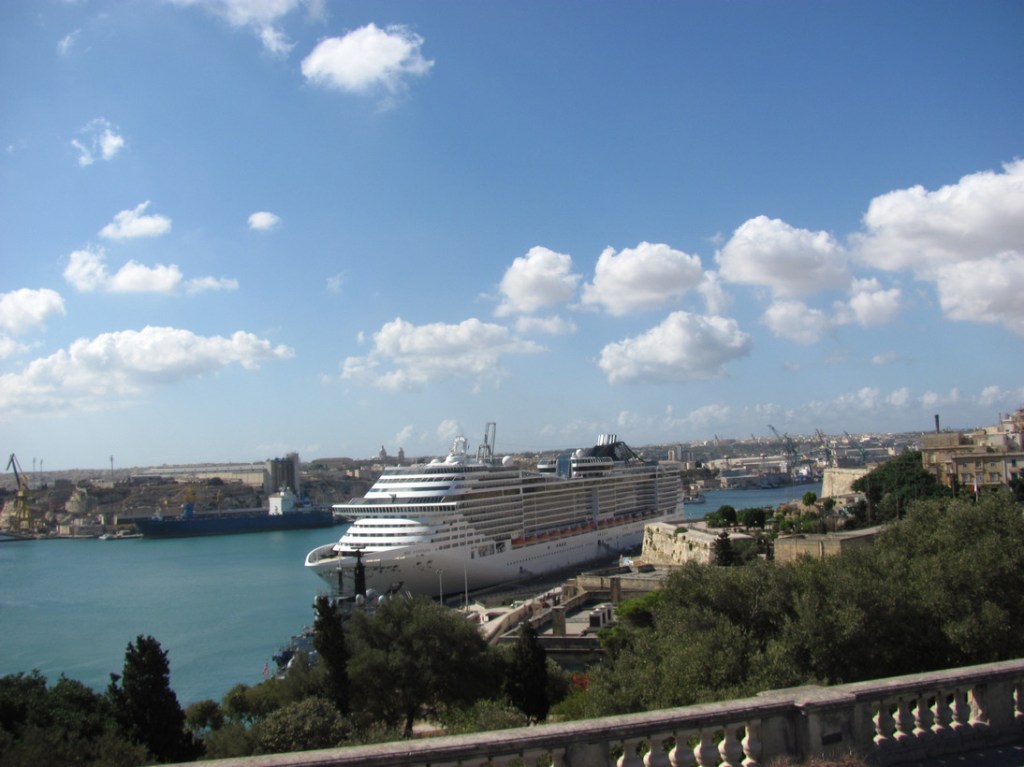
I also missed the story of Fort St. Angelo, which has been protecting the harbor for centuries. However, we saw a large cruise ship similar to the one we traveled a few months ago.
When we reached Hypogeum we hurried to get off the bus, but it turned out that this landmark can not be visited without pre-registration on the Internet, which happens for months ahead. For September, for example, there is not a single vacancy, although the month has just begun.
Hypogeum is actually an underground Neolithic temple complex dating back to 4100-2500 BC, in which the niches themselves, the oracle and the frescoes on the walls are preserved. The Hypogeum consists of 3 levels, with only the first 2 open to the public. This monument is under the protection of UNESCO, designated as a World Heritage Site. On the Internet I had seen many interesting photos and really wanted to see this city, but again I looked at it only from the booklet, from where I also learned that the structure of these underground rooms was used both for burials (remains of about 7,000 people were found) and for an altar for fertility (there were many statuettes of fat women). Hypogeum was accidentally found by workers who were starting to build a house, it turned out that there was already one underground – on 3 floors, with the lowest level being 10.6 m below the earth’s surface. It is interesting that we still learned about the existence of such an underground city, consisting of walls, rooms and corridors of more than 500 sq.m.
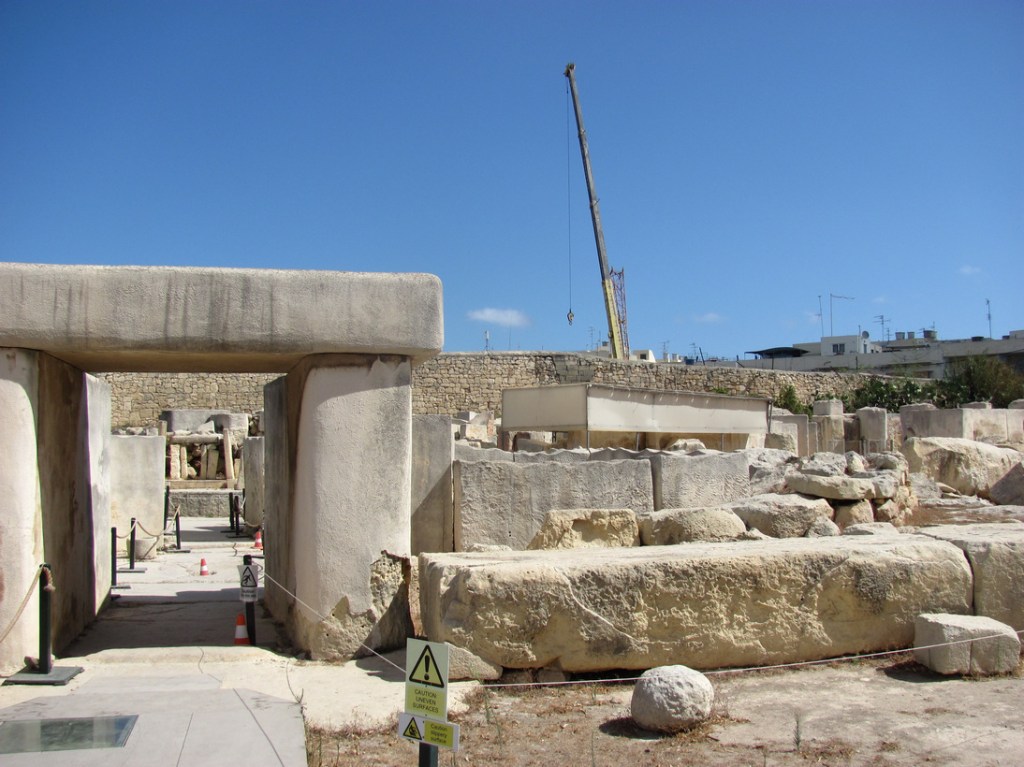
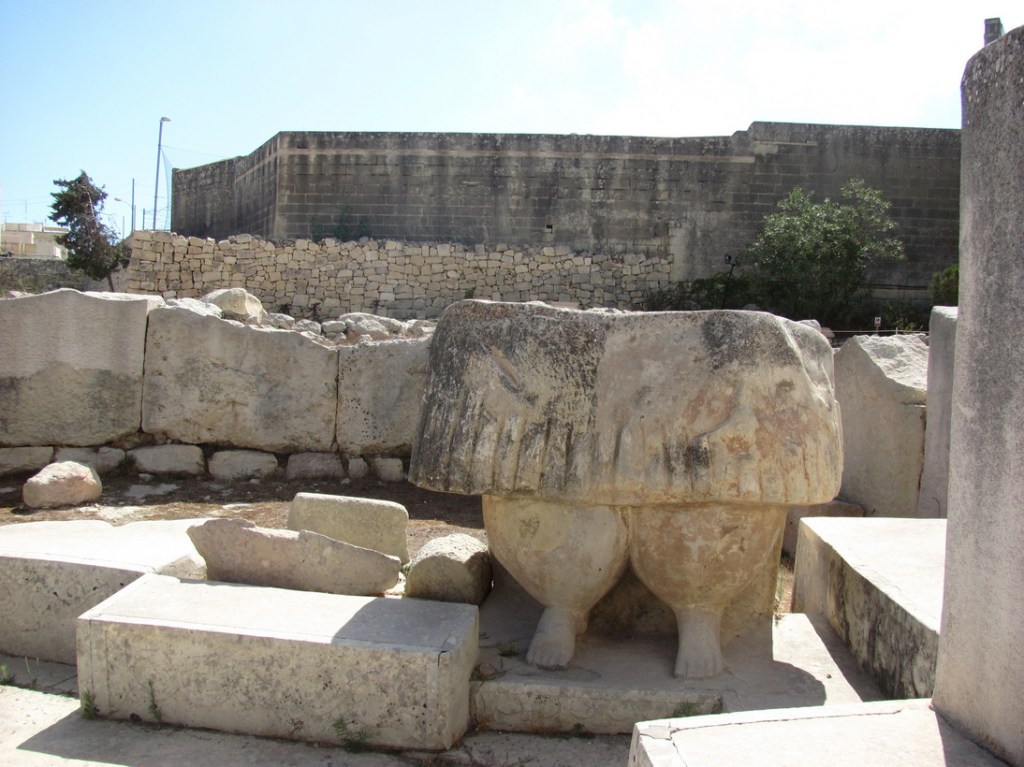
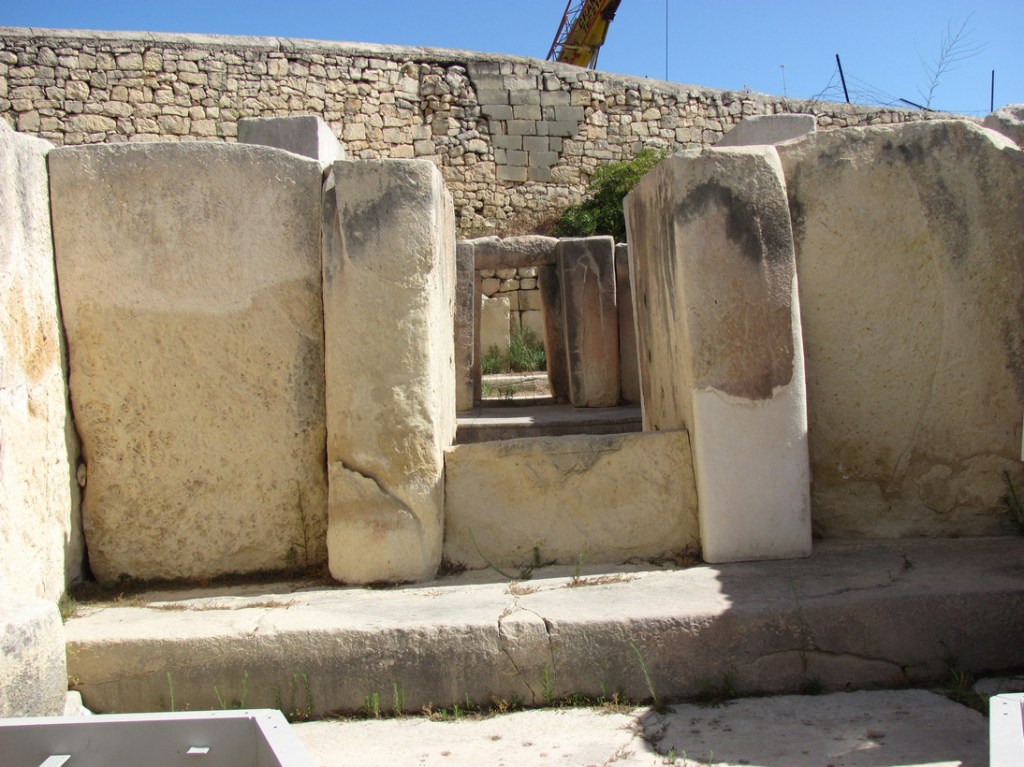
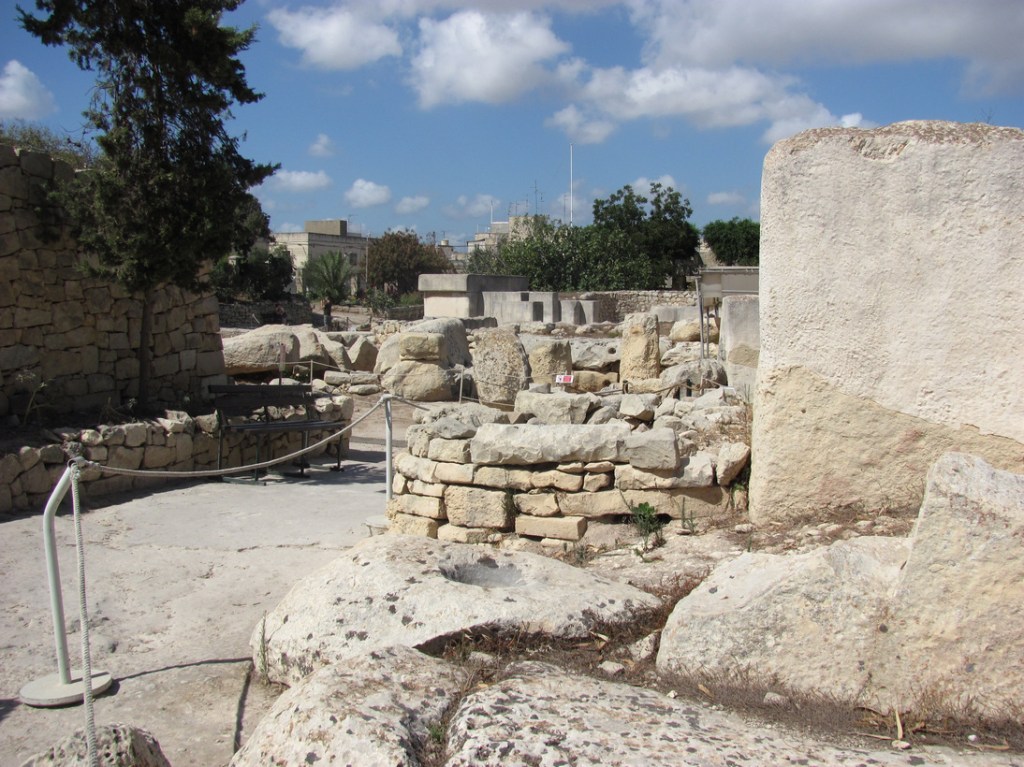
We realized that we could not enter the Hypogeum after we had got off the bus, so we had to wait for the next one, which will come only after 1 hour. So we decided to see the other sights of the town of Paola – the temple complex Tarxien Temples, which at least were located on the surface. They are many stones that date back to 2200 BC. Based on the artifacts found, it is believed that the temple was used for an oracle. One of the stone structures is especially impressive, it is 2.50 meters high with a statue of the Mother Goddess, but now it is broken in two and the upper part is missing. Here, too, like many places in Malta, statues of “fat” women have been found, believed to symbolize fertility. The whole complex resembles the Bulgarian Perperikon, which was in larger sizes and better preserved.






Even after the walk in the temples, we still had a lot of time to wait for the bus, and when it finally arrived it was full and we had to stand on the first floor again.
Again we passed the three great cities, there was a stop in Senglea and then at the marina in Vittoriosa, we passed the Bieb-is-Sultan, which is a magnificent triumphal gate built by Grand Master Nicholas Cotoner in 1675.
We also passed the Zejtun Parish Church, which is located in the mid-sized city in southern Malta, Jejtun. The name comes from the Sicilian Arabs, meaning “olive”. It was one of the most developed industries here. In the city center there was another church St. Gregory, which was the largest and undoubtedly one of the most interesting churches on the island in the 16th century.
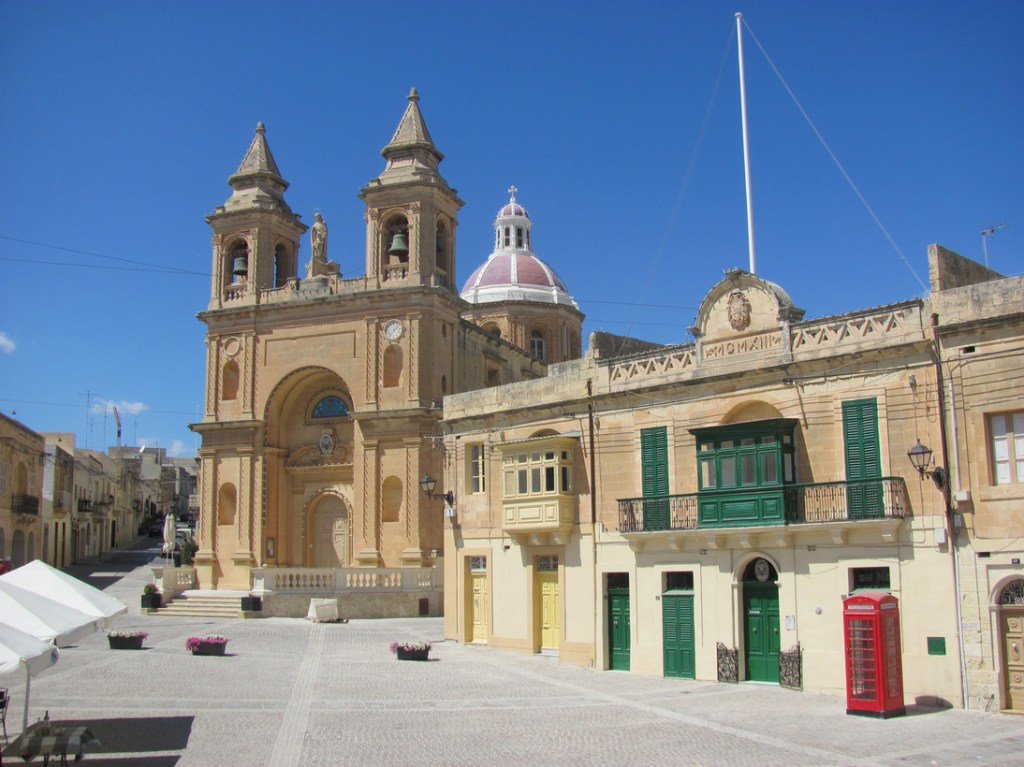
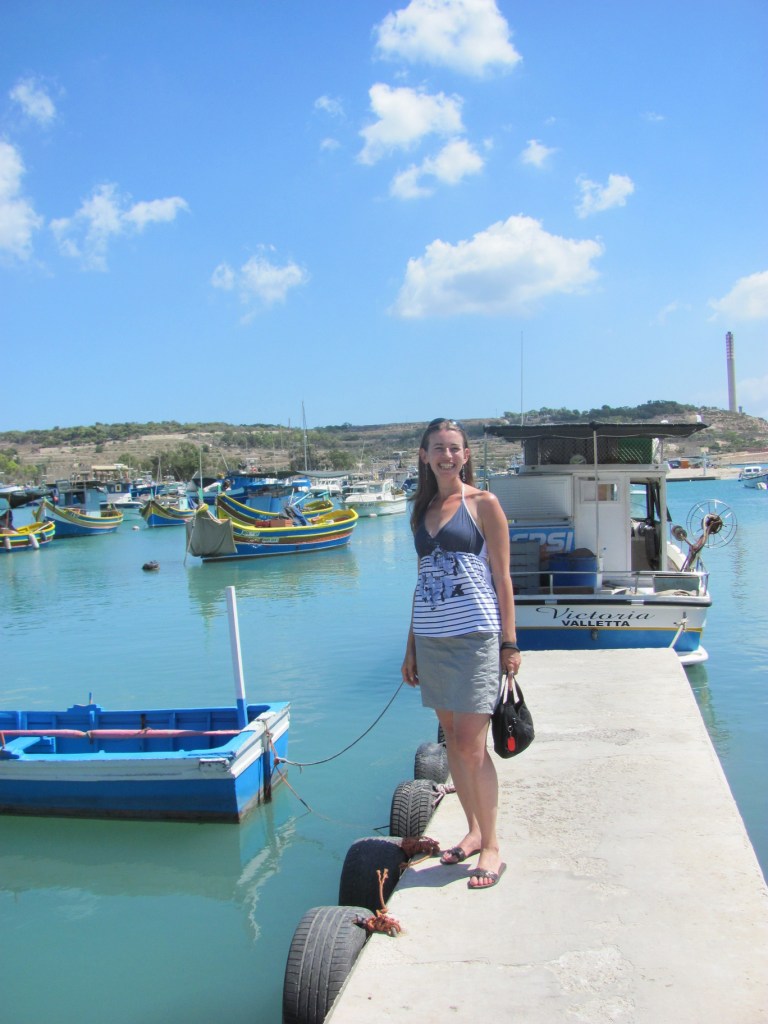
We got off the bus only when we reached the southern town of Marsaxlokk, which is a typical Mediterranean fishing village, with colorful boats moored on the shore, a souvenir market and many restaurants perched along the shore of the port. The walk along the coast was very relaxing and pleasant. We ate ice cream and drank Kinnie, which is a traditional Maltese soft drink made from oranges and specific spices. The drink had an interesting refreshing taste, but I definitely wouldn’t drink it again.
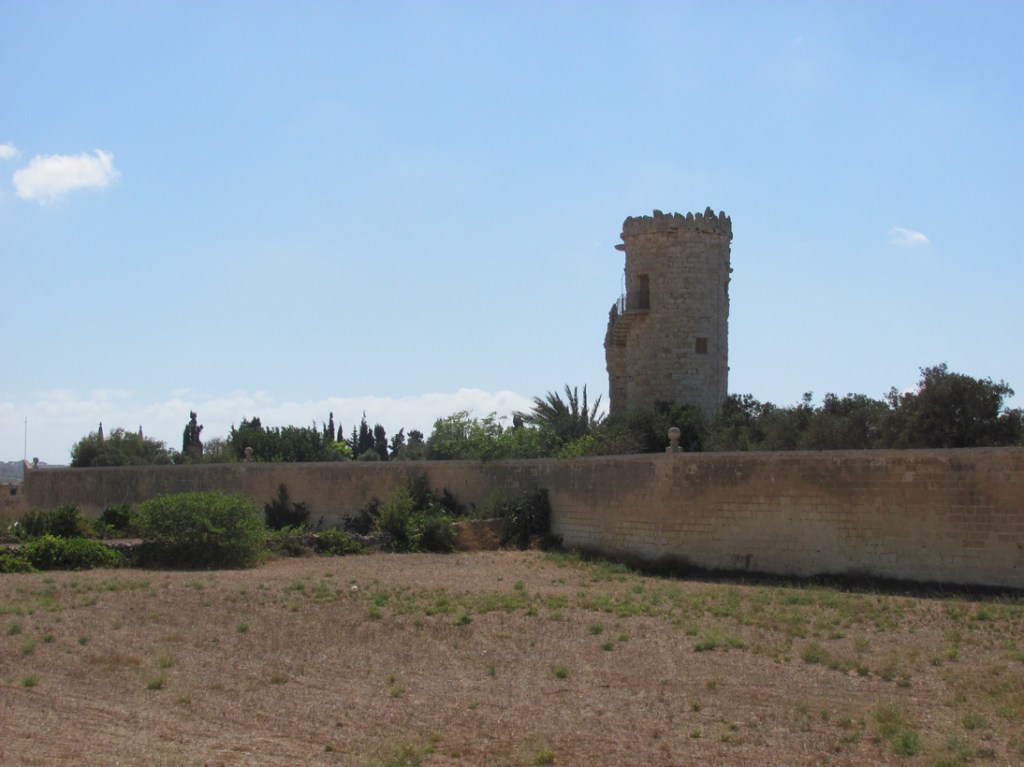
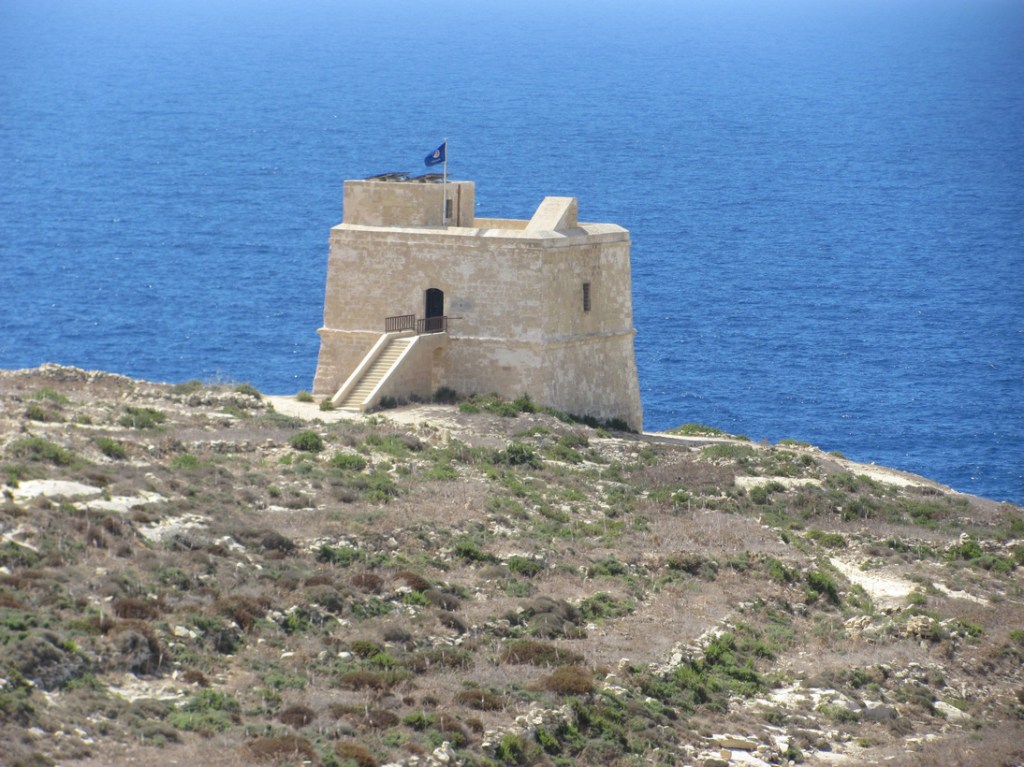
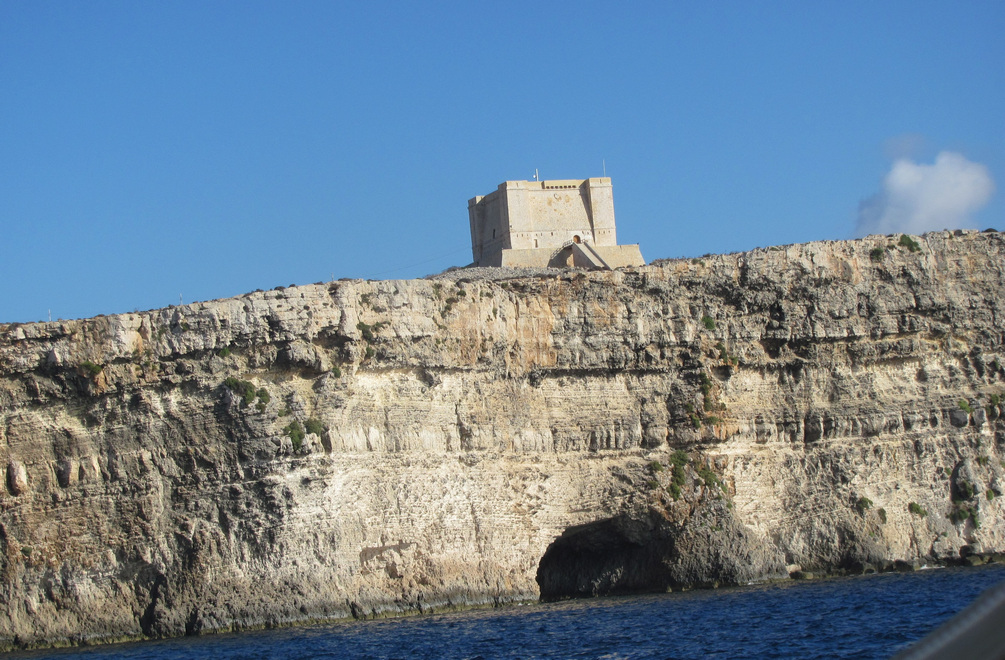
I liked the fishing town, but not the boring waiting for the bus. When it finally came, we managed to sit on the second floor, listening to the speakers and taking pictures at the same time. We passed the St. Lucian Tower, which is a fortified watchtower since the time of the Order of St. John. In fact, such watchtowers have perched all over the island, along the entire coast and even in the interior of the hillier places. So if a ship approaches from somewhere, through signals, the towers transmitted messages and promptly warned people to hide.
Communication was really good, unlike now. Maltese is hardly understood, being a mixture of Arabic and Italian. It is good that English is their second official language, so we could communicate. Otherwise, for a greeting they say Merhaba, and for thank you Grazzi.
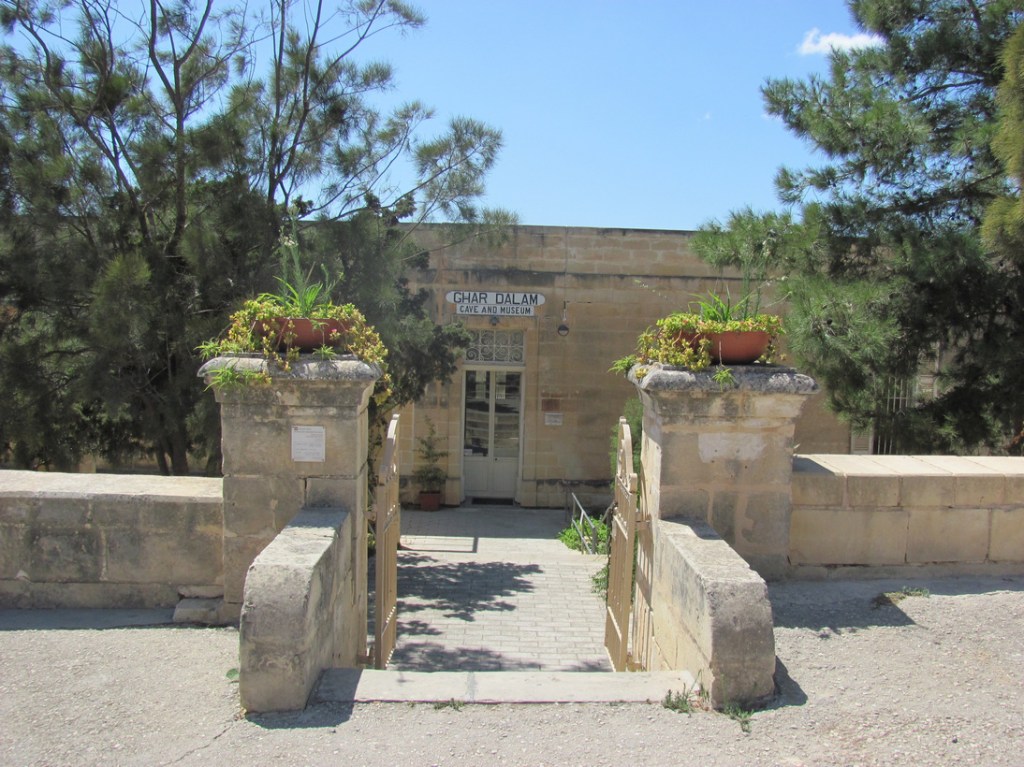
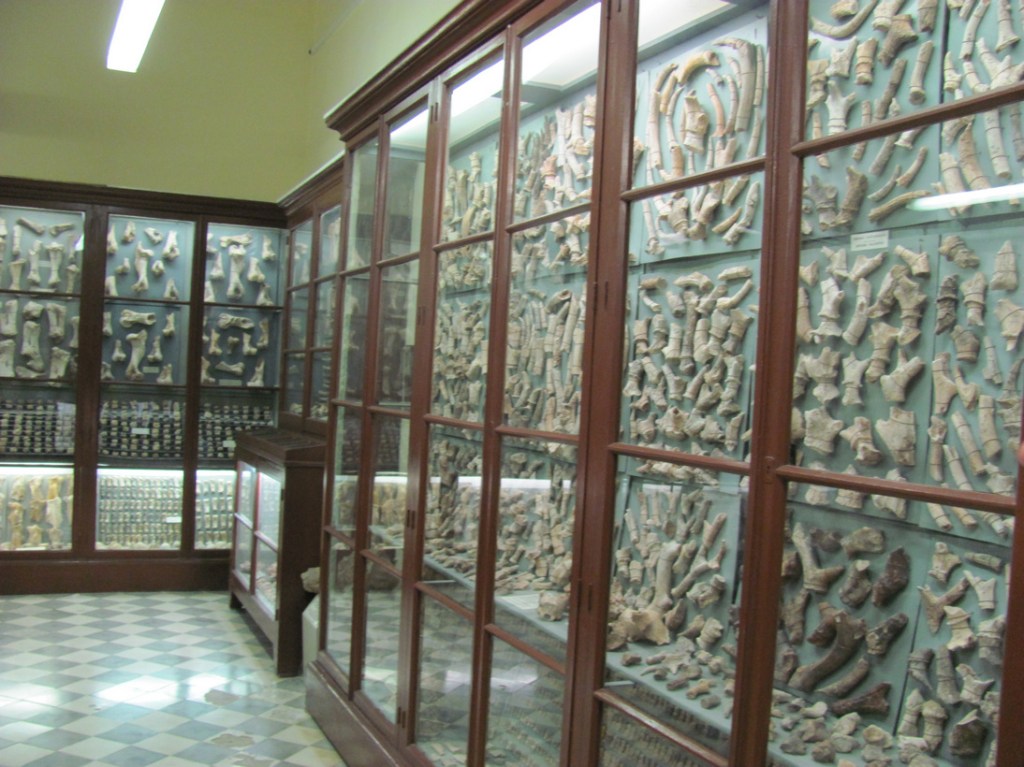
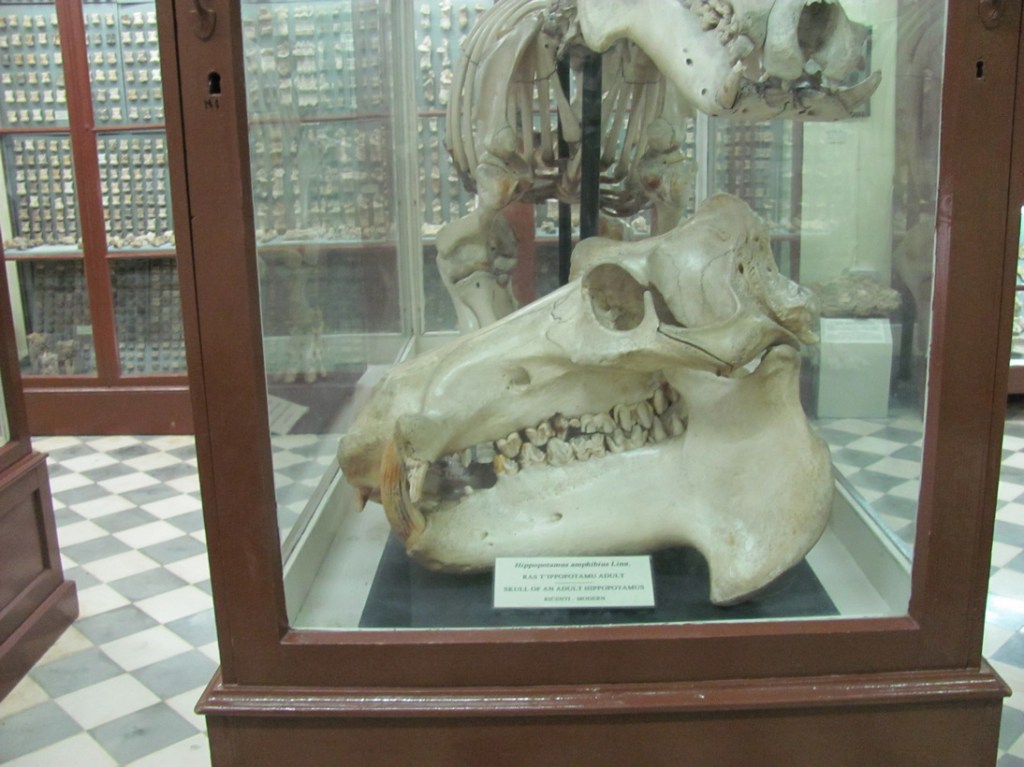
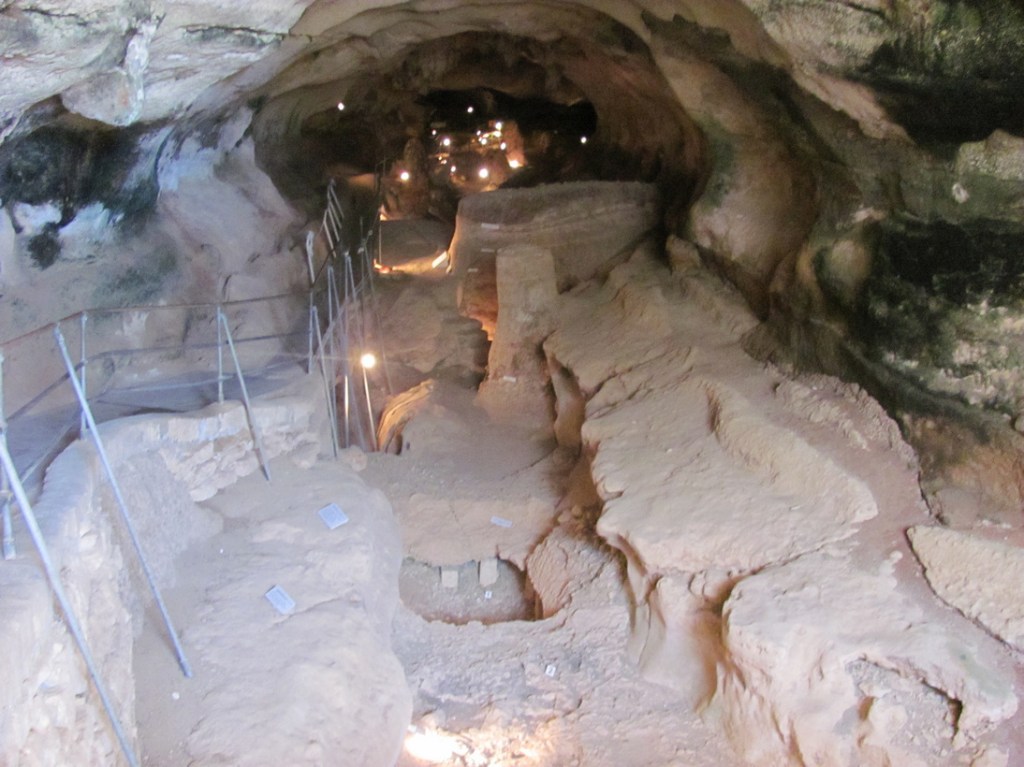
We got off the bus at the Dalam Cave, where at the entrance there was a museum. This is one of the oldest caves on the island dating back 500,000 years. Bones of long-extinct animals were found in it. However, compared to our Bulgarian huge caves, it looked like an ordinary hole in the ground. Yet it was beautiful, it had a depth of 144 meters, of which only the first 70 m were open to visitors. It was really interesting to see stalactites and stalagmites on such a small area. While in Bulgaria the caves are in the mountains, and here, due to the lack of a mountain, the same are underground. The remains of animals found in the cave were exhibited in shop windows in the museum. There were large animals such as elephants and mammoths that testify that 200,000 years ago there was a land connection between Malta and Sicily. Interestingly, during the Ice Age, snow did not reach Malta, although the climate had a significant impact. It is believed that a river passed by the cave, but it has long since disappeared. Today, Malta has neither rivers nor lakes, but seawater is processed. The same thing is felt most strongly in the hotel when I brush my teeth with a lot of salt water and still feel that it has been processed.
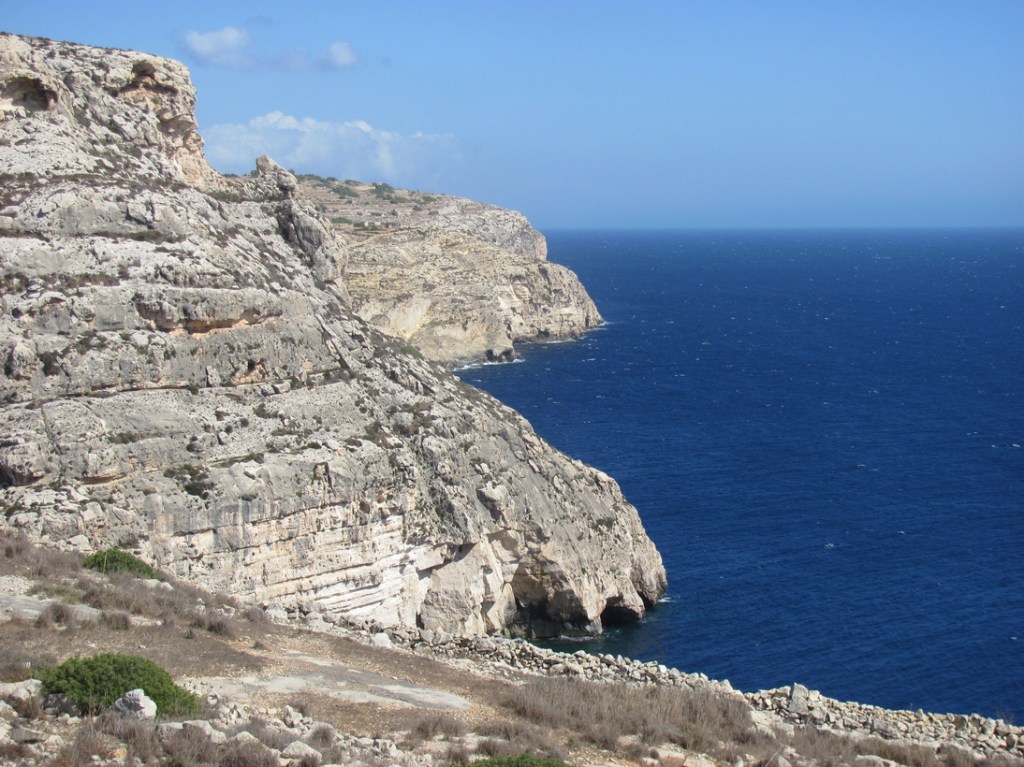
We continued with the bus, whose next stop was Blue Grotto. It is a naturally landscaped cave with crystal blue waters. Unfortunately, we did not have time to get down and see it. For this purpose, we had to rent an additional boat. We preferred to spend time on the next landmark Hagar Qim & Mnajdra. These are two prehistoric temples that are located in the immediate vicinity.
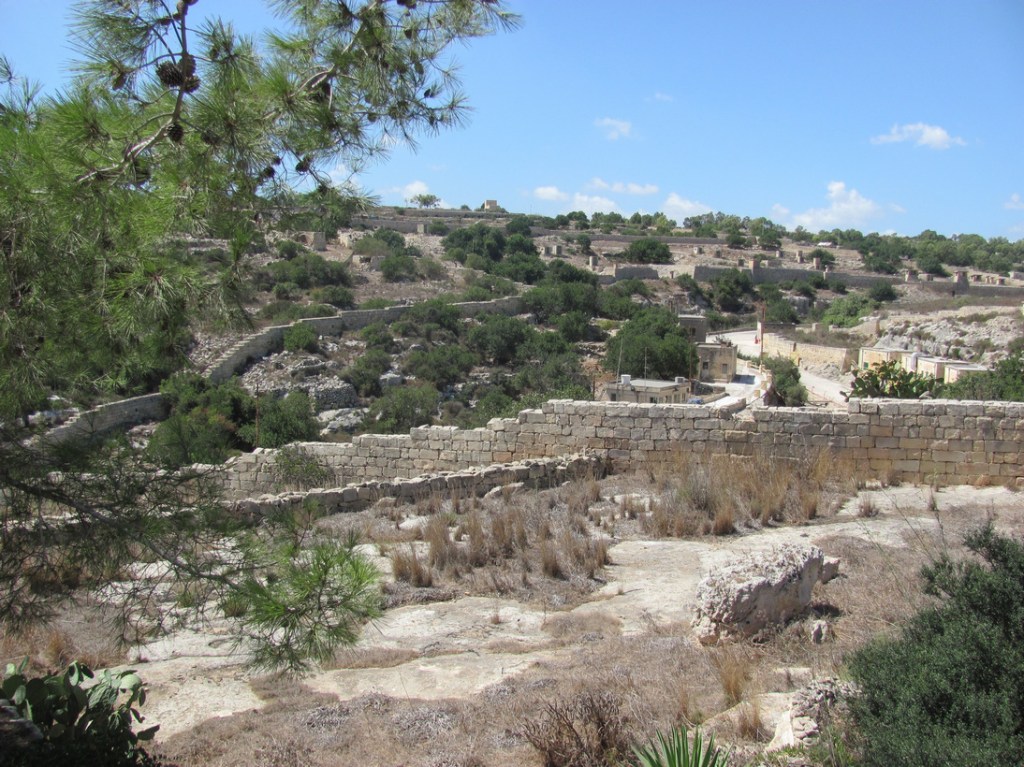
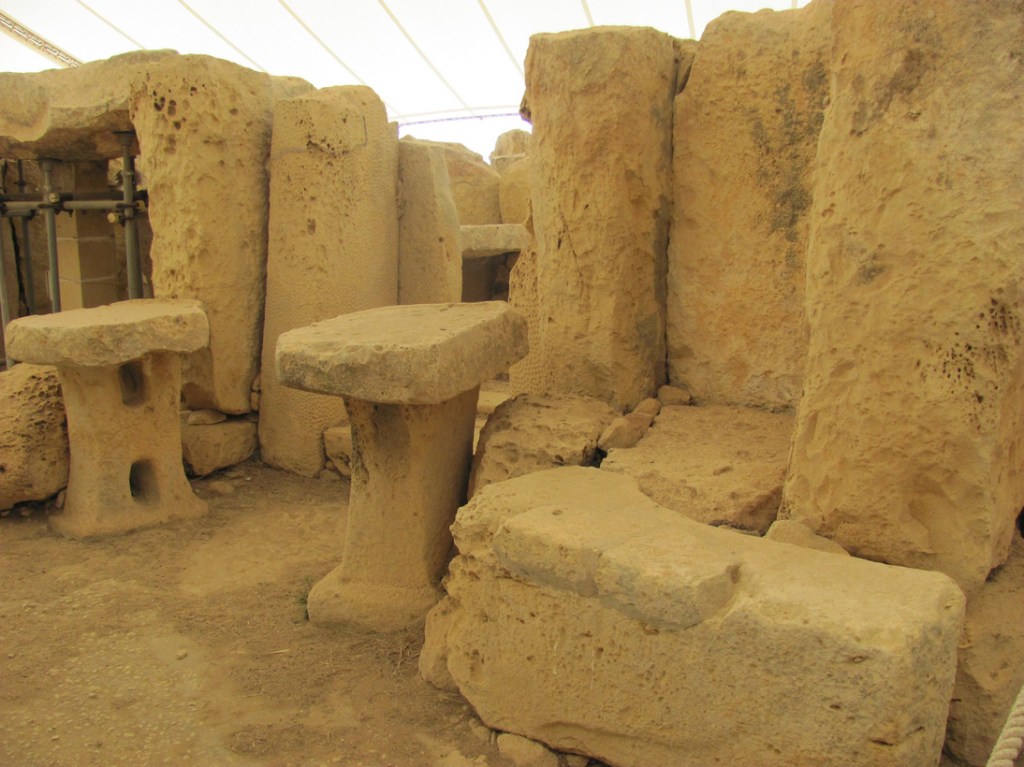
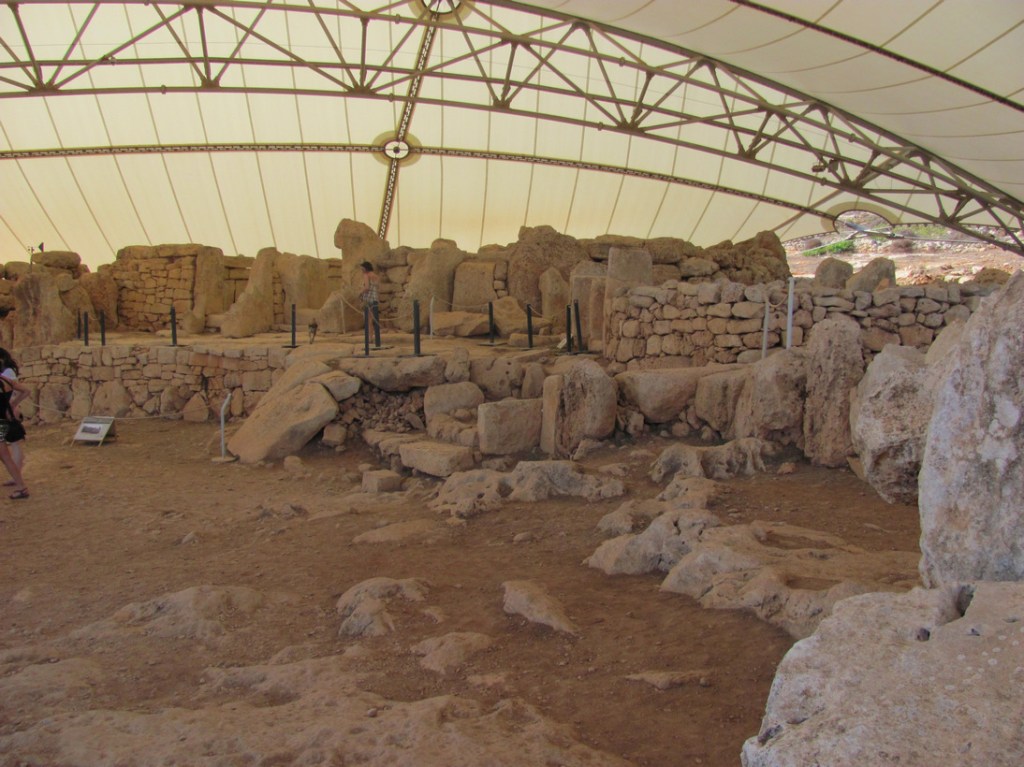
It was incredibly warm and too sunny for a walk through the stones, but since they had a shed we hoped to endure and photograph this sacred place. It is believed that the first Hagar Qim temple was built in 2700 BC, and over the centuries it has undergone some modifications. The stones used for the construction of the temple are relatively soft and easy to shape. Unlike the Mnajdra Temple, located only 500 meters away, where the stones are quite hard. It is believed that people were treated here, and clay models of parts of the human body were found with marked symptoms of various diseases. We quickly explored the temples, hurrying to catch the bus at 16:10. However, it never came. We managed to at least to catch the last bus at 5:10 p.m., which left us next to the hotel.









The week had just begun, and we have already explored the northern and southern parts of the island of Malta. The next day we got up in no rush, as we have decided to have a day on the beach. Tuesday is the day of the red planet – Mars (mardi in French, martes in Spanish), the English equivalent is respectively the Norwegian deity Tyre, who is also the god of war, and therefore Tuesday is believed to be a day without luck. The Greeks, for example, believe that it was on Tuesday that Constantinople fell, the Spanish speakers have the saying En martes, ni te cases, ni te embarques (on Tuesday neither marry nor go to a trip).
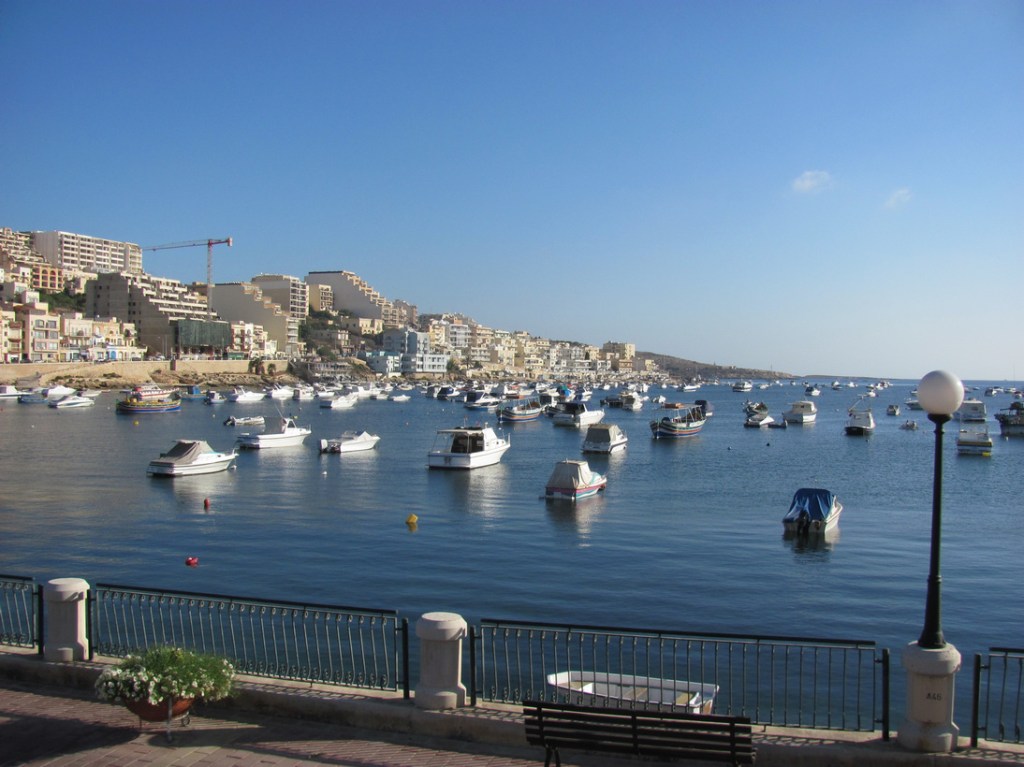
This sunny Tuesday, however, was far from these superstitions. The relatively warm Mediterranean waves caressed the gently rocky shore. We went to the beach in the bay of St. George. The water in the bay was very calm and unlike the Golden Bay there were no waves. The water was crystal clear and we could easily see the bottom even when we were at the deep. Otherwise, the sea became gradually deep, so it was perfect for a smooth immersion.
The water was not so warm, unlike the weather that helped us to dry quickly after each going out, and instead of droplets of water, there were dust of salt left on the skin.
From 10:00 to 14:00 we stayed on the beach. We had rented an umbrella for 3 euros, which at every strong wind was falling to one side. Instead of sand on the shore there were small pebbles with a red glow. An umbrella could not be stuck, so they gave them with a stand. There was also a trick to fill the stand with pebbles, so that the umbrella does not fall. So instead of playing with the “sand” we took turns holding the umbrella.
In the afternoon we headed to the center of Sliema and walked around the shopping streets. We also ate pancakes and had dinner in cafe 516 in the bay of Sliema opposite the church, this time enjoying the wonderful paella (rice with lots of seafood, vegetables and chicken).
Wednesday came quickly, the lucky day, or so I believed it was for me. In the Roman Empire they dedicated this day to the god Mercury, who later corresponded to the Greek Hermes and the German deity Woden (hence the English Wednesday). This god protects travelers, writers, and even couriers. He had shoes with wings and quickly got from one place to another. In ancient times, people believed, different gods influenced their lives. Today we know these influences come from the planets, and accordingly we have turned the ancient religion into astrology. The planet that has the greatest influence on Gemini – my zodiac sign – is Mercury. So that day (mercredi in French and miercoles in Spanish) should bring me luck and go smoothly, especially since I was on an island from which the sea could be seen from everywhere.
We made a sea voyage, heading to the island of Gozo – the little brother of Malta, planning to have a bathe in the Blue Lagoon near the island of Comino. We got up early at 07:00 to be able to have breakfast and take the bus at 08:15. I quickly managed to review the book about Malta, from where I learned that the island of Comino is named after a plant, which grows there. Malta was long called Melita, from the Greek honey island. According to another theory, the name comes from the Phoenician word Maleth, which means “heavenly” and can be explained by many bays on this sky blue and paradise island. Gozo comes from the Latin gaudium and means joy and pleasure.
Unlike the other two islands, Comino was not protected and it was dangerous to live there. However, there was always someone to settle here, mainly pirates. At the moment there were 4 people living on the island and even there was even a hotel! What the island is known for is undoubtedly the Blue Lagoon, located in the western part. The crystal clear water shines on the white sand, and the place is excellent for swimming and snorkeling.
In fact, Malta, Gozo and Comino offer excellent diving opportunities – something we were about to try at the end of the week. Now we headed to the island of Gozo, riding the double-decker buses again. On the island of Malta, there are really very few signs of deceleration (only 1 sign I saw with a limit of 30 km/h), in most places there is a sign and a marking on the road with the word SLOW, which everyone obviously interprets in their own way.
Although very quickly we managed to see some of the northern resorts of Malta. For example, we passed the resort of Bugibba and its continuation Qawra, where until recently, besides hills above the water, an observation tower and ruins of a prehistoric temple, there was nothing else. Now, however, these places are lively resorts, with the tower and garrison next to it turned into a restaurant with a nice panorama, and the ruins are preserved and became part of a hotel complex.
Our bus also passed by the beautiful bay of St. Paul, where some of Malta’s oldest resorts are nestled. A long time ago, it was fashionable for wealthy people to have a second home on the coast where they could spend the hot summer months. Today, residential areas prevail here and the tranquility in the hotels was much better. There are also many churches, which is actually typical for the whole island.
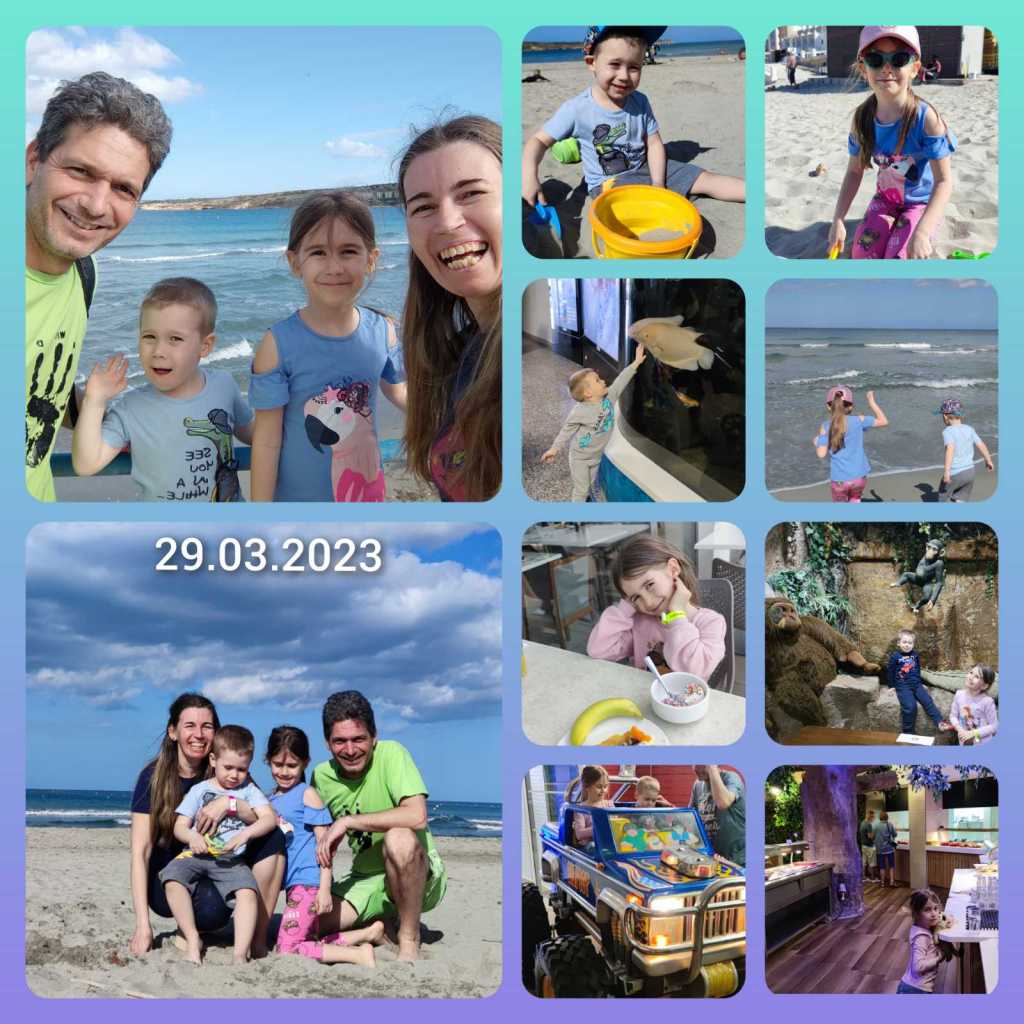
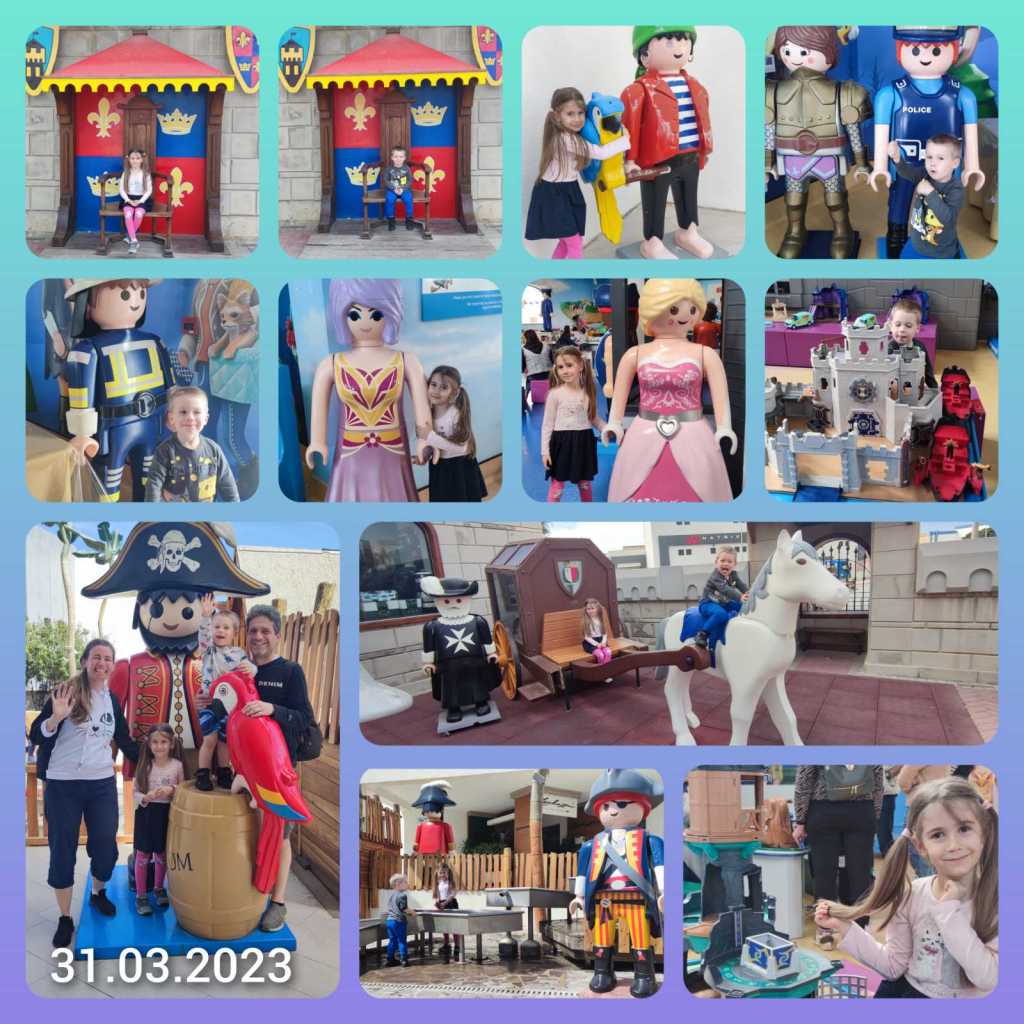
The northernmost resort we visited was Mallieha, located on the bay of the same name Mallieha bay. The longest sandy strip is right here and the calm sea water makes it an ideal place for a family holiday. It was here that we stayed during our return visit to Malta. The all-inclusive hotel db Seabank Resort & Spa was excellent with a lot of fun for children, including children’s pools, and there is a sandy beach in the immediate vicinity. In front of the hotel there is also a stop on the double-decker tourist buses, so getting around the island was relatively easy. We also took advantage of the ecabs app, where we easily ordered a taxi and explored other sights, as the smallest, but favorite of our children Playmobil Park.
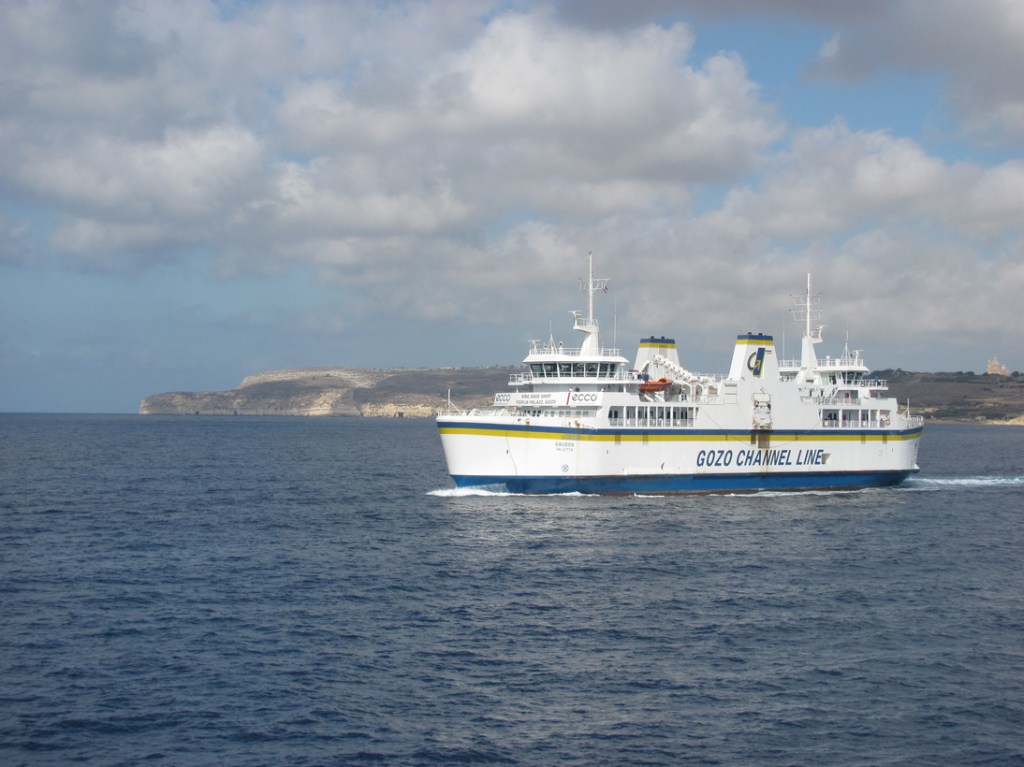
However, let’s go back on our first trip when the bus left us at the port of Cirkewwa, from where we took the ferry to Gozo. The journey took 30 minutes, with a new double-decker bus waiting for us on the opposite coast, this time green, with which our tour of Gozo began.
A few years ago, there were plans to connect the islands of Malta and Gozo by bridge, with Japanese engineers beginning to do research. Technically, the assignment was feasible, but the costs were significant and for the time being the project was suspended. The inhabitants of Gozo were most pleased with this, as they feared that if Gozo became too easily accessible, the island would lose its old-fashioned charm, which Malta had already lost half a century ago.
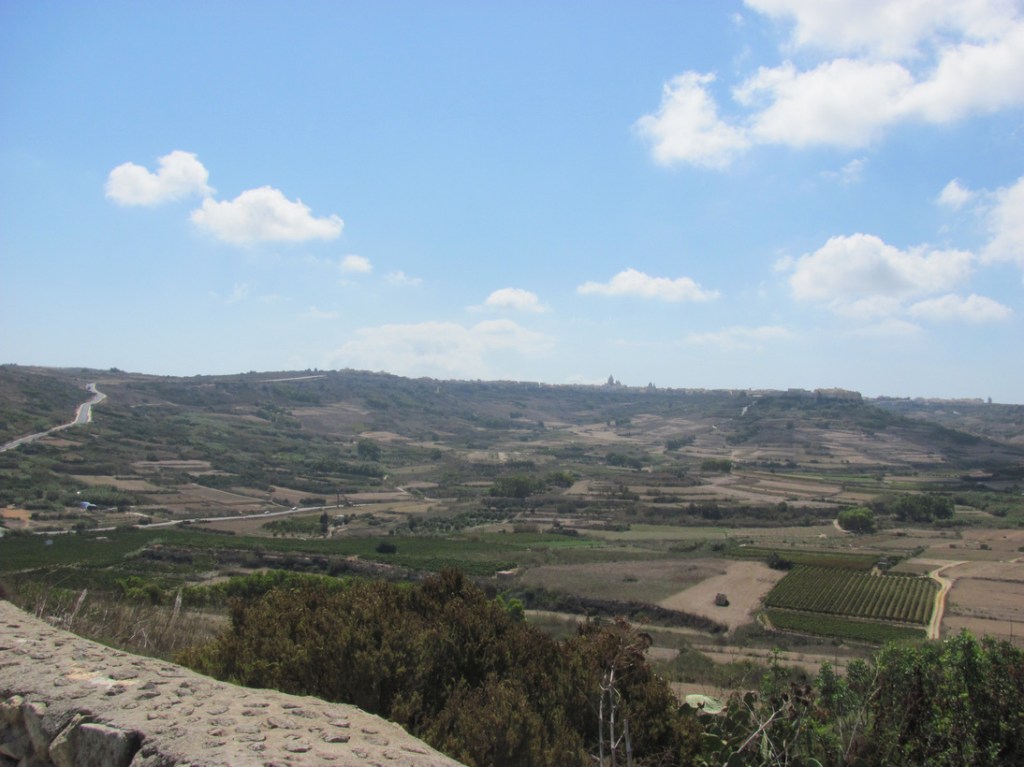
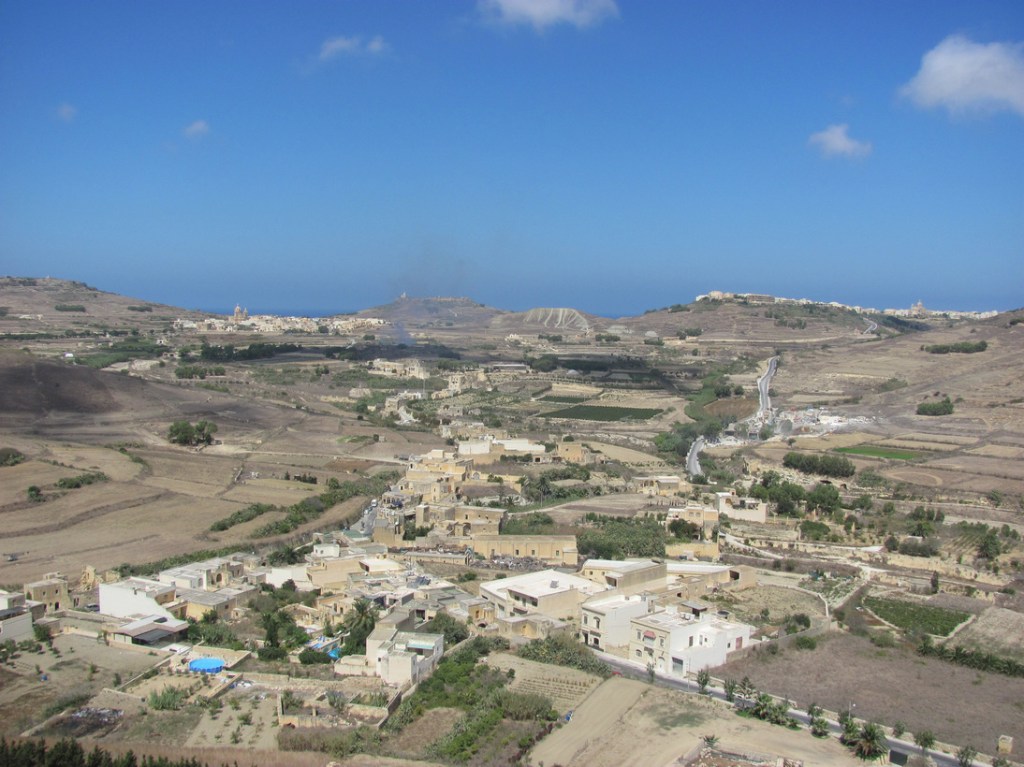
Malta’s little brother boasts a prettier panorama, more fertile soils and vegetation. Although Malta and Gozo share the same story, Gozo has suffered more misfortunes. For example, in 1551 the Ottomans decided to capture Malta, but because it was too well fortified they moved to the neighboring island of Gozo, where they bombed the citadel for several days. The governor of the Knights of Gozo decided, that resistance is futile and opens the gates of the citadel. The Corsairs and Ottomans plundered the city and took the entire population of Gozo (5,000 men) into captivity, which they then sold to Libya. After that, the island began to be slowly inhabited by the Maltese.
The port of Mgarr and the capital Victoria of Gozo resemble the Valletta and Medina of Malta – the capital is in the middle of the island and the large port is ready to protect it. In Gozo, however, the citadel in Victoria remained the most fortified, and in the Middle Ages people were obliged by law to spend the night in the citadel in order not to be attacked by corsairs at night.
Before visiting the Citadel, the bus took us from Gozo’s main port, Mgarr, and headed to the Naval Museum, holding rare exhibits such as a piece of Lord Nelson’s HMS Victory or part of Constitution, the first U.S. warship. However, we did not descend, but continued on to the famous temples Ggantija Temples. It is believed that this is the oldest standing alone building in the world, in which the largest megalith weighs 50 tons and its walls reach 7 meters. Altars and ruins of stones are preserved, on which the eternal fire is believed to have shone. In fact, Ggantija is better known as the Giant Tower and is one of the most impressive and preserved prehistoric temples. Unfortunately, due to the delays of the trips, we were only allowed one disembarkation from the bus in order to be able to pick up the boat to Comino on time. So we decided to go down and see the medieval capital Victoria. These ruins, compared to Stonehenge, we had to see them from the pictures in the book about Malta.
The next stop was Calypso Cave, which houses one of Gozo’s most popular legends. Calypso was the daughter of Atlas, who entertained Odysseus for 7 years, until the god Hermes, a messenger of Zeus, ordered Calypso to release the Greek hero. Here we had 5 minutes for a photo break, which of course lasted 15 minutes. In fact, this cave Ggantija dates back to 3600 BC and corresponds exactly to Homer’s description, namely the height of the cave above the sea and the beautiful panorama of the Ramla Valley with the red sand dunes.
The beach we saw from here Ramla is one of the best sandy beaches not only in Gozo but also in Malta. From here the bus took us to Marsalforn – a lively coastal resort.
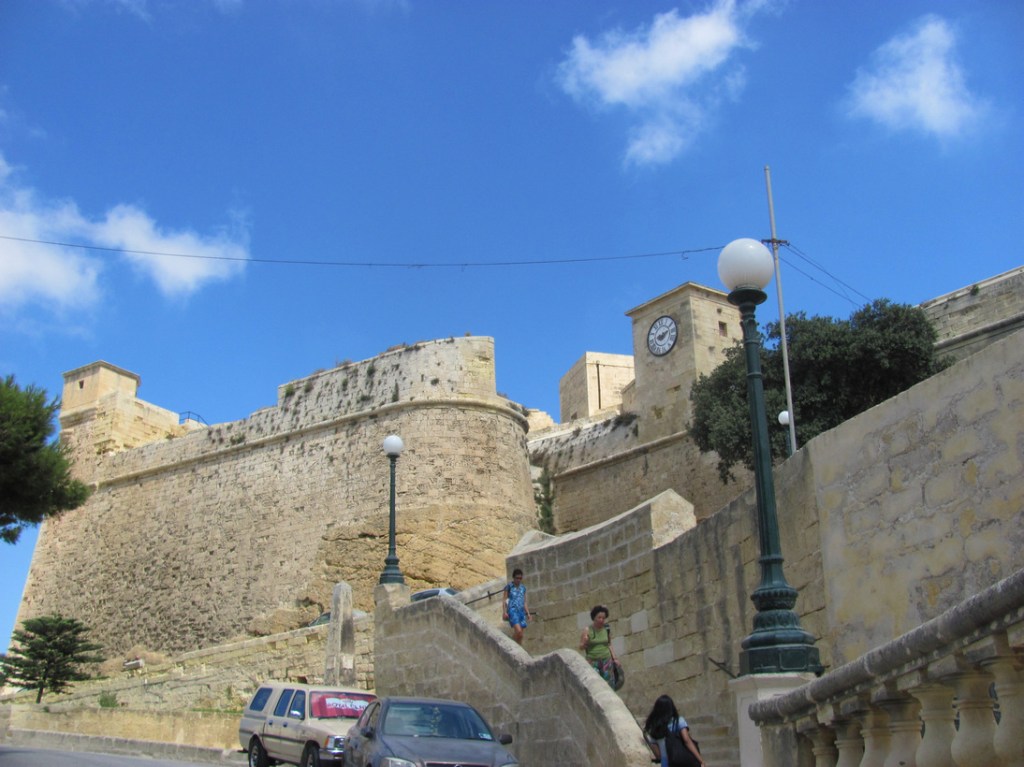
We finally reached Victoria, where we had only 45 minutes to climb from the lowland parking lot to the high-lying citadel to explore it and get back. We managed to do this and we liked the city. In fact, the real name of the capital city is Rabat, but in 1887, on the occasion of the anniversary of the Queen of England, the city was named after her – Victoria. However, locals continue to call the city Rabat.
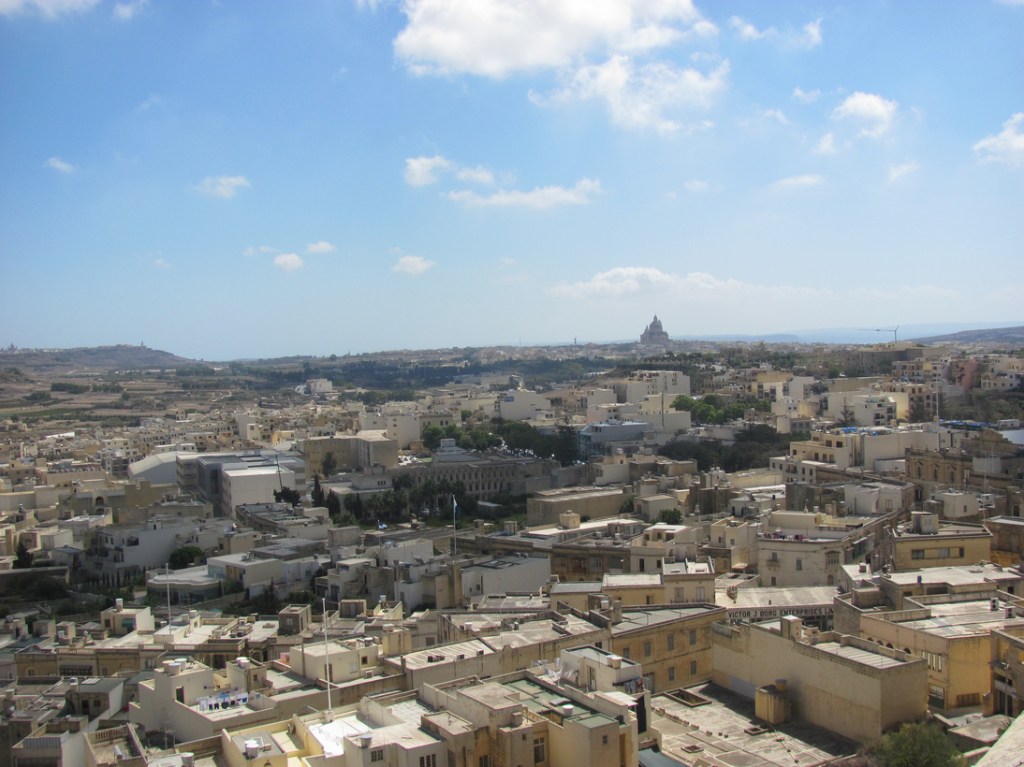
The beautiful and impressive citadel is located at the very top and dates back to the end of the Middle Ages. The fortress walls themselves were erected and strengthened in the 16th-18th centuries. Most of the buildings in the citadel are in ruins, but the cathedral, for example, is very well preserved and is even currently restored. However, I was more impressed by the beautiful landscape, as from the walls you can see not only the whole city, but the whole island.
We got back on the bus, admiring all the sights, and absorbing the Maltese sun and wind.
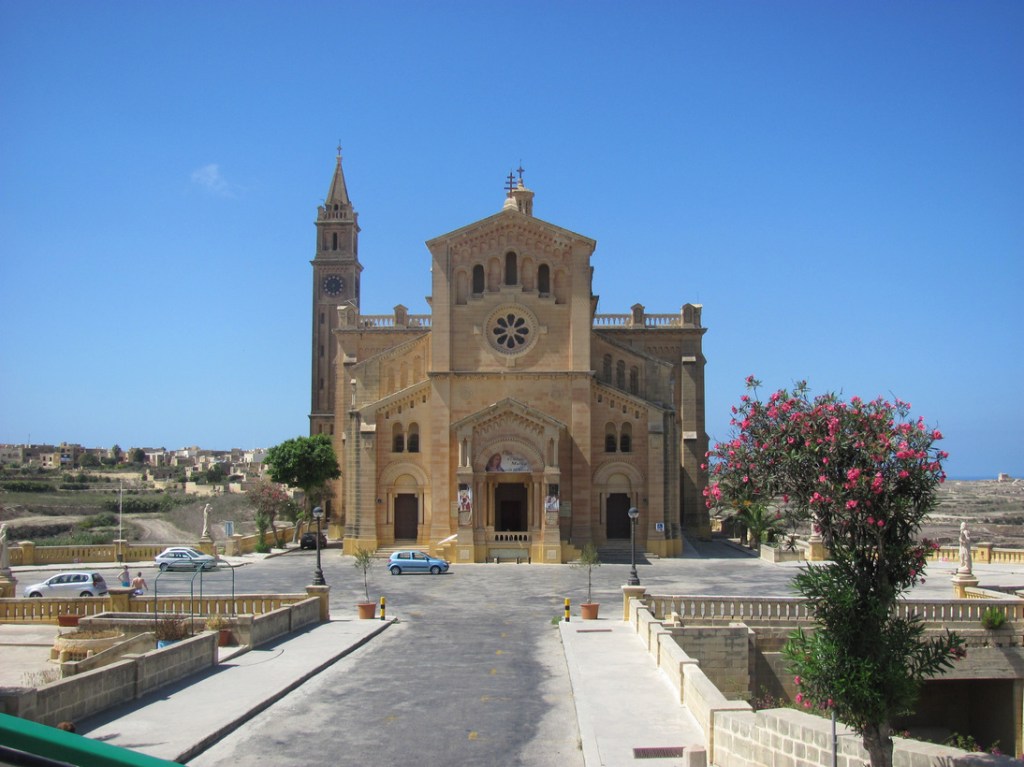
We passed Ta‘Pinu sanctuary, a 16th-century church that is considered a sacred place where the Lady of Ta’Pinu can perform miracles. According to legends on June 22, 1883, a local resident heard the voice of the Virgin here, who ordered several things that subsequently helped Gozo to save itself from the plague the following year. Accordingly, people began to bring flowers as a sign of gratitude. Today’s church, however, received its presence look in between 1920 and 1931.
From here we continued to the Ta’obiegi crafts village, which is a craft village located on the highest hill of Gozo, where local craftsmen sell many handmade goods, such as the famous local lace, brown glass, paintings, pottery and more.
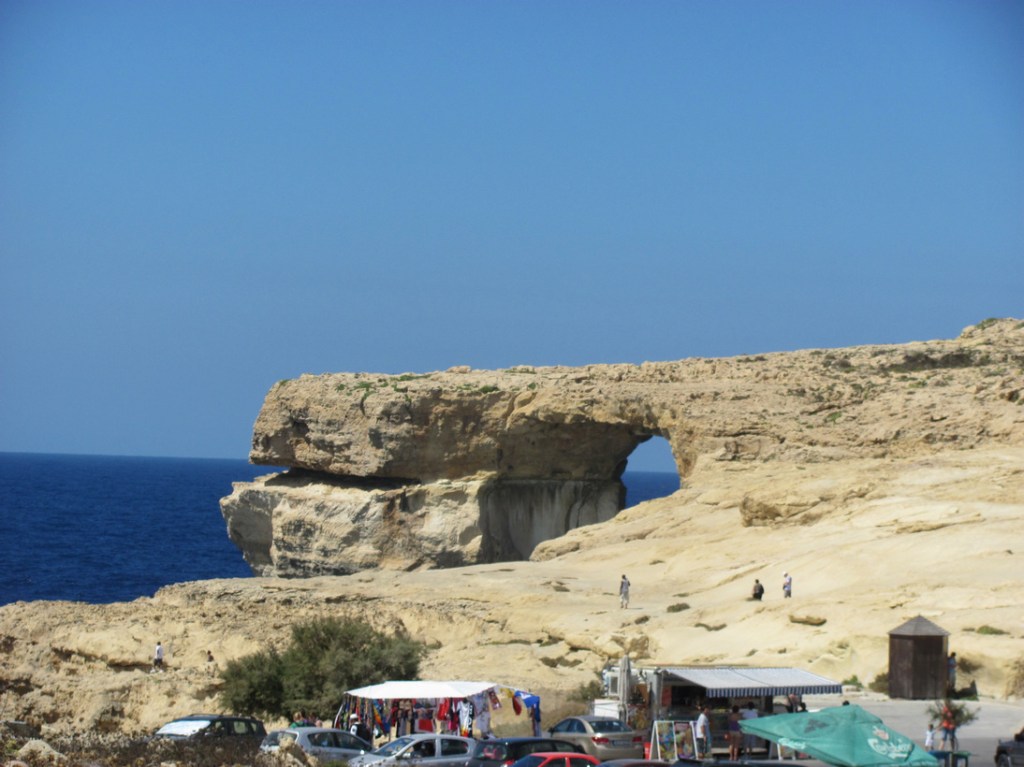
The next stop was one of Gozo’s most famous natural attractions, the Dwejra Bay, where the Azure Window is located. They call it a window, although it looks more like a door and represents rocks in the sea in which there is a big hole in the middle. The sea here is very blue and is an excellent place for snorkeling. There is also a small inner bay, which the Maltese call the inland sea, again exaggerating in size (e.g. for them Mdina has city status, although less than 400 people live there). So this sea or lake is connected to the sea by a 100-meter tunnel among the rocks.
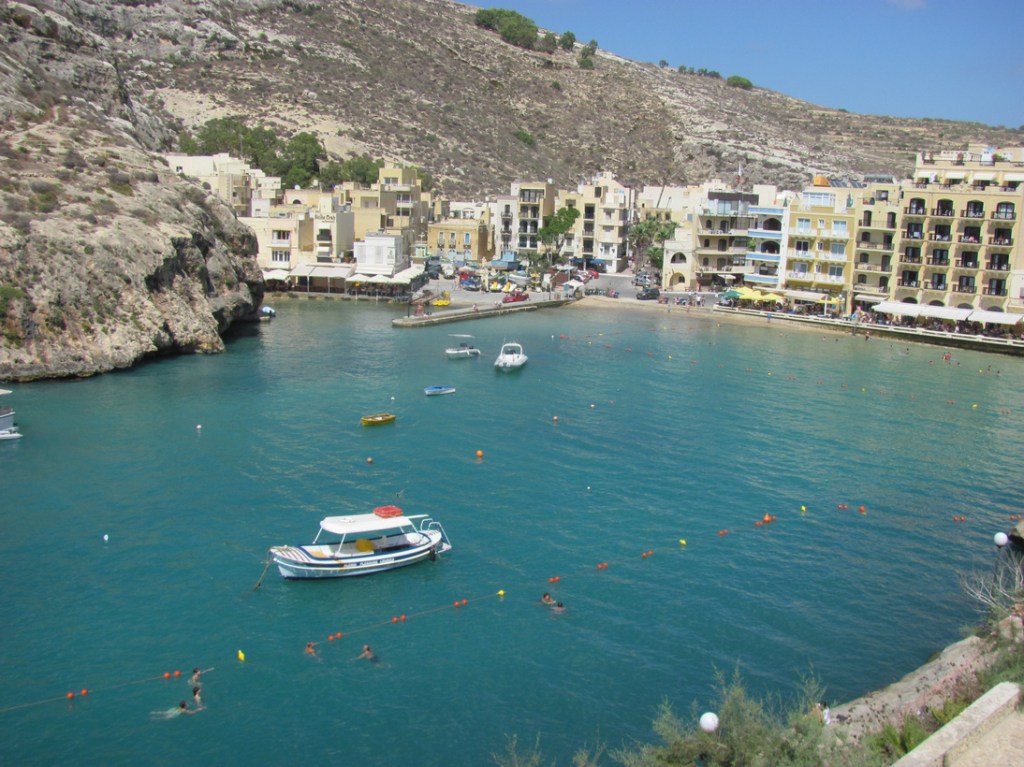
Unfortunately, we didn’t have a 5-minute photo break to shoot this natural phenomenon. All we had left were the photos from the bus, continuing back to Victoria, and from there to the resort of Xlendi, whose cove was really beautiful and we couldn’t wait to swim too.
In fact, it was here in 1961 at a depth of 35 meters that two sunken ships were found, dating from the 2nd century BC and the 5th century AD. Many amphorae and other goods are taken out and exhibited today in the Archaeological Museum of Gozo.
We continued to the next settlement of Fontana, where 846 people live (the total inhabitants of the Republic of Malta are about 400,000). The city is located on the outskirts of Victoria and bears the local name Triq tal-Ghajn – the road to the spring, Fontana in Italian also means spring.
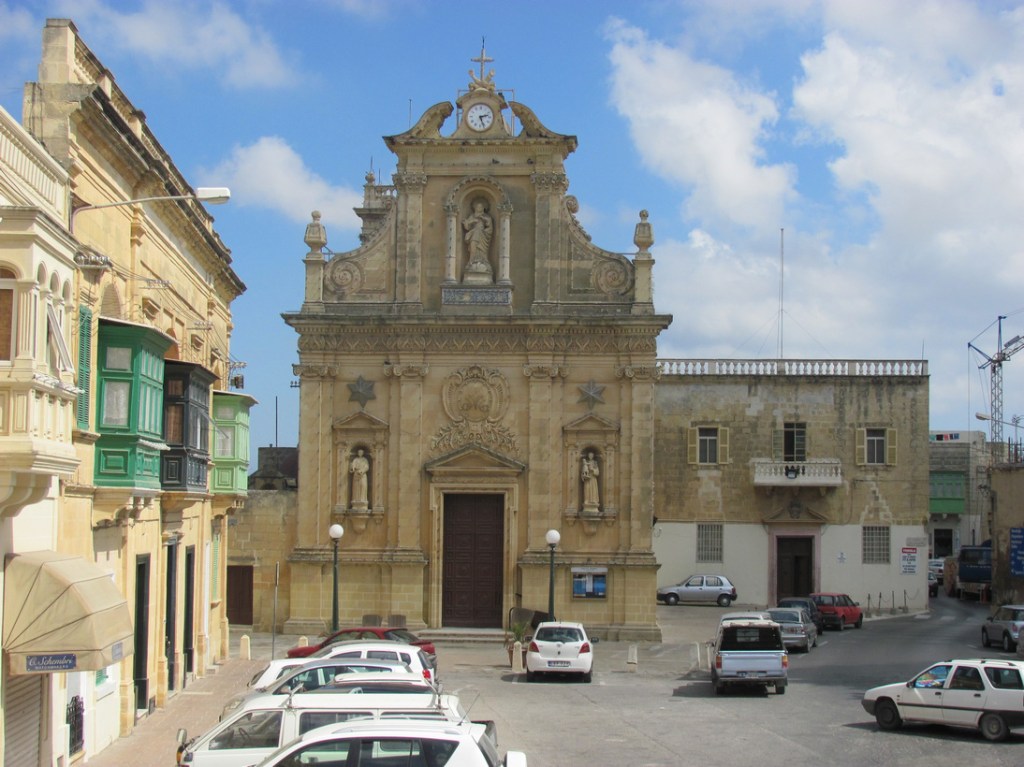
Our bus again passed through the capital Rabat to reach Xewkija, whose name most likely comes from the Maltese word Xewk meaning donkey thistle. This city is famous for its magnificent church The Rotunda, which is dedicated to St. John Baptist and erected on the remains of an ancient church. This church is the seat of the Knights of the Order of St. John. It was built of Maltese stone by local craftsmen and it is the largest church in Gozo.













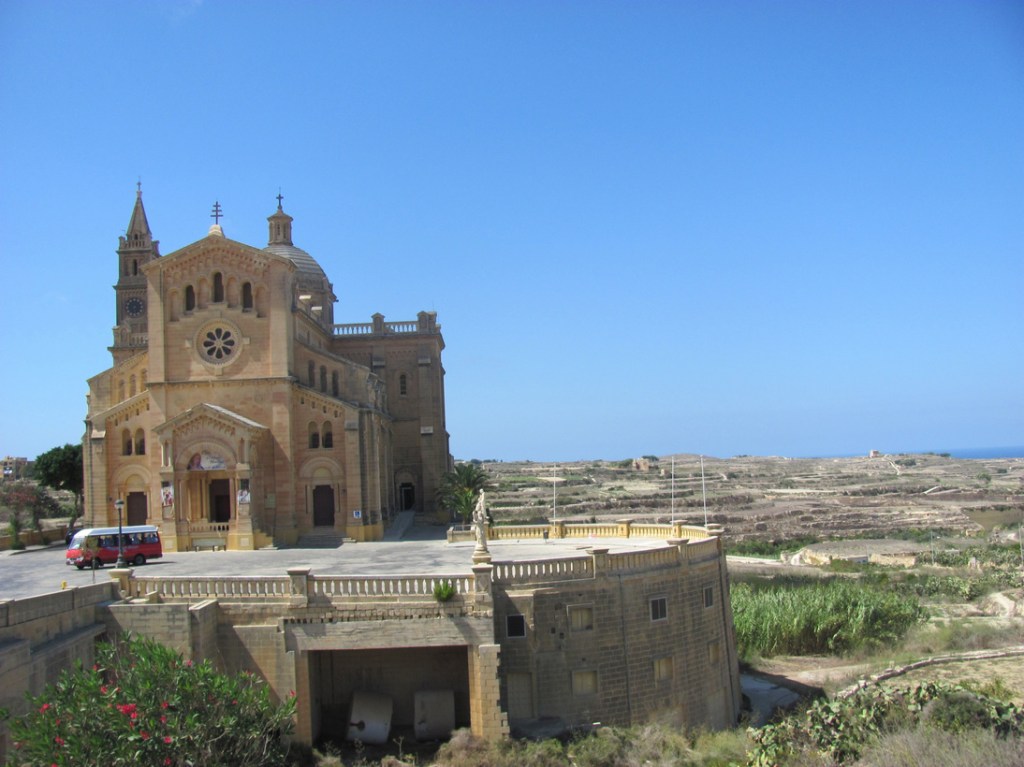



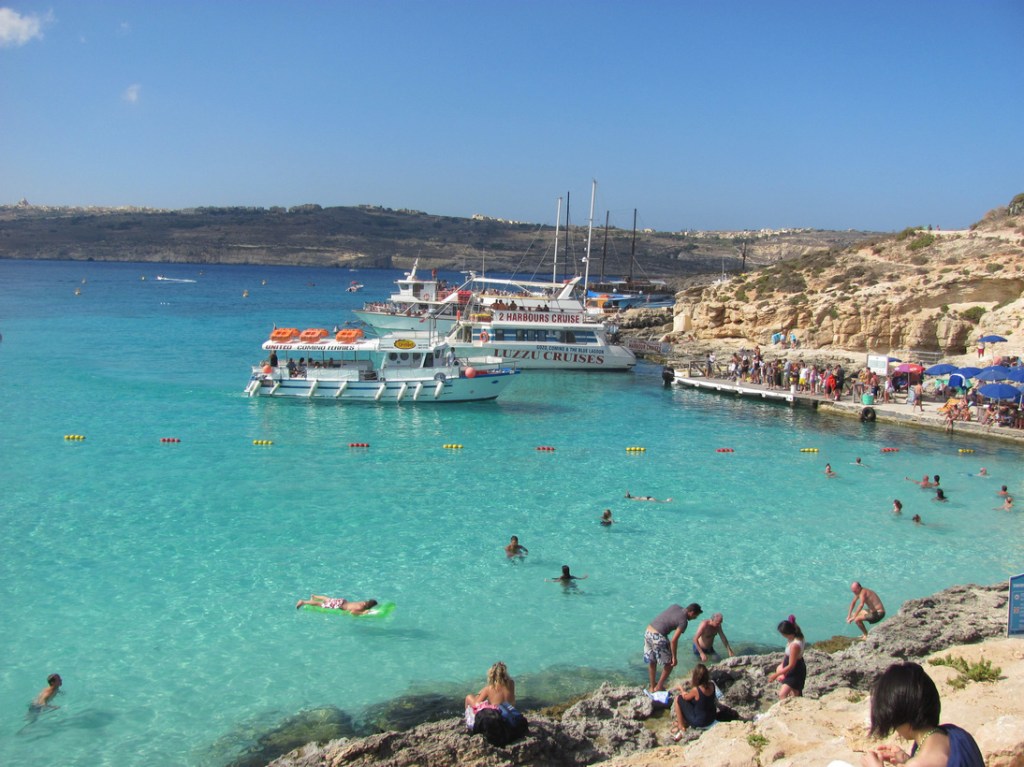
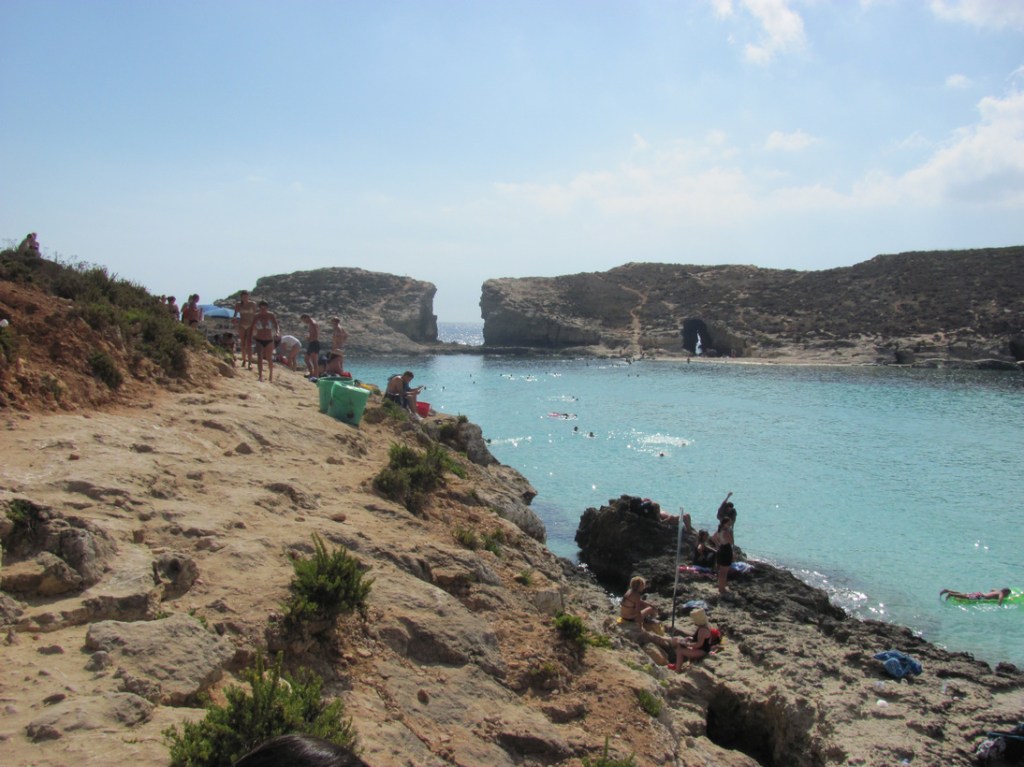


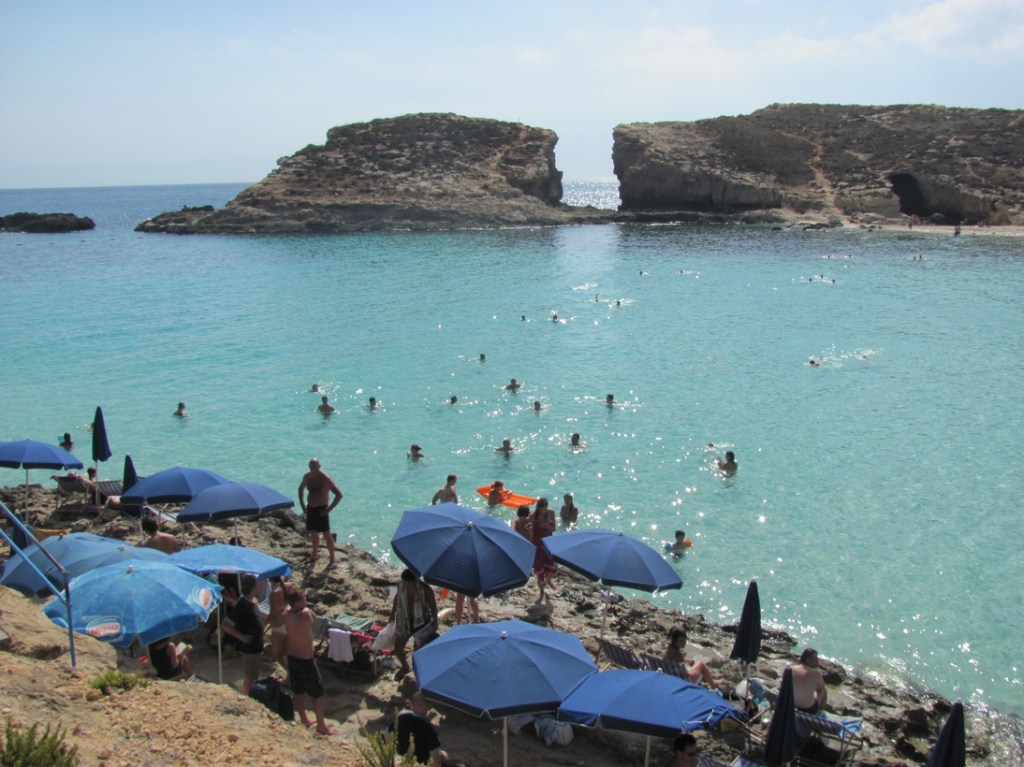
The bus left us at the port of Mgarr, from where we boarded a speedboat that took us to the island of Comino. Undoubtedly, the culmination of the day was swimming in the Blue Lagoon. The water was crystal clear and unlike the stone beach, the bottom was made of white sand giving an even more crystalline color to the water.
The only drawback was that initially the water seemed quite cold compared to the Golden Bay of Malta, where we were. But after the scorching sun that accompanied us throughout the day, we were able to immerse ourselves in these waters. The blue lagoon is actually large in size, but relatively shallow, and it is a real pleasure to swim among the clear waters by the rocks. We had 2 hours here. We managed to get sunbeds and umbrellas for 4 euros per person, the price is one regardless of whether you pay for a whole day or a few hours.
At 4:45 p.m., or as it is in Maltese, around this hour, the speedboad came to pick us up and drove us this time to the port of Cirkewwa of Malta. From there, we took the bus directly to the hotel.

The festive September 8 came, and in the Bulgarian Orthodox Church it is also the day of the nativity of the Most Holy Mother of God or the Little Virgin Mary. In Malta, they celebrated Victory Day. Combining the date with the day of the week Thursday – the day of Jupiter, Zeus or the god of Thunder means that the day will be celebrated loudly and divinely amusingly.
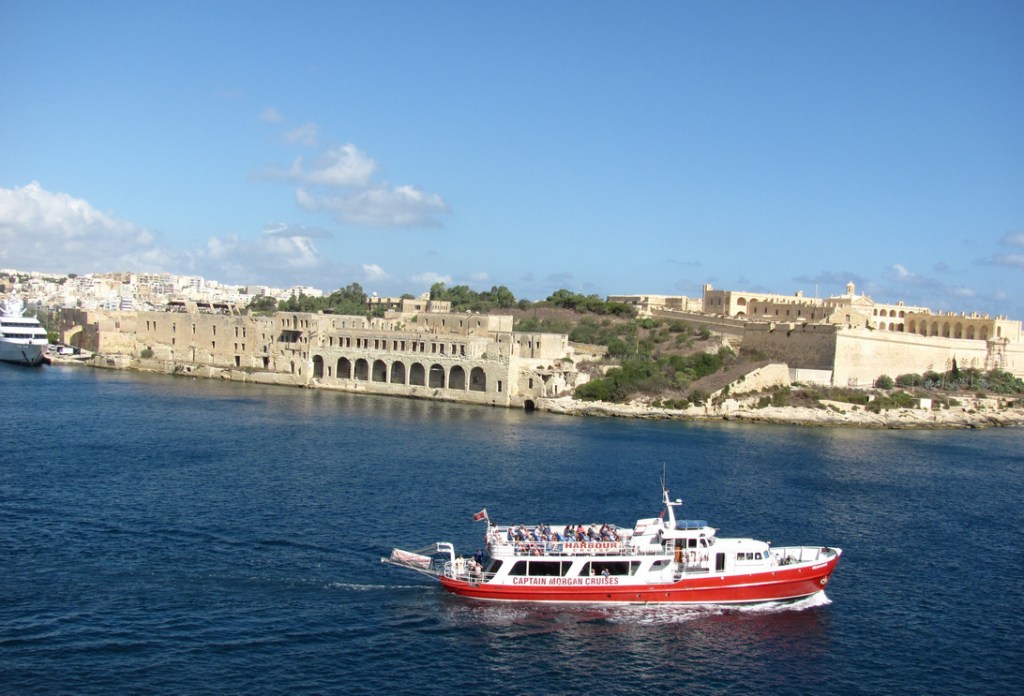
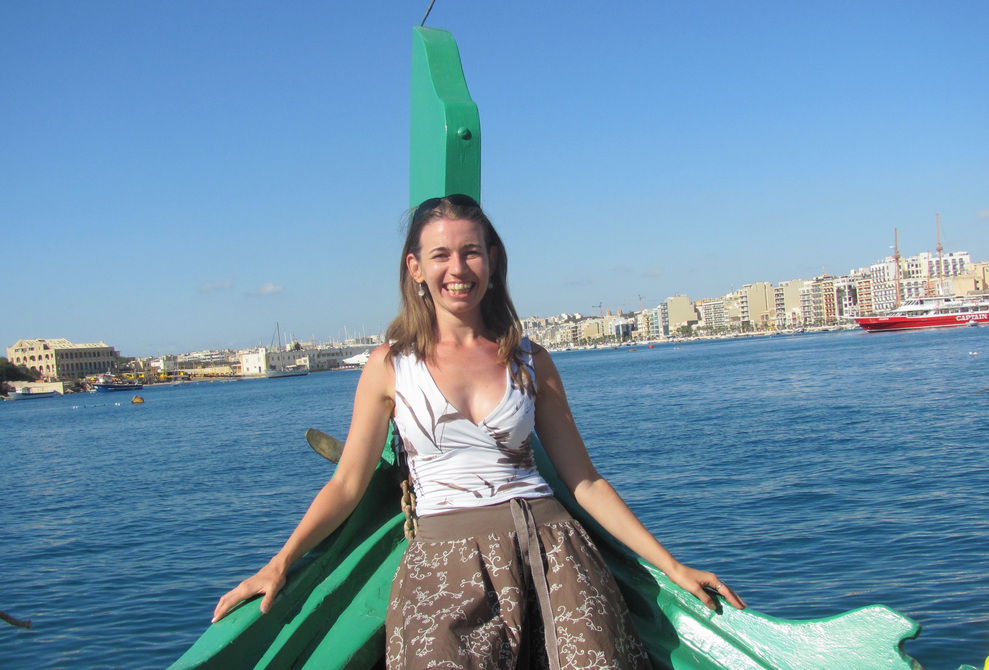
The important days should be celebrated in important places, that is why we headed to the capital of Malta – Valletta. With each ticket purchased from the 2-storey buses – on the red / south or the blue / northern line we were entitled to a free boat trip through the port of Valletta. We took a boat from the port of Sliema and sat on the stern at the front, ready for photos and landscapes, except that the sun was shining all the way and only on the way back we had shade. Overall, the tour went well, and for 1 hour and 30 minutes we toured 3 coves. Due to the upcoming frigate, the Great Port was closed, but we had the opportunity to see an additional third bay, which was not included in the program.
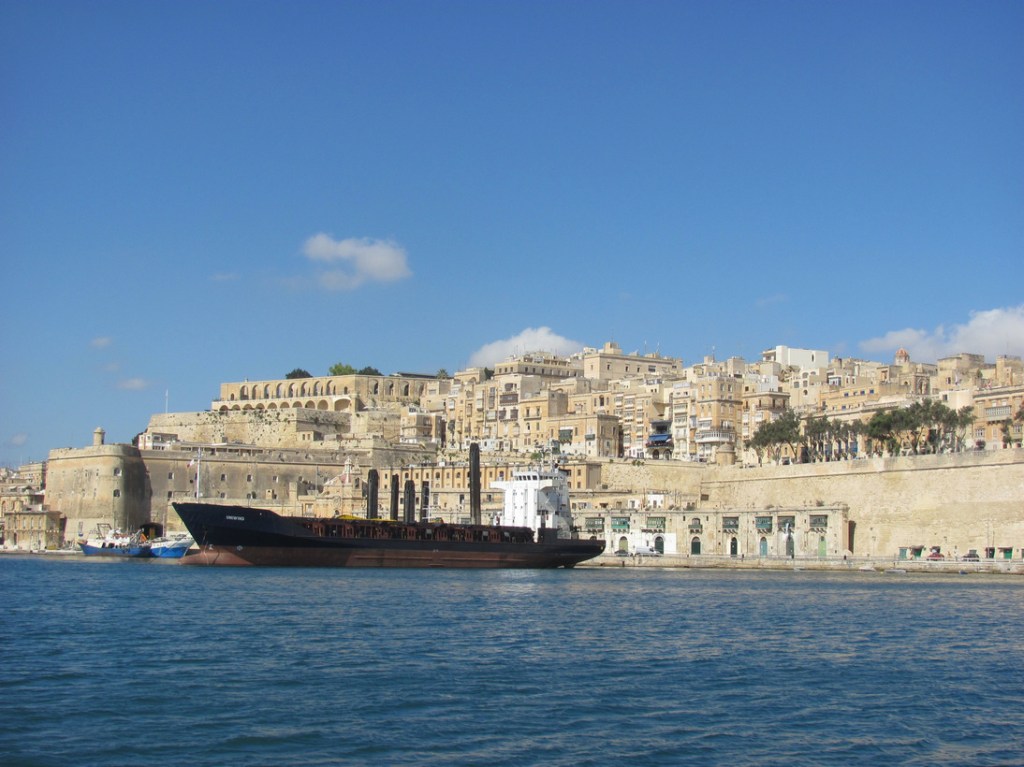


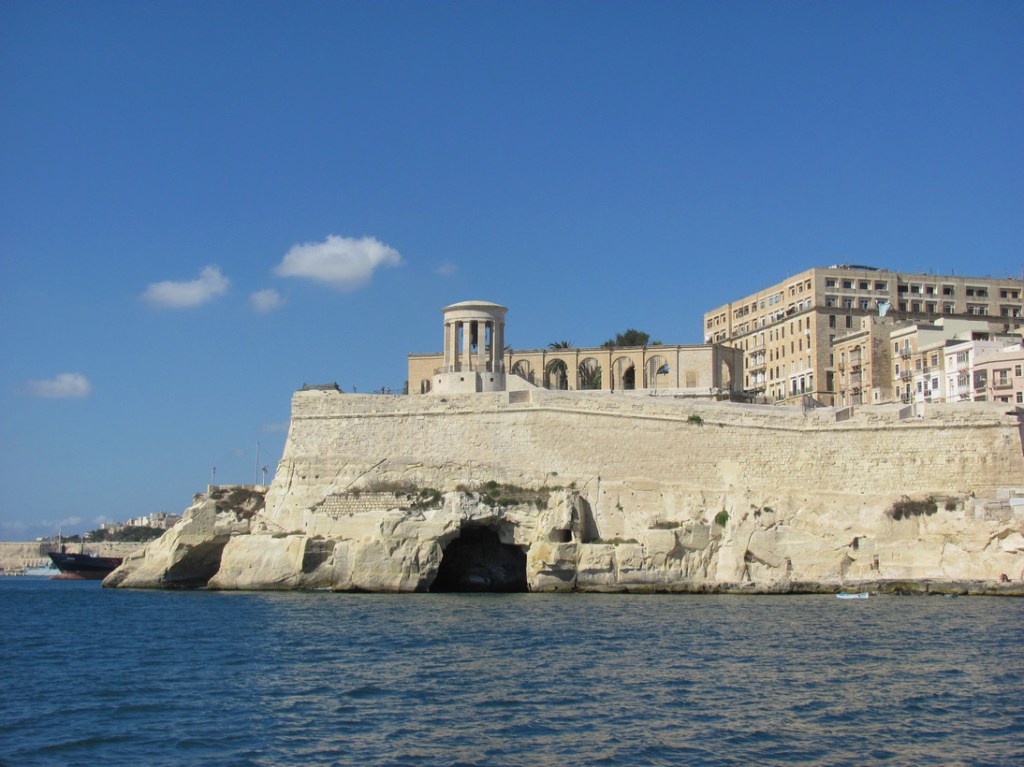

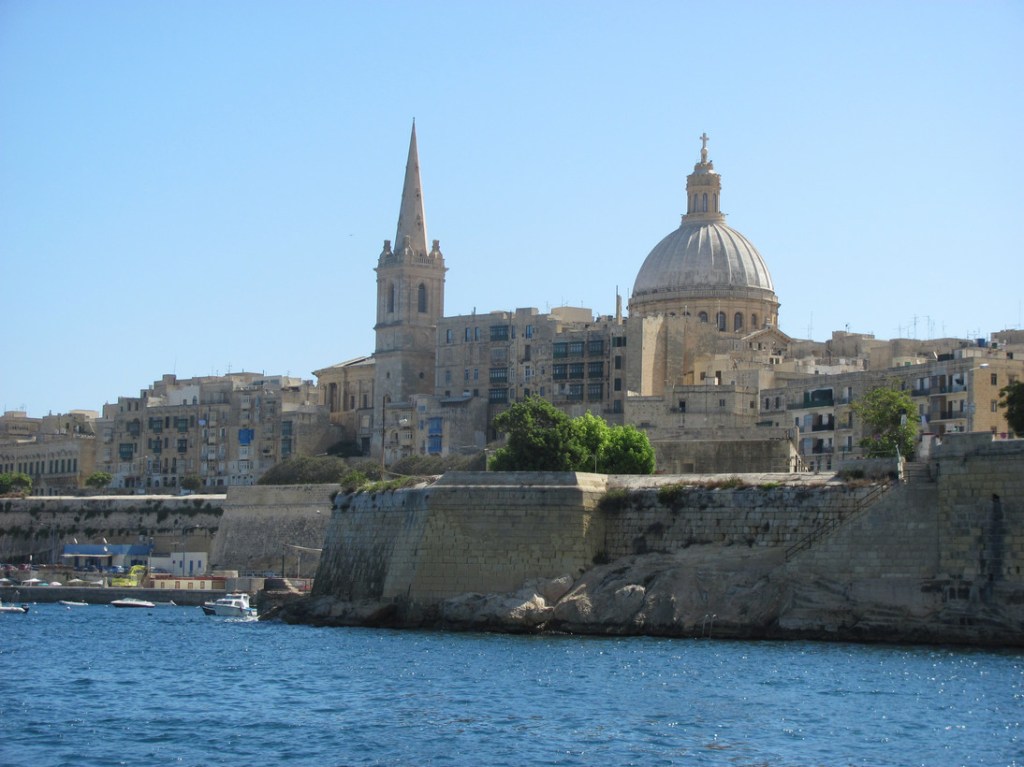
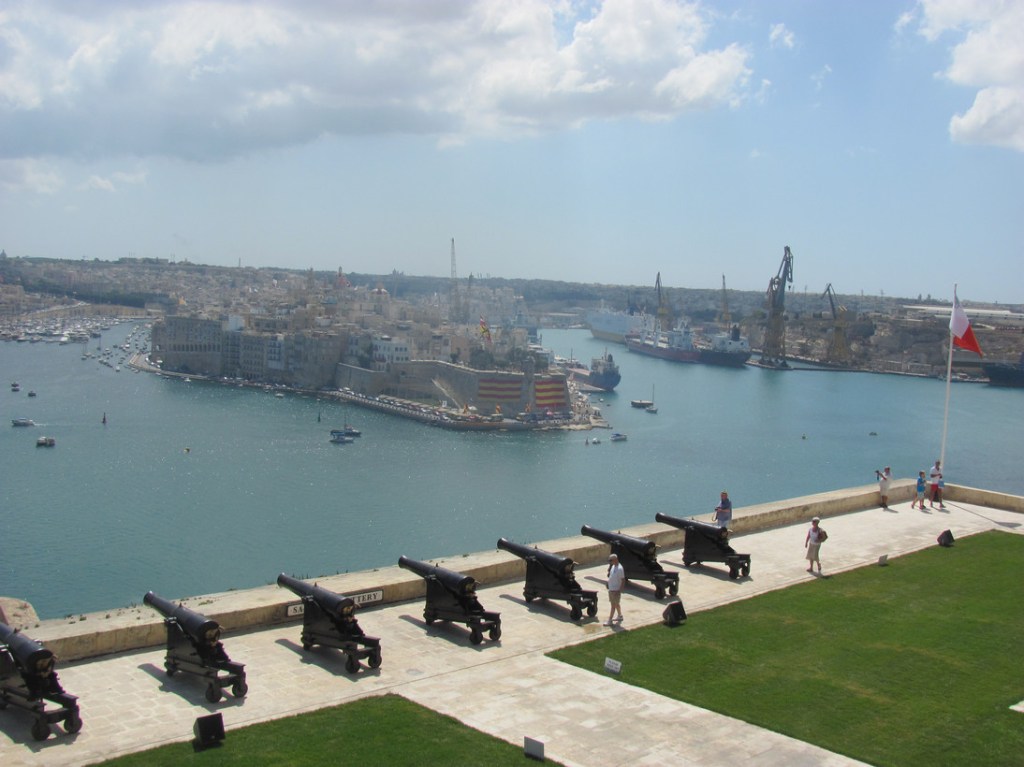

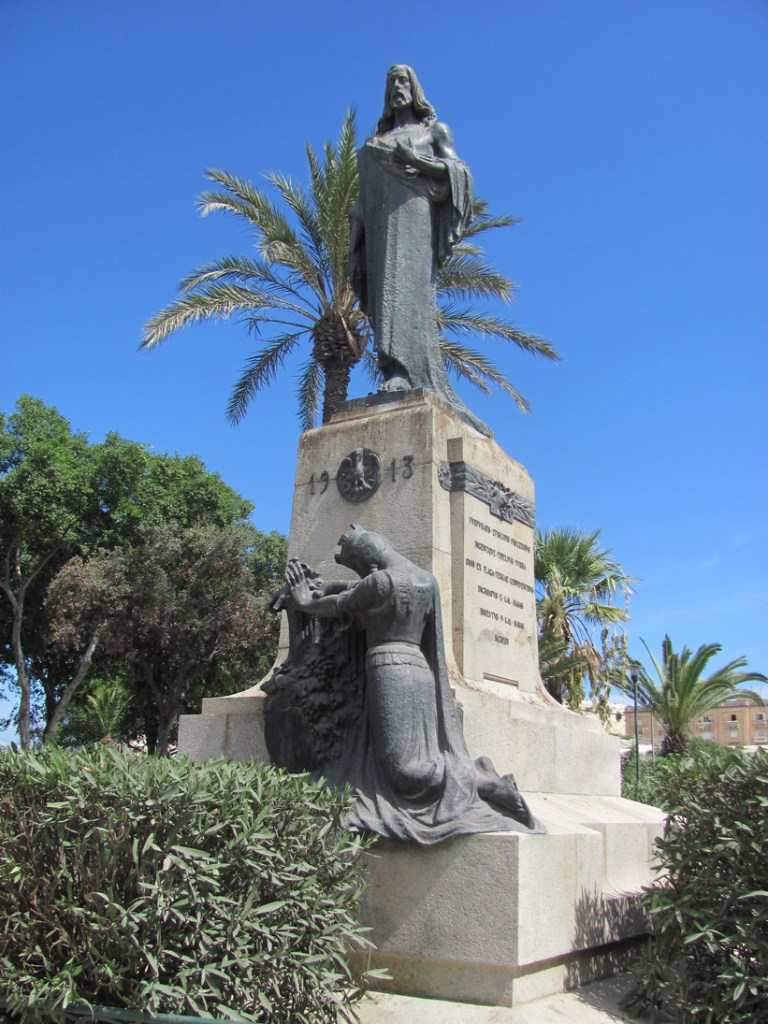
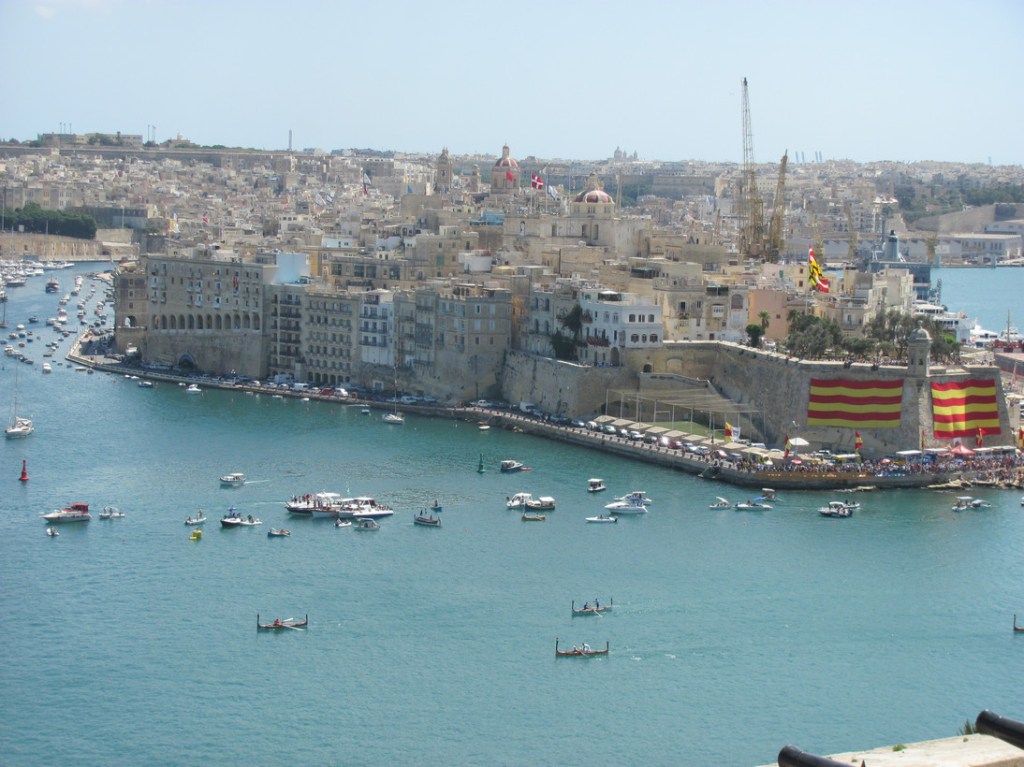
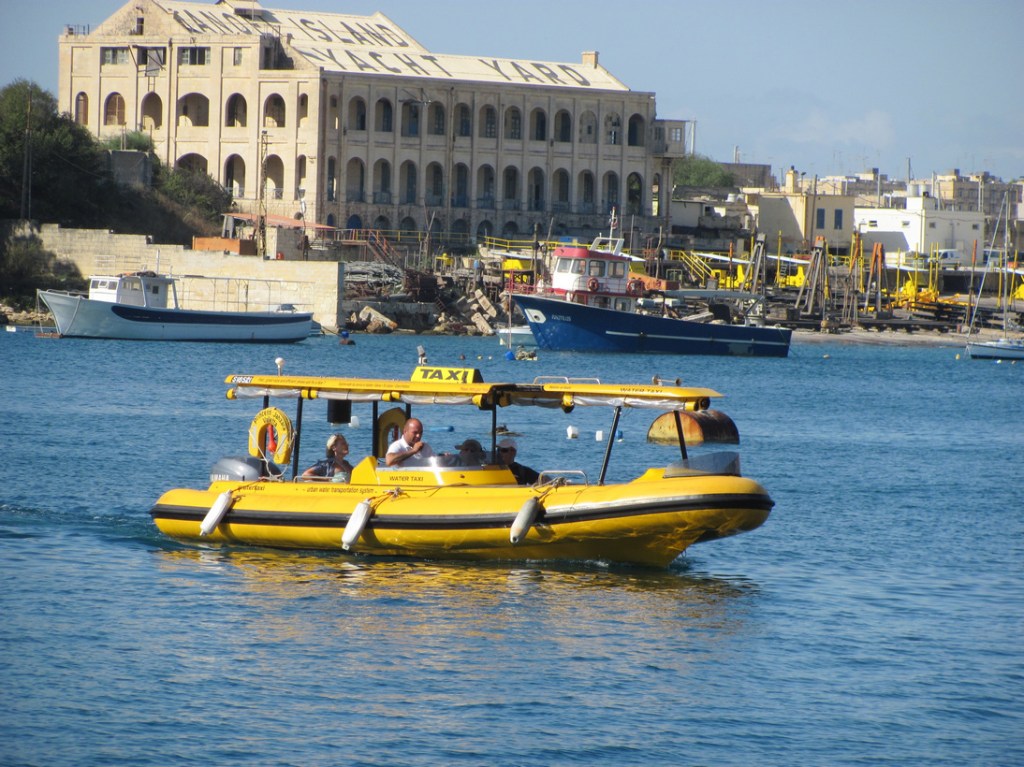
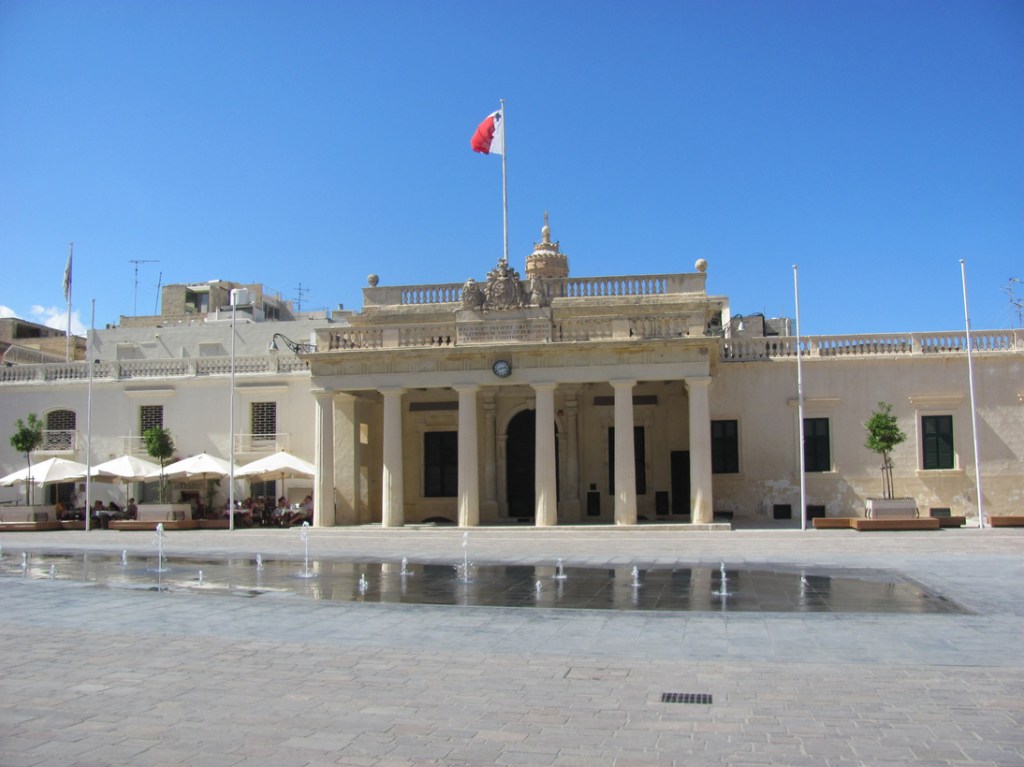
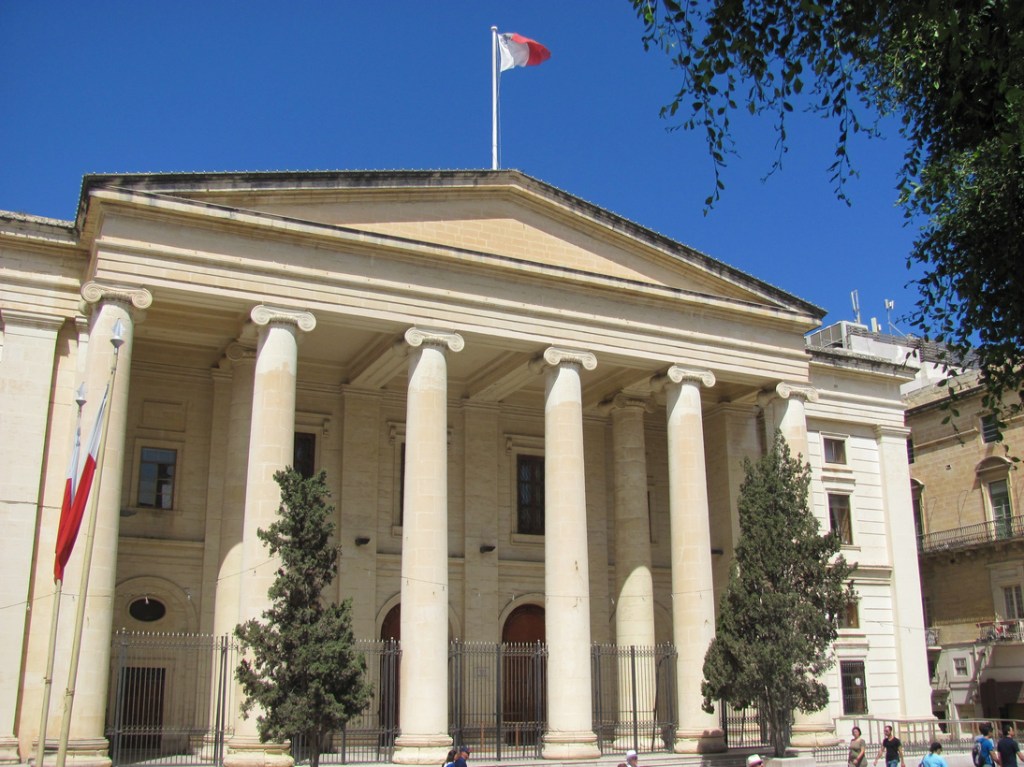
After returning to the port, we took a public transport trip, which left us at the main gates of Valletta. The ticket of the bus was 2.20 euros, although prices of 0.50 euros were listed on the Internet. From here we explored the whole capital on foot and were amazed at how small it really is. From all sides we could see the sea, as we headed to one of the highest parts of the city Upper Barracca Gardens, from where a panoramic view of the Grand Port stands out.
We arrived just in time, because at 12:00 o’clock the cannons were thundering and from here everything could be photographed. We decided to go back to this place to watch the regatta, descending the narrow medieval streets of Valletta.
The two main shopping streets of Valletta, laden with shops and representing pedestrian streets, are Republic Street and Merchants Street. But due to their national holiday, all shops were closed, even their famous mall The Point had closed its doors. Only a few souvenir shops welcomed tourists with their pleasant air conditioners and souvenirs.
According to Valletta’s map, there are 15 churches in the city (almost one on each street), and we toured most of them, but did not enter any because we caught their siesta time. We also took a break in a garden restaurant where we ate very tasty pancakes with fruits.
The frigate turned out to be boat rowing, not colorful yachts, as we had hoped. The thunder of the cannons, however, was impressive and brought a festive mood. The sun was in full swing in the middle of the holiday and managed to hide the few shadows it had in the capital. We went from Valletta to Sliema by water taxi, which turned out to be cheaper than public transport.
So far, the holiday went well – we saw many places and almost got used to the sluggishness of the locals. It remained to get used to the sun’s rays before our good complexion got better.
Friday is the day of love, dedicated to the goddess Venus and Aphrodite. September 9 is also declared World Beauty Day. Instead of shiny outfits, however, we preferred the comfy swimsuits and headed to the beach. At 09:30 we had a diving appointment at the Cresna Diving Center. There we met Charlie (the girl at the reception) and the instructor Steve, they were very kind and patient with us, after all, this was our first diving lesson.
First we signed documents that we do not have any diseases such as asthma, diabetes, etc., then on a sunny bench, Steve introduced us to the basic equipment when diving. We put on underwater suits / overalls to keep us warm underwater, a mask to see better beneath, swimming fins and a vest on which the oxygen tube is fastened. The whole set of equipment, which we were going to put on our backs weighed 30 kg, which makes more than half my weight.

From the oxygen tube came out four hoses, of which we were responsible for only one – the one through which we would breathe. For the others, Steve took responsibility. One of the hoses shows how much oxygen is in the bottle, the other hose inflated or lowered the vest, and the same would help us to come to the surface, as well as to dive further down.
When we put on our diving suit, Steve also put a belt on which three stones were tied. I felt like a prisoner who was put cannonball on his feet and made him jump into the water. The mask we were going to look through had a big screen and only one flaw – it presses on your nose and I couldn’t breathe through it. It is interesting that breathing underwater occurs entirely through the mouth. In case water gets into the mask, it can be exhaled through the nose, so the same will come out. In theory, everything sounded good.
Equipped we went down the stairs and found ourselves in front of a small cove with fences. It was very deep. Accordingly, we had to jump into the water, with our vests full of air and we quickly came to the surface.
Here Steve again showed us how to properly put on our masks and breathe underwater while swimming on the surface. Breathing only through your mouth is a challenge – even for me, although at the beginning of the year a whole week passed during which I did not use my nose due to an awful running nose.
On my first descent, I was scared and signaled to come to the surface. I took a breath and we went down again, this time swimming a lot. We got out of the fences and Steve showed me different fish. He held my hand the whole time and I was very calm. At first I held my other hand by the breathing machine, but then when we saw so many fish I wanted to catch them and all the time I waved my hand, but I never caught a fish, and they were so close, so colorful and beautiful. The only discomfort I got was that I felt cold on my ears, but probably the same ones were just fading due to the change in pressure.
At first I thought I’d be scared, but the truth is, I liked it very much. I felt just like the little mermaid, like the bottom is really so colorful and diverse, and we were all the time in the bay, what’s deeper? I saw grey, red and yellow fish. Some moved on their own, but the smaller ones were in passages. Stepping on the bottom of the Mediterranean Sea, 3 yellow fish stood on my flipper, which was the same color. I didn’t see crabs or even shellfish, but there were a lot of stones and algae. The algae swayed by the waves instead of the wind resembled exotic plants in a pot.
I definitely missed my camera here and if one day I have the opportunity to dive again, I will definitely get an underwater camera.
All this pleasure took us only 1 hour, but every minute was worth it. This was actually a test dive and the price is 35 euros per person, if we liked it so we could enroll in a one-day or three-day course, at the end of which we would receive an international PADI certificate. For today, however, this dive was enough for us, when I went ashore I was very enthusiastic, with a lot of adrenaline in my blood, as if I had just got off a roller coaster in a theme park.
It was very difficult for me to climb the ladder with those 30 kg on the back that pulled me back. Steve still in the water helped me get my flippers down, but I had to take the rest of the equipment ashore, and I just didn’t have the strength to pull forward. But with a lot of effort and a nudge in the back, I was able to handle that too.
After the dive, we went to the beach and spent the whole day there. The water seemed warmer and the sky was sparkling blue without a single cloud.
It was our last day in Malta. The evening followed again a walk along the promenade of Sliema, this time having dinner in a restaurant on the beach called Paul’s seebreeze. We could really feel the sea breeze there, but it was warm and pleasant. On departure we said goodbye to it, to the nice bay and the calm and beautiful promenade.
They say that traveling is not just about getting to a new place, it’s about feeling the new culture. Over the past 7 days, we’ve had that opportunity. The salty taste of the sea was slowly disappearing from our lips, the sunny sky evoking memories of the sunny island of Malta and the 930 photos would forever capture these memories of a nice and fruitful holiday
General information about Malta:
Location: Malta is an island country located in the Mediterranean Sea, south of Italy, east of Tunisia and north of Libya. Malta consists of three inhabited islands (Malta, Gozo and Comino), as well as three uninhabited (Cominoto, Filfla and St. Paul).
Capital: Valletta.
Area: 316 sq.km
Population: 445 426 people (data from 2014)
Official language: Maltese and English.
Climate: Mediterranean climate with an average annual temperature of 23 C.
Time zone: UTC+1
Currency: euro (EUR)
Further information: http://www.visitmalta.com/
Trip Tips for Malta:
Best time to visit: May, June and September are probably the best months for excursions and holidays. July and August temperatures exceed 30 C and it is quite hot. Most tourist attractions run from May to October.
Typical foods and drinks: especially delicious here are fish and seafood. Try octopus, squid and swordfish.
Places to visit: the capital Valletta, the old capital Mdina, Gozo and others. To explore the whole island you can rent a car, and if you do not want to drive with left wheel, try the round-trip tours with the double-decker tourist buses (http://www.citysightseeing.com.mt/en/home.htm).
 TripTips