CHRISTMAS SPIRIT IN KATANIA
author: Ana Boneva


Sandy beaches, gentle sea, and instead palms there is a Christmas tree.
Reindeers with a sleigh, instead of surfers in the bay.
Summery Christmas – sounds good to me, especially when Santa Claus’s village is surrounded by palms trees.
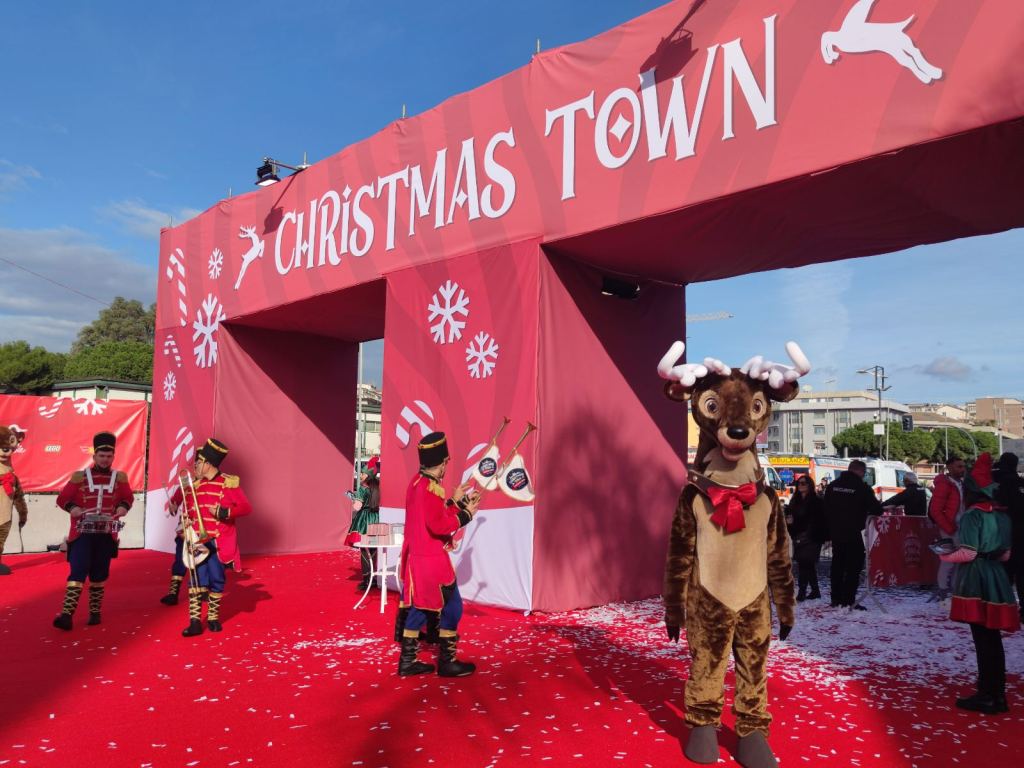
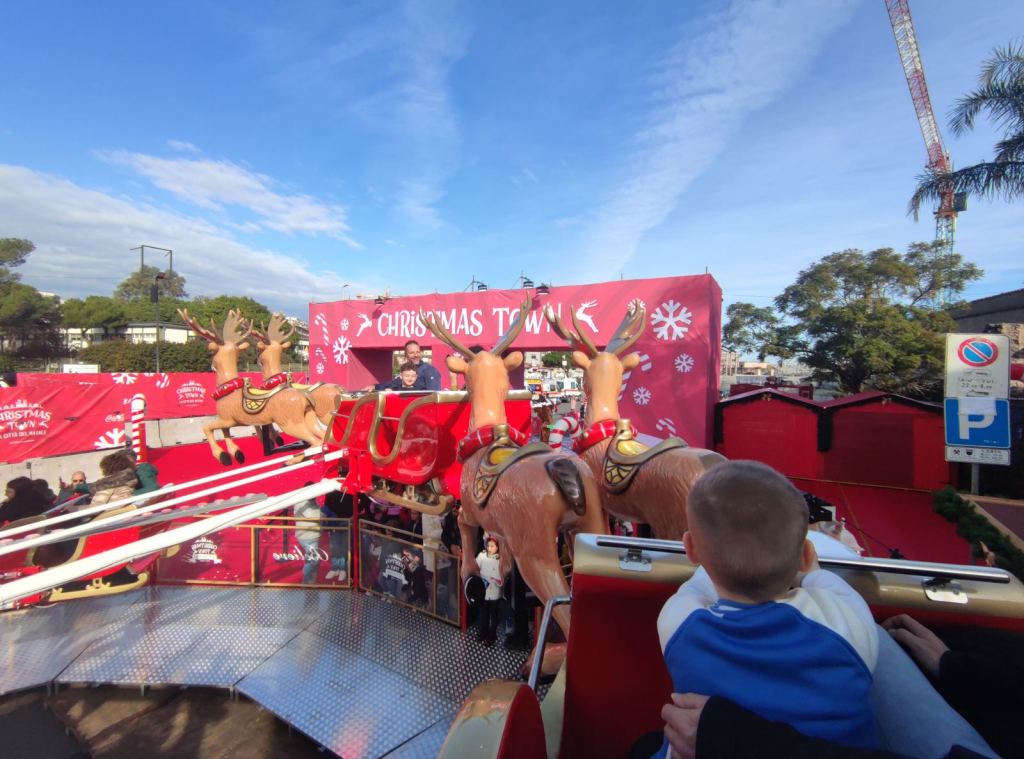

Every year on Christmas Eve, the Le Ciminiere Exhibition Center in Katyana turns into a magical Christmas town that attracts guests from all over the world. There you can see Santa’s house, his toy workshop, and among them many other attractions for young and old such as a magic show, musical performances, a Christmas circus, a cinema with Christmas movies, carousels, a Ferris wheel, a sphere with huge balls, Lego, Barbie and Hot Wills play areas, as well as a wonderful ice rink for figure skating. In 2024, the park was open from December 7, 2024 to January 6, 2025, every day from 10:00 to 23:00.
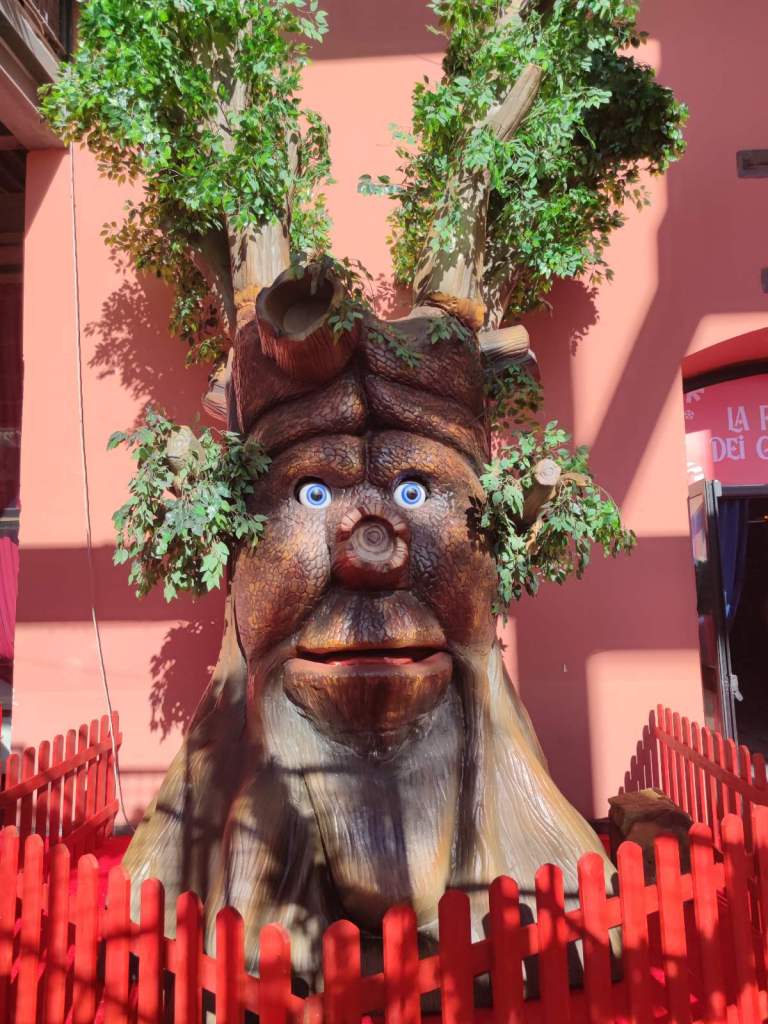

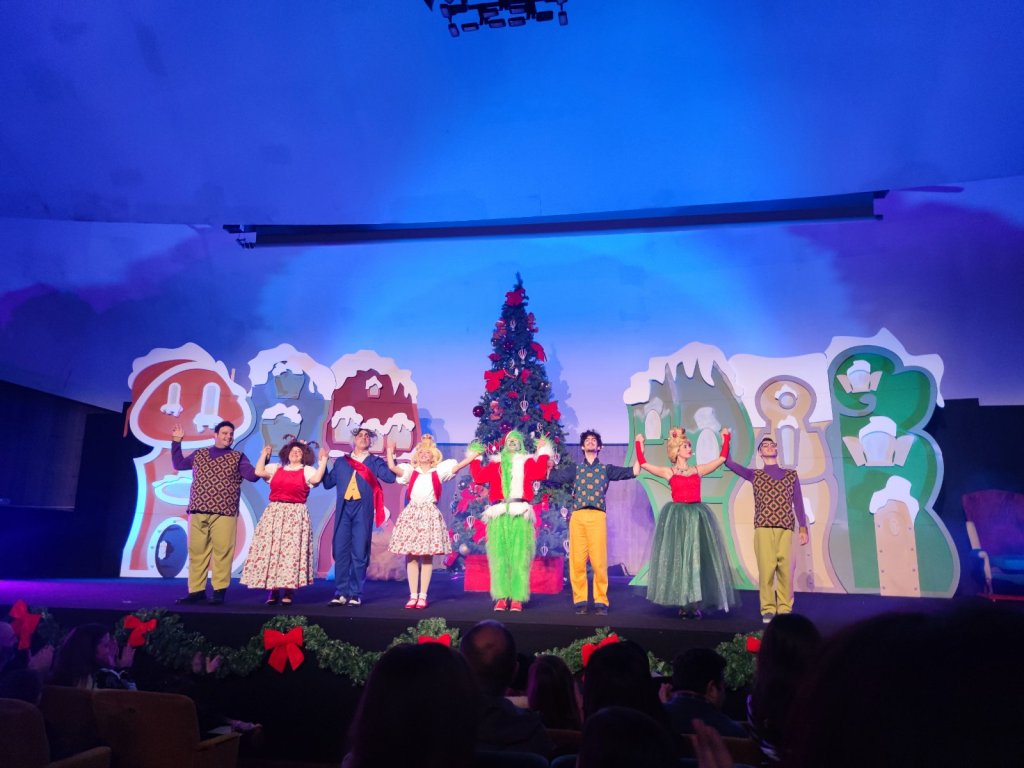
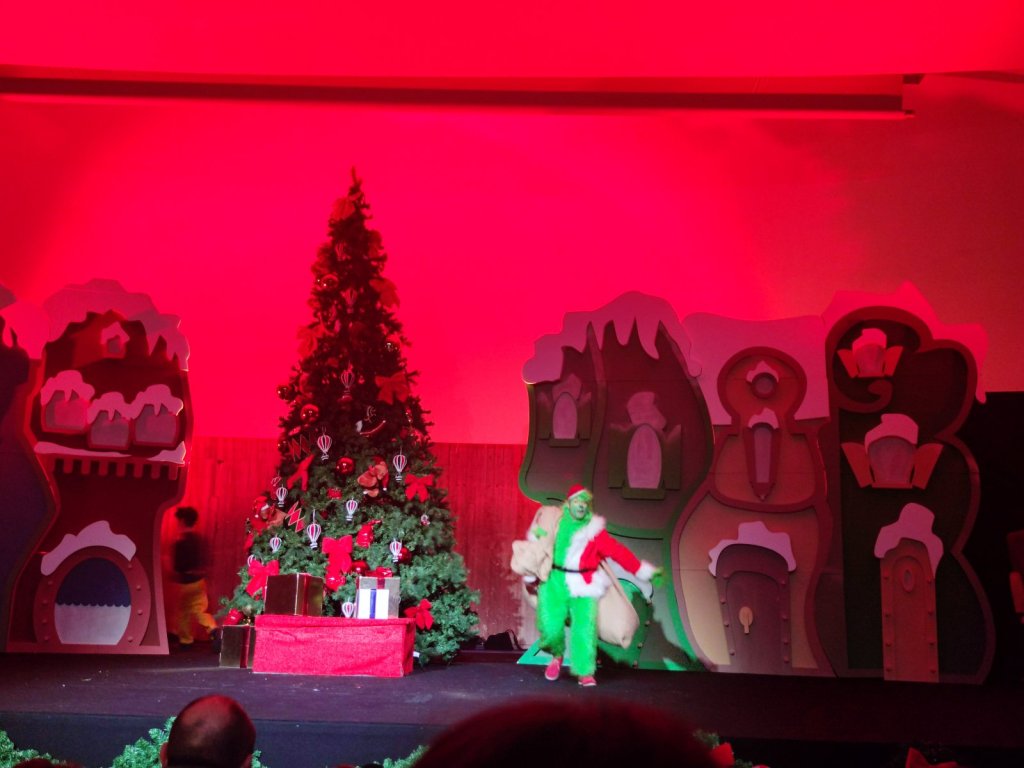
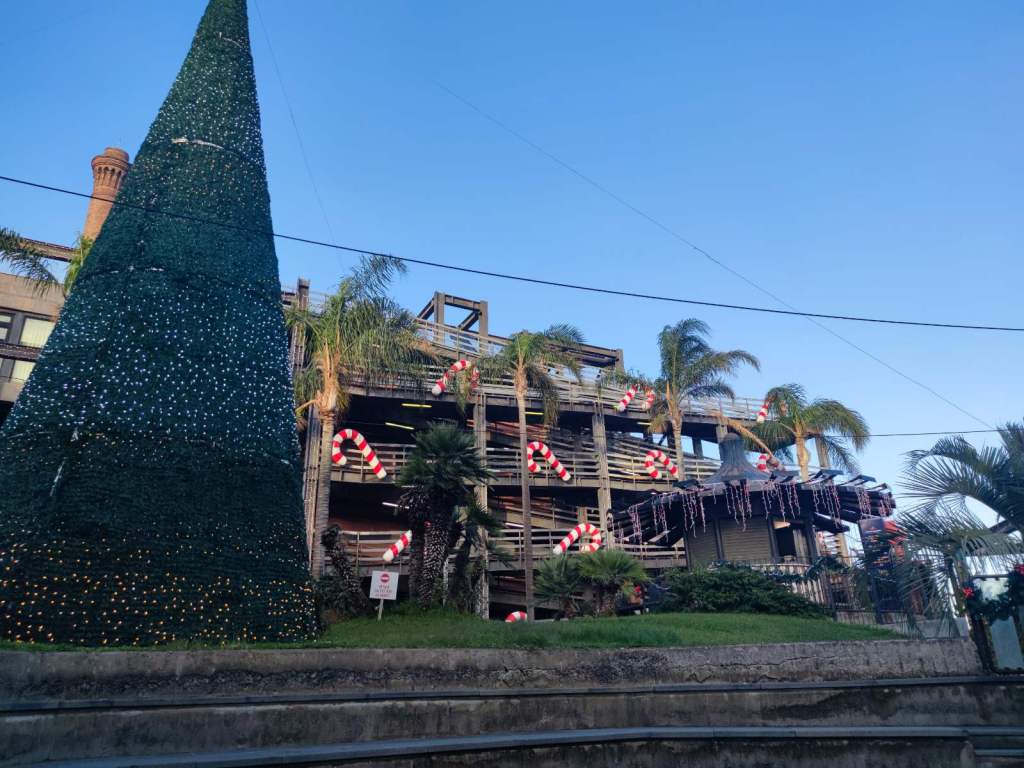
The Christmas town is richly decorated with Christmas decorations, although palm trees stick out from everywhere, the sea is a few steps away and the temperatures on December 7, 2024 were 20 degrees! The feeling of summery Christmas is phenomenal and although it is not in tune with the holiday, it actually warms the hearts more than Gluck wine in the rest of the Christmas markets.

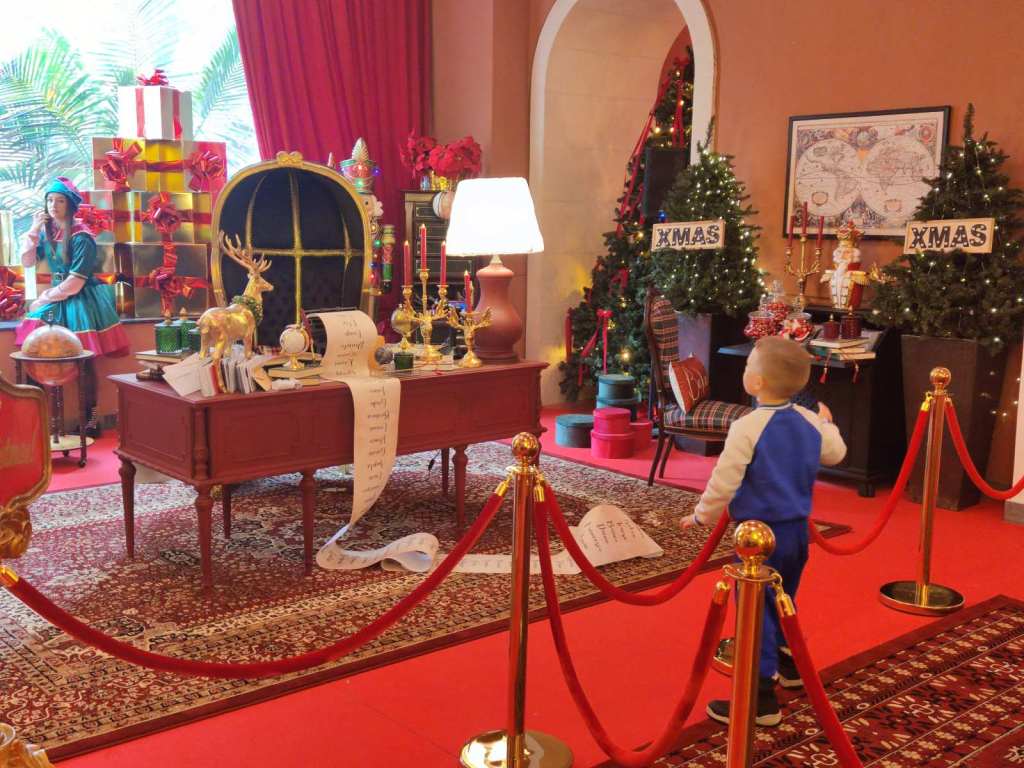

The whole city of Catania has wonderful Christmas decorations, there are different Christmas markets in the whole city and a festive mood that, like the three seas that surround Sicily, overwhelm locals and tourists.


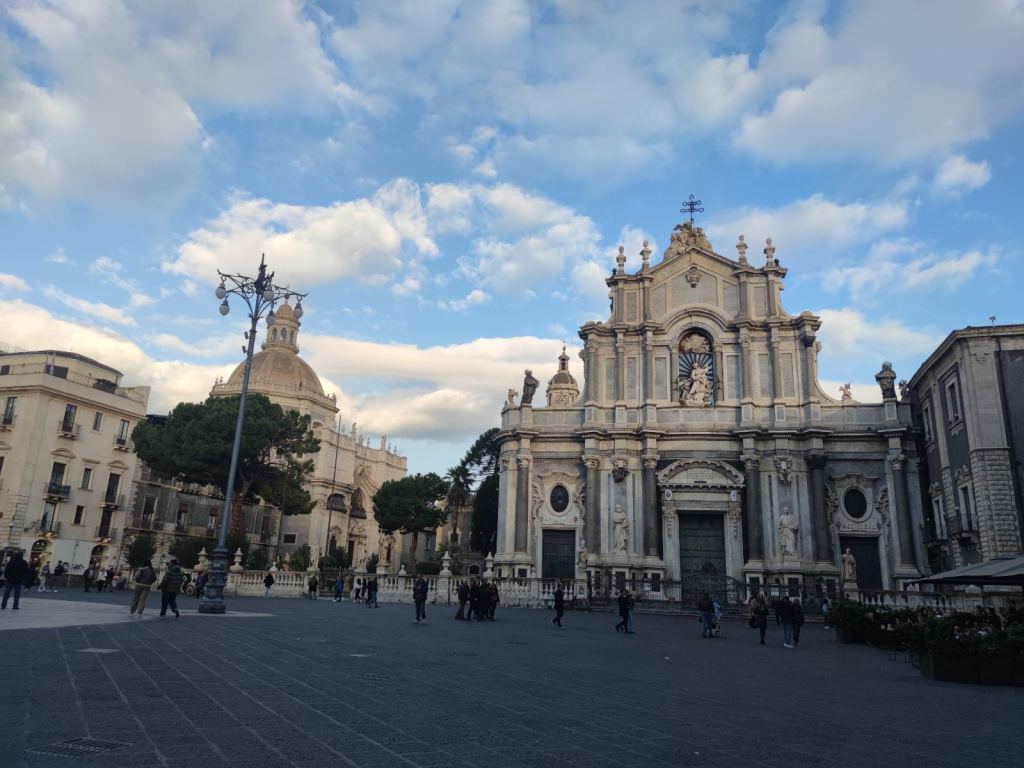
If you want to learn more about Catania and the famous island of Sicily, check out the advent calendar below with 24 legends and stories about the big and undoubtedly one of the most beautiful islands in the Mediterranean.
Day 1: The legend of the origin of Sicily
Once upon a time, in ancient times, three beautiful nymphs traveled around the world. They took all the beautiful things they saw during their trips. As soon as all of them were gathered, they began to boast of all the things they possessed. Gathering all the beautiful things, an island appeared in the middle of the sea with rich land and all sorts of wonders of the world. This treasure of land and beauty was created by the three nymphs, and so the island of Sicily appeared with three corners – the coast of each of the three nymphs.
Day 2: The legend of the symbol of Sicily
Sophisticated female beauty also lies in the symbol of Sicily, which is called Trinacria, and stands on the flag of the island. The symbol of Sicily consists of three bent legs that come together to form a triangle. They symbolize the three capes of Sicily: Peloró, Passero and Lilibeo. These are believed to be female feet, and symbolize the sensual and breathtaking beauty of Sicily’s coastal beaches. The leaves located between the legs symbolize the agricultural wealth of the Sicilian land. As early as ancient Rome, Sicily produced large quantities of grain. In the very center of the Trinacria stands the head of the Gorgon, whose hair consists of snakes and her image protects everyone from invaders.
Day 3: The legend of the Gorgon Medusa
According to Greek mythology, Medusa was the daughter of the sea gods Phorkis and Keto, and the only mortal gorgon. She was very beautiful and boasted that she was more beautiful than Athena herself. The goddess decided to punish her, and after the god Poseidon seduced her in her temple, she turned her into a monster with snakes instead of hair, and a petrified gaze – everyone who looked turned into a stone statue. Only Perseus managed to defeat Medusa with his mirror shield and used her head to petrify his enemies. Then he gave her head to Athena, who put it on her shield. To this day, it is believed that the head of Medusa is a symbol of protection that repels invaders and turns anyone who approaches to stone.
Day 4: The Island of the Cyclops
Even in ancient times, many of the greatest travelers passed through Sicily. Among them was Odysseus, who met the Cyclops there – creatures with only one eye on their foreheads. One of them, Polyphemus, locked him and his men in a cave and was preparing to kill them, but Odysseus managed to get him drunk and gouged out his only eye. He began throwing stones at them, and so the coast of Sicily was surrounded by rocks (still visible today), along which Odysseus and his men managed to escape. However, Odysseus was punished for his deed, since the Cyclops was the son of Poseidon and the god punished Odysseus to wander in the sea for 10 years.
DAY 5: Mount Etna
According to mythology, the forge of the god Hephaestus is located inside Mount Etna. It was in the fires of the volcano that he forged his invincible weapons. It is believed that under the volcano there is an entrance to Tartarus, the “world of the dead”. Mount Etna is one of the most active volcanoes in the world and is in almost constant activity, and to this day you can hear the god Hephaestus forging his weapons.
Day 6: Mount Etna and Encedalus
Another legend from Greek mythology tells about the giant Encedalus – brother of Zeus. He was jealous of his brother’s strength and decided to confront him. He began to build the highest mountain with which to reach the clouds and Olympus, and to take the place of his brother. However, the mighty Zeus sent him lightning, which collapsed the mountain of Encedalus and pressed him motionless to the ground. According to legend, to this day, Encedalus stands motionless under the lava, and only his fierce incandescent breath comes out as lava and causes the eruptions and earthquakes of Etna.
Day 7: The legend of Persephone
According to mythology, it was in the volcano Etna that the god Hades lived – the ruler of the kingdom of shadows, the brother of Zeus, who fell in love with the beautiful Persephone and therefore opened the earth and swallowed the beautiful girl. Her mother, the goddess Demeter, however, objected and asked Zeus, who finally agreed that two-thirds of Persephone should stay on earth and one-third in the dungeon with her husband Hades. When Persephone is on earth, everything blooms and the sun shines, and when she is gone, winter comes and nature sleeps, waiting for Persephone to appear again.
Day 8: Etna is a woman
Another popular legend about Etna (or formerly known as “Aitna”) tells that she is the daughter of Ouranos and Ge. It is she who keeps the giant Encedal with her. The belief that Etna is a woman is still believed today, with her rich soil easily associated with the idea of motherhood, abundance, and fertility. In addition, to the question “Why does Etna have a female background?” Many Sicilian men would answer that this is due to her frequent mood swings, alternating periods of relative silence and sudden eruptions.
Day 9:Colapes Colapes was a fisherman and excellent swimmer who lived during the reign of Frederick II. The king, hearing about his famous swimming skills, decided to challenge him and threw several objects into the deepest part of the sea. Colapes managed to pull out some things, but on his second dive, he never resurfaced. People believe that it is still underwater today and supports one of the three columns that hold Sicily and prevent the island from sinking into the sea.
Day 10: The Island of Currents
According to legend, Odysseus’ sailors sailed for a long time in the waters that surround the southernmost point of Sicily. Only the brave Trojan hero Aeneas managed to land on the island of the currents at Capo Pasero. Aeneas, although a minor character in Homer’s Iliad, is a famous demigod (son of a mortal and Aphrodite) and is considered the founder of Rome. When he reached Sicily, he met a Greek named Achaemenides, one of Odysseus’ men, who had been abandoned when his companions escaped from the cave of Polthemus. He says Achaemenid is on board and they narrowly escape Polyphemus.
Day 11: Sicily and the Phoenicians
The Phoenicians were an ancient civilization that flourished between the 15th and 6th centuries BC. They are best known for creating the first alphabet, which subsequently influenced writing systems around the world. The Phoenicians were also good navigators, gradually migrating to the Mediterranean from the Red Sea region. From the 11th century BC the Phoenicians began to settle in western Sicily, already having colonies in nearby parts of North Africa. Large Phoenician settlements were found in Solunto (modern Palermo) and Motia (an island near today’s Marsala). The indigenous people of Sicily were then called Elimi, Sicani and Sicels, and from the latter comes the name of the island.
Day 12: The Emergence of Catania
In 734 BC The Greeks began a systematic colonization of the island of Sicily, starting from the city of Sicily. Naxos was created by colonists from Naxos in Greece and Ionians. The city was founded one year before Syracuse and Catania.
Catania itself originated as an ancient Greek colony of Naxos, with the Greeks settling on the slopes of Mount Etna in 729 BC and traces of their first settlements can still be found today on the site of the Benedictine monastery.
Catania was erected as a Greek colony in the 8th century BC, and over the centuries, Romans, Byzantines, Arabs, Normans and Spaniards invaded and occupied the city, leaving their traces in it.
Day 13: The name of Catania
The name Catania means “grater” or “skinning knife”, and the name was adopted by the Greek settlers and left under Roman rule. In ancient times, the city was a major place for the export of corn from the rich lands around it. In other translations, the name means “uneven terrain” and “sharp stones”, with Catania proudly rising between the blue sky and the black mountain (Mount Etna). Hence the nickname of Catania – “the black city”, due to the color of the buildings, blackened by the soot and ash of the volcano, whose eruptions often damage and even destroy the city, which, like a phoenix, manages to rise again from the ashes, more beautiful than before.
Day 14: The legend of St. Agatha
Santa Agata is the saint of the city and a majestic cathedral was erected in her honor in the center of Catania. Agatha was a Roman citizen and was very beautiful. At the age of 15, she decided to become a nun, but the local ruler did not allow her, as he wanted to marry her. She refused his offer and so he threw her in prison, where she was tortured and then sent to the stake. She was dressed in white with a red cloth thrown over, which the fire never approached, and the ruler freed her, but Santa Agata died of her wounds in the morning. Nowadays, people believe that by veiling themselves with red scarves and praying to the saint for help, she will help them. It is believed that the saint also protects them from the volcano, which has not reached Catania for many years.
Day 15: The Fountain of the Elephant
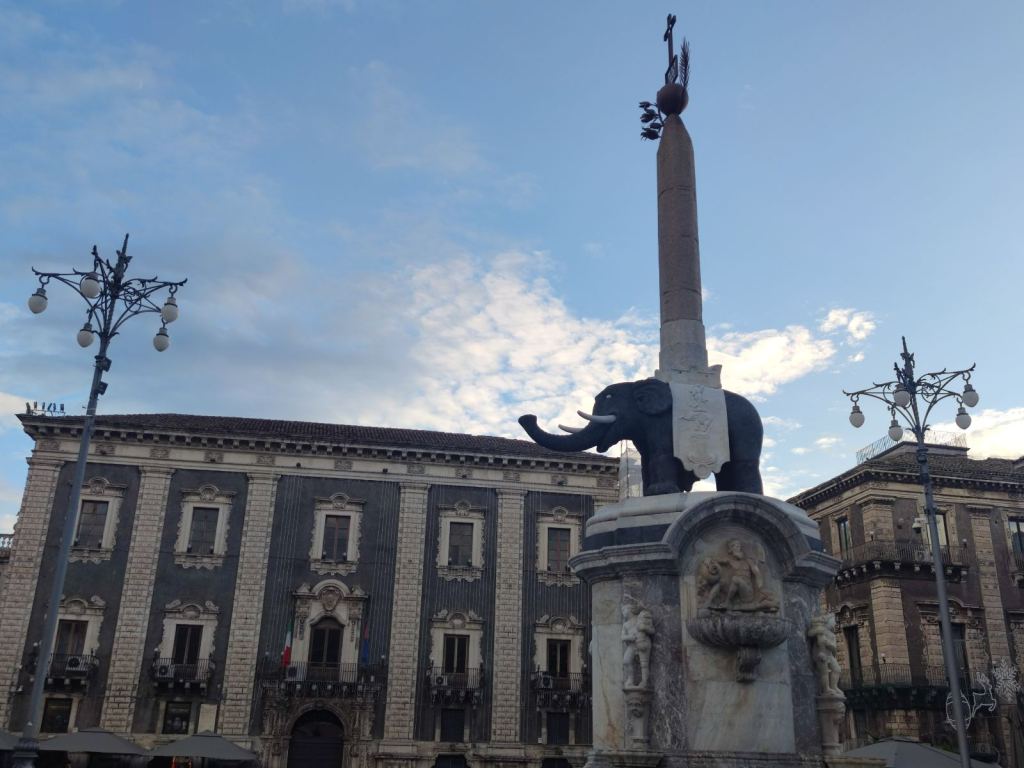
According to legends, there were many wild animals in Sicily and only when an elephant appeared, the inhabitants were able to get rid of the beasts. As a gratitude, they erected a monument to the elephant in the time of the Romans. In 1693, Catania was destroyed by a strong earthquake and during its reconstruction in 1735. in front of the cathedral of Santa Agata was erected a beautiful fountain with an elephant. Most historians believe that the architect was inspired by the Elephant and Obelisk erected in Piazza della Minerva in Rome. Here the fountain has two jets symbolizing the two rivers of Catania – Simeto and Amenano. The elephant’s trunk faces the cathedral of St. Agatha, the patroness of Catania. It is also believed that the Egyptian obelisk on the back of the elephant served as a sundial and showed the time with its shadow that fell on a dial drawn on the ground.
Day 16: Benedictine Monastery in Catania
Just a few steps from the Cathedral of Catania, rises one of the largest Benedictine monasteries in Europe. This is a unique place that tells about the human and historical events of the city at the foot of Mount Etna. The construction of the monastery began in 1500. and continues to this day. It is an example of the architectural integration of different styles in different eras. It is dedicated to San Nicola di Bari. The monastery was famous for its huge organ, which had 5 rows of keys and an exact imitation of various musical instruments. The German writer Goethe, describing it in his volumes A Journey Through Italy, “the monk played beautifully with the magnificent instrument, making its softest notes whisper in its farthest corners, and at the same time filling the whole hall with the crash of its strongest tones.” Unfortunately, this organ was plundered over time and only the legends remain of it.
Day 17: Catania and Bellini
Vincenzo Bellini is one of the most famous Italian composers who raised Italian opera art to a new, higher stage. He wrote 11 operas and during his lifetime he was famous throughout Europe, but died of illness at the age of only 33. He was born in Catania and it was here that the famous opera Teatro Massimo Bellini was named after him, in the city there is also Bellini Park, Piazza Vincenzo Bellini, a statue of Bellini, Bellini museums, Bellini café, etc. Even the airport in Catania is named Vincenzo Bellini Catania Airport.
Day 18: The Amphitheater in Catania
The Amphitheater in Catania was built in the 2nd century during the Roman period and it is the largest amphitheater in Sicily. In addition to its gladiatorial fights, the theater is also famous for the speech of Alcibiades, who incited the Catanai to ally with Athens against Sparta and Syracuse during the Peloponnesian War. The theater was designed to accommodate about 7000 spectators, being elegant and equipped with a stage with marble columns. There was room for a huge orchestra, and the waters of the Amenano River were channeled in such a way that the water elements of the stage could be used and brought to life or the mechanical gears of various equipment could be used. Even in ancient times, this theater aroused the admiration of people.
Day 19: Acis and the Mermaids
Sicily is shrouded in legends about mermaids, one of the most famous of which tells about the love of the shepherd Acis and a nymph. Galatea was a water nymph and also fell in love with Acis, but when she rejected the love proposals of the cyclops Polyphemus, the rejected jealous man threw a stone and killed her love. Neptune, the father of Galatea, turned the dead beloved into a river so that he could flow to the sea and be reunited with his daughter. To this day, the villages at the base of Etna begin with the prefix of “Aci” (Acitrezza, Acicastello, Acireale, etc.) in his honour.
Day 20: The legend of the freshwater lake in Syracuse
Once in ancient times, the nymph Arethusa fell in love with a man who also fell in love with her. They asked Zeus for permission to marry, but he firmly refused. However, this did not dissuade the lovers. The nymph asked Artemis to turn her into a lake, and the young man gave gifts to Poseidon to turn him into a river. The river flowed into the lake and so the two lovers were united forever. And today on the shores of Syracuse you can see this small freshwater lake, sweet as the love of two.
Day 21: Syracuse and Archimedes
The legendary Syracuse was described by Cicero as “the greatest Greek city and the most beautiful of all.” It was here that the genius mathematician and inventor Archimedes was born. He left a great legacy in mathematics, physics and technology. He found, for example, the number “pi”, which is equal to 3.14 and also gave a proof of the infinity of natural numbers. In physics, Archimedes’ law states that “every body immersed in a liquid lightens as much as the weight of the fluid pushed out of it”. According to legend, Archimedes discovered this law while lying in a warm bath, suddenly rejoiced and ran naked through the streets of Syracuse.
Day 22: Odysseus and the Aeolian Islands
The Aeolian Islands are a group of volcanic islands in the Tyrrhenian Sea north of the island of Sicily – known as the lands of wind and fire. The ancients believed that Aeolus, the king of the winds, lived on one of these islands and kept the winds and storms locked in a cave, unleashing them when he was angry.
After Odysseus escaped from the cyclops Polyphemus, he stayed in the house of Aeolus for a month, recounting his adventures during the Trojan War. On his departure, Aeolus gave him a special gift: a wine bottle tied with a chain, in which he hid all the winds of the earth, except Zephyr, the softest, who would guide the sails of Odysseus’s ship. However, Odysseus’ jealous companions wanted to see what was in inside and released all the winds that created terrible storms. According to legend, Aeolus was very disappointed when Odysseus returned to him with the empty bottle and banished him forever from the lands of wind and fire.
Day 23: Palermo
The capital of Sicily is called the “city of palaces” due to the many historic castles and mansions. Numerous festivals are also held here, one of the largest among them is on July 15 dedicated to St. Rosalia – the patron saint of Palermo. According to legend, Rosalia was born into a noble family, whose ancestors descended from Charlemagne. Intensely pious, she retired to a hermitage life in a cave on Mount Pellegrino, where she died in 1166. Legend has it that she was taken to the cave by two angels, and wrote on the wall: “I, Rosalia, daughter of Sinibald, Lord of the Roses and Quiskvina, have decided to live in this cave, dedicating my life to my love Jesus Christ.” In 1624. a terrible plague swept through Palermo and Rosalia appeared first to a sick woman, and then to a hunter, to whom she pointed out where to find her remains and told him to bring them to Palermo and carry them in a procession. The hunter did this and after the procession the plague stopped. Since then, Saint Rosalia has been revered as the patron saint of Palermo.
Day 24: The emergence of the Gulf of Naxos
The beautiful Gulf of Naxos is located right next to Taormina, on the coast of the Ionian Sea. According to legend, it was created when one day Zeus woke up tired and irritated after once again cheating on his beloved wife Hera. His wife knew about his constant betrayals and always forgave him, but this time Zeus wanted to compensate her and repent for the infidelity. He took the largest diamond from his crown and threw it into the sea. The island of Sicily suddenly appeared on the site. He asked his brother, Poseidon, to form a beautiful river, which Homer later called the “Bay of the Gods”, and the god of Vulcan to slide a river of lava under the river to form a beautiful bay. It was at this beautiful bay that the first Greek settlers landed in 734. coming from the Greek island of Naxos and calling the gulf Litus (land touched by the sea), and so the gulf of Naxos was created as a divine garden and a gift from the Gods.

GENERAL INFORMATION ABOUT CATANIA:
Location: Catania is located in the eastern part of the island of Sicily, at the foot of Mount Etna.
Area: 182.90 sq. m.km
Altitude: 7 m
Population: 311,584 people (2019 data)
Official language: Italian
Climate: warm Mediterranean
Time zone: UTC+2
Currency: Euro (EUR)
Further information: www.visitsicily.info/en/localita/catania
TRIP TIPS FOR CATANIA:
Best time to visit: all year round, with the tourist season being from June to September. In December, a Christmas village is organized in the city.
How to get here? There is a direct Ryanair flight to Catania Airport from Sofia.
Typical food and drinks: Italian cuisine is famous all over the world, and Sicily is no exception, and here you can taste uniquely delicious pizzas, pasta and ice creams. While on the island, be sure to try Arancini – fried balls with rice and cheese.
Places to visit: San Agata Cathedral, the Fountain of the Elephant in front of it, and baroque architecture in the city center. Every morning, except Sunday, a large fish market is organized in front of the cathedral and a street market for food and clothes on Via Etnea. It is also worth taking a day trip to Mount Etna, which is visible from all over the city.
 TripTips