HEIDELBERG – A FAIRY TALE IN A DAY

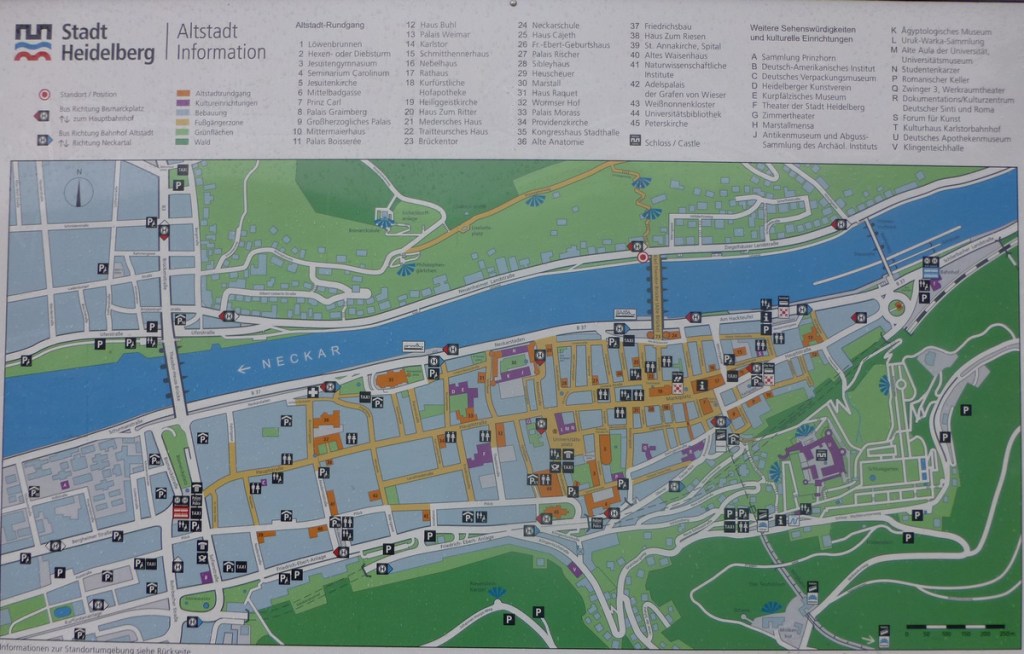
Nestled 90 km south of Frankfurt, the picturesque town of Heidelberg has inspired for centuries people like Goethe, Heinrich Heine and Mark Twain. Unlike other German cities, during World War II, Heidelberg was spared by the allied bombings and retained its original buildings from the late Middle Ages and the Renaissance. The historic appearance of the city merges with the youthful spirit of its inhabitants, turning Heidelberg into a leading university city in Germany and a real treasure for tourists from all over the world.
We headed to this fabulous destination in early May, getting train from Frankfurt. Our first stop was Darmstadt, where lots of people boarded. Darmstadt, like Frankfurt, was in the Hesse region. The city was famous for its annual architectural competitions, which had left a legacy of many significant architectural sites. Among them was the famous Hochzeitsturm or Marriage Tower, also known as the Tower with the Five Fingers. It was built by architect Joseph Maria Olbrich on the occasion of Grand Duke Ernst Ludwig’s wedding to Princess Eleonora on February 2, 1905.
The train passed by several other small settlements, moving so fast that I could not read their names. We also passed a hill with a castle, but rushing so fast I couldn’t make a photo. Bensheim train station was full of young people. I saw a lovely cathedral in the distance, but again the train was faster than my camera. Bensheim was located at the foot of Mount Odenwald with a magnificent view of the lowland of the Rhine. In 2014, the city hosted the annual Hessentag / Hesse Region Day, which took place from 6 to 15 June 2014 with numerous concerts and cultural programs.
The green panorama through the window continued, reaching the next Wеinheim station. There were no people on it, so our train quickly moved on. However, I wrote the city name for future visits as its nickname was Zwei-Burgen-Stadt or the City with the Two Castles. In addition to its castles, the city had a beautiful market square, palace gardens and so-called Exotenwald (The Exotic Forest), which has trees from all over the world, especially North America and Japan.
After arriving in Heidelberg, we took bus 35 from the station to the city center, and the driver showed us how to get to the hotel. The midnight city fascinated us and we couldn’t wait to wake up and see the city in the daylight.

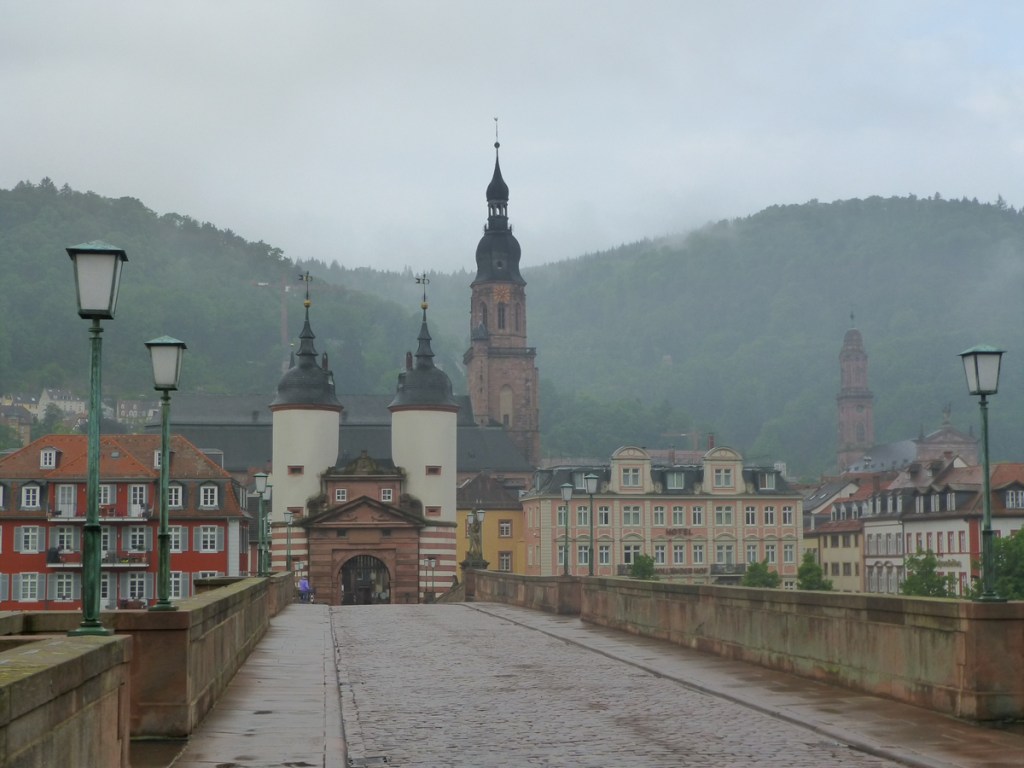
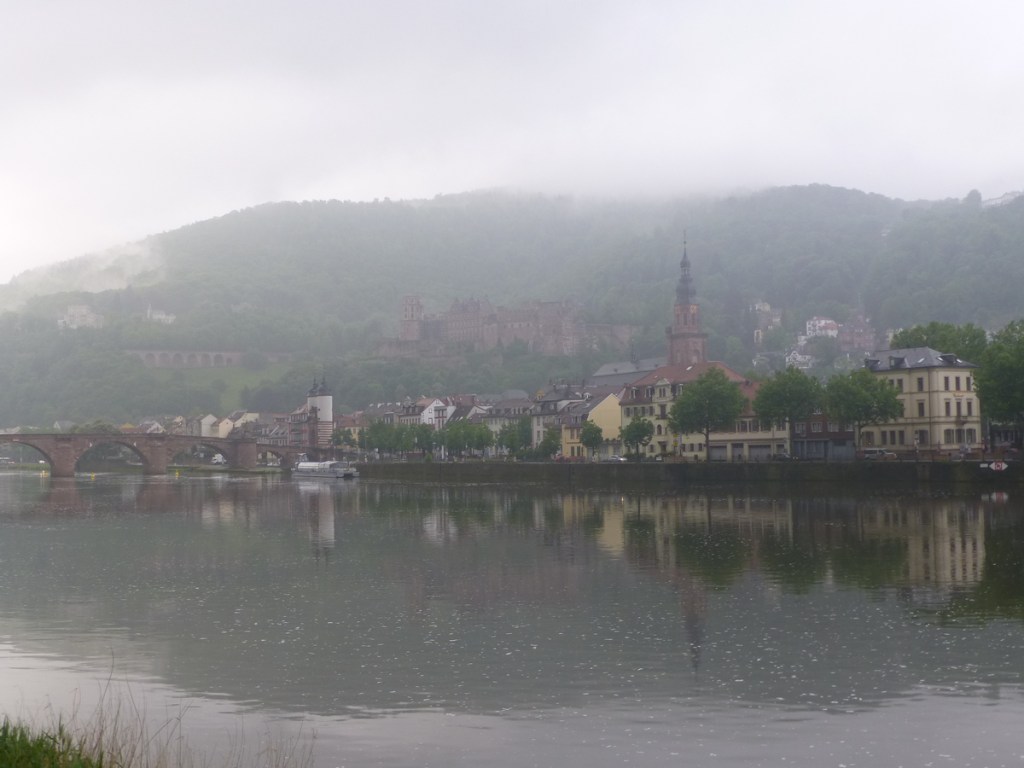
As a morning person, my day started at dawn, stalking the sunrise over the old bridge – one of the sights of the city. The day however came without a pink smile. The city was surrounded by clouds and a slight fog, as if it were really coming out of a fairy tale. I replaced the morning workout with a morning walk along the famous Philosophical Path, from where the best view of the whole city was revealed.
Heidelberg was a town of around 150,000 inhabitants, famous for its romantic castle and with Germany’s oldest university. For centuries it was the capital of the princes of the Kurpfalz, and from here they ruled the Holy Roman Empire. Through the city passed the deep river Neckar, which contributed to the charm of the city.
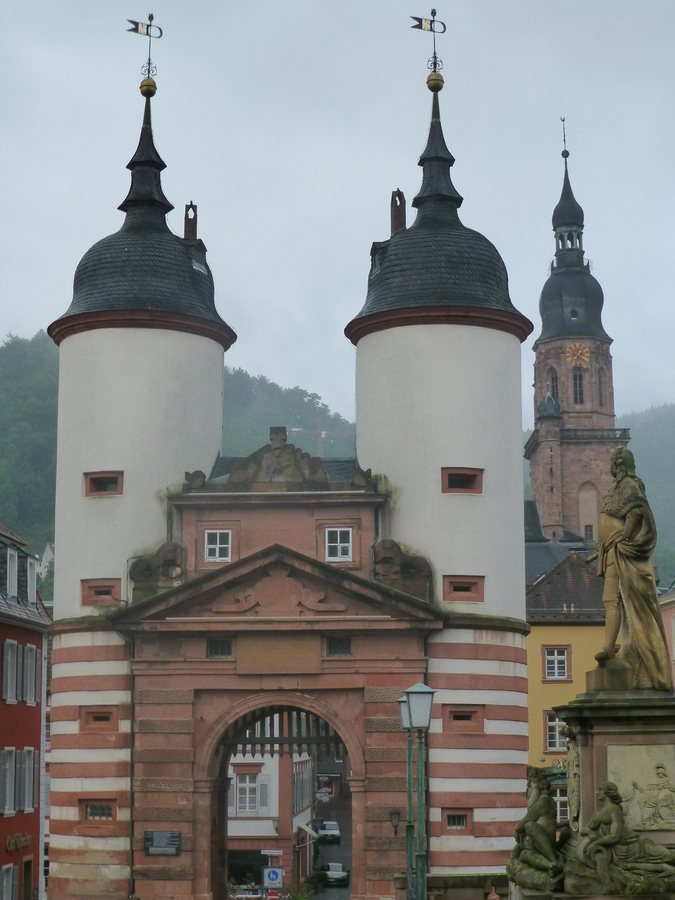
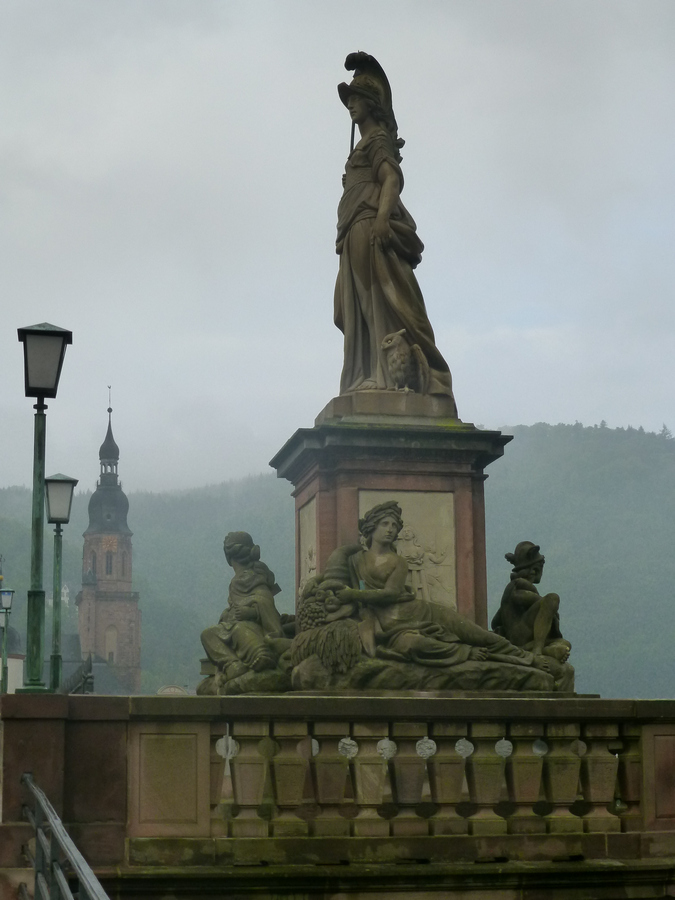
The walk started from Alte Brücke / Old Bridge, which in daylight was much more impressive. The bridge was also named Karl-Theodor-Brücke and was erected in 1788 connecting the old part of the city with the eastern district of Neuenheim. Due to floods, the bridge was built 9 times, and in 1788 it was made entirely of stone with 8 supports. From the old part of the town, the bridge had beautiful medieval towers, which served as both dwellings for the guards of the bridge and for a prison. They rose to a height of 28 meters and their white facade was excellent for photos. Beautiful statues were erected along the bridge itself, similar to the Karlovo Bridge in Prague. On one of the statues was represented Karl-Theodor himself, and on the other the goddess Minnevra, who was revered at the University of Heidelberg.
On the other side of the bridge, surrounded by stone walls, began the Philosophical Path. As I left the hotel outside, it rained and instead of the blue sky, I enjoyed my blue umbrella stretching over me. In the beginning, the philosophical path was narrow, steep and surrounded by high stone walls. There was no panorama at least in the first 20 meters. Then I scampered the many steps, passing by the beautifully landscaped terraces with magnificent views over the Old Bridge, the Castle and the old part of Heidelberg. It was called in the 19th century the Alley of the Philosophers or Philosophischesweg, as this was the favorite place of many artists who visited the city.
Despite the clouds that had descended low to the ground and covered the lovely panorama, Heidelberg seemed very inspiring to me. As I climbed, I enjoyed the bird singing, then I also saw a yellow lizard with black spots, known as a rainer. All the way long I was captured by the beautiful panorama of the city.


In the center of Heidelberg there was a beautiful castle, the residence of the Grand Dukes of Hesse. The counts also had the castle located on the hill above a town called Frankenstein. Author Mary Shelley used this exact name for her world-famous novel Frankenstein, which she wrote while traveling through the region and was inspired by the castle. However, we did not see it, and like our train, we passed it by, wishing next time to visit it.
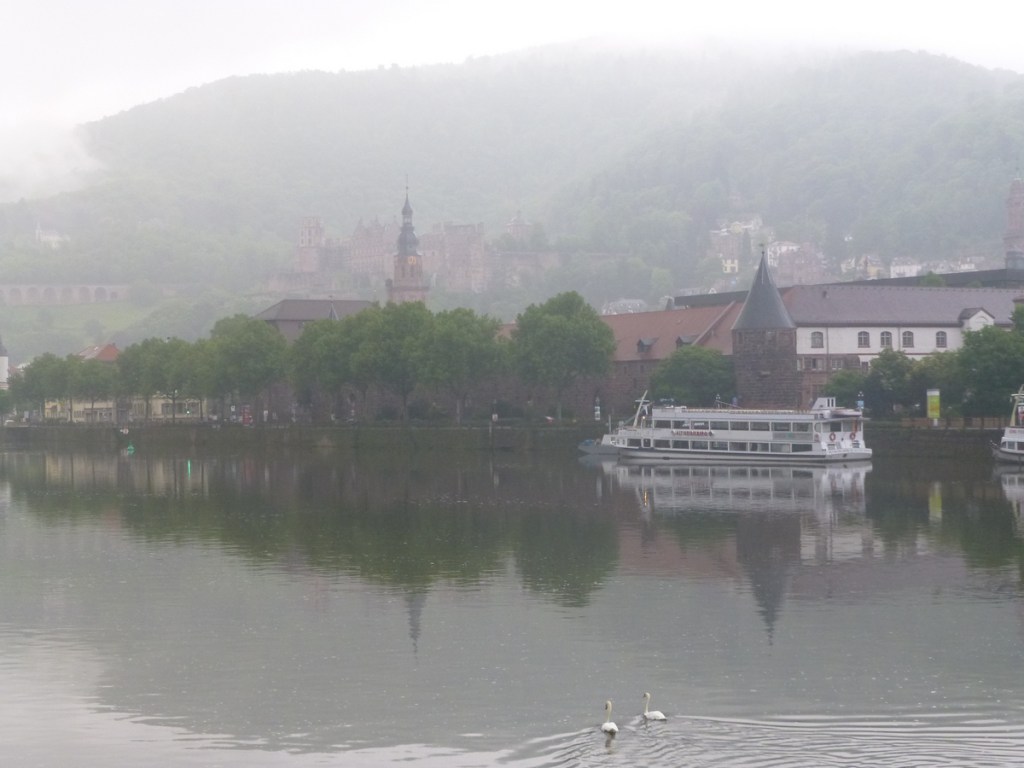
The photos from the panoramic promenade fell like the rain before. The clouds continued to give a fabulous mystery to the city, and the morning light made all the buildings reflect in the Neckar River. I continued my walk along the alley, taking pictures of the distinct picturesque panoramic terraces, some of them decorated with many flowers and even palm trees. There were beautiful gazebos and benches. They were wet from the rain, but the clouds had not hidden the beautiful view that was revealed from them. In some places there were also information boards with photos and maps of Heidelberg over the years. The birds continued to sing. The air was clean and fresh. I descended another stairs, passing beautiful residential buildings and expensive houses. I found myself on the promenade where my walk and photos continued. The beautiful houses looked around in the river looking at their beauty or greeting the swimming swans and herons.
I went back to the Old Bridge, where next to the beautiful arches there was a statue of a monkey holding a mirror. While I was taking pictures of the statue and all the images around it, a child with a school bag passed by. A little embarrassed he rubbed his fingers in the monkey’s mirror and fingers, then ran, probably for school. I took this as a positive sign of good luck, and I wish this kid to have a great day at school. Then I also rubbed my fingers against the monkey’s ones, and I touched its reflective mirror. I caressed for good luck a stone scroll of paper laid next to the monkey, as well as the two small mice nearby. Subsequently, I learned that the caressing of the mirror brought wealth, the caressing of the mice brought many children, and the touch of the monkey’s fingers – a return to Heidelberg. I blessed in my mind again this child who showed me that this monument was not put there just for photos.
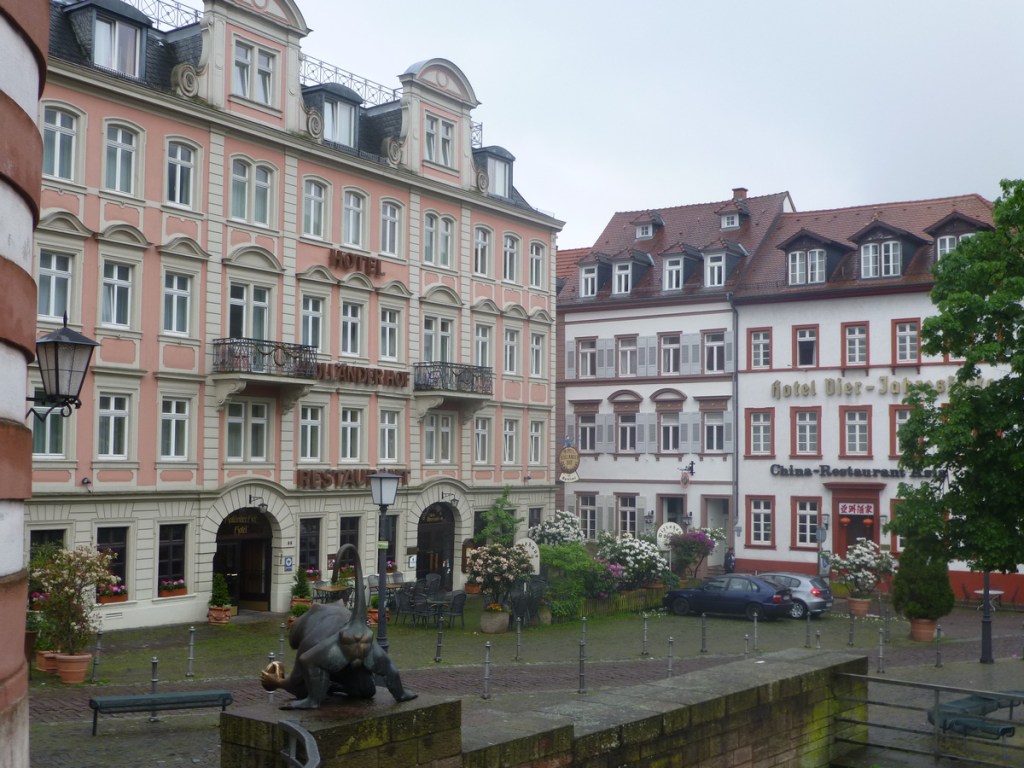

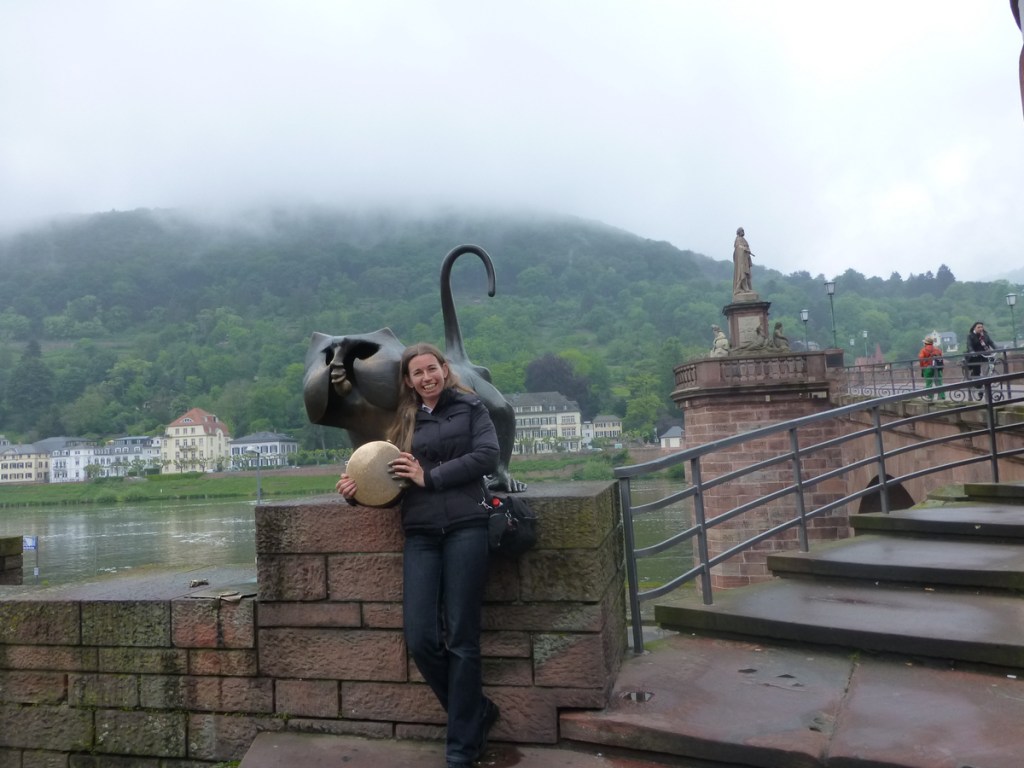
In fact, this monument with the monkey was erected in 1979, with a monkey in Heidelberg mentioned as early as the 15th century. Later, Martin Zeiller mentioned it in his poem in 1632, and it was this poem that was carved into the bronze roll of paper laid next to the monkey. With one hand the monkey held a mirror, and with the other its fingers were bent in the form of a sign symbolizing the chase of evil spirits. The idea was for the monkey to hold the mirror so that it could ridicule passers-by, as was written in Zeiller’s poem:
Was thustu mich hie angaffen?
Hastu nicht gesehen den alten Affen zu Heydelberg /
sich dich hin und her/
Da findest du wol meines gleichen mehr
What did you stare at me like that?
Haven’t you seen Heidelberg’s monkey?
Look around
Maybe you’ll see similar ones to me.
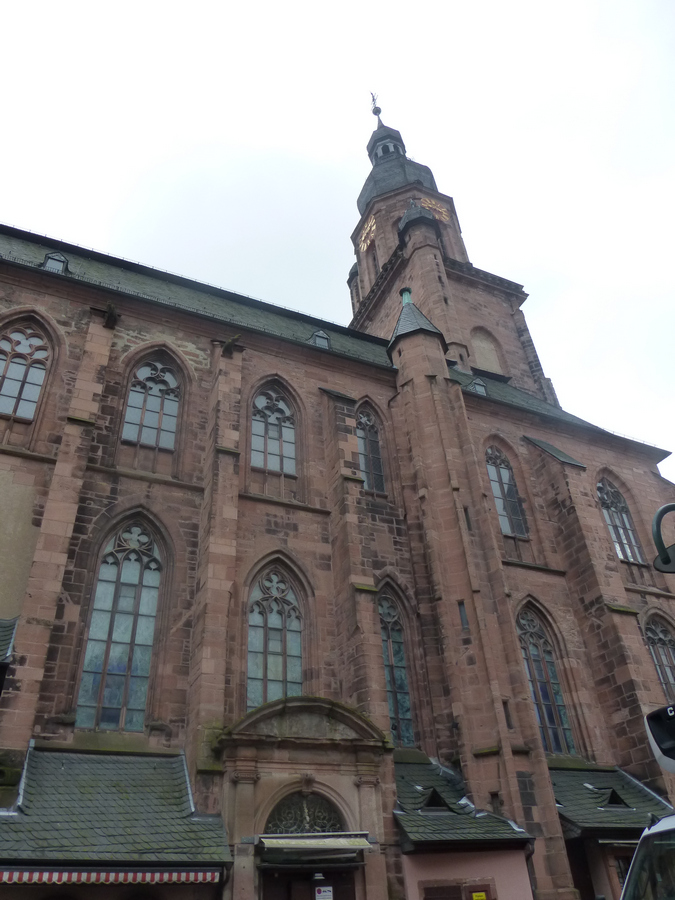
The morning fabulous walk with a panorama of the clouds of Heidelberg cheered me up and fascinated me. I joined my friends and we headed to the Cathedral of the Holy Spirit, located in the market square in the old part of Heidelberg. Before this 14th-century church, there were two other older basilicas on the site.
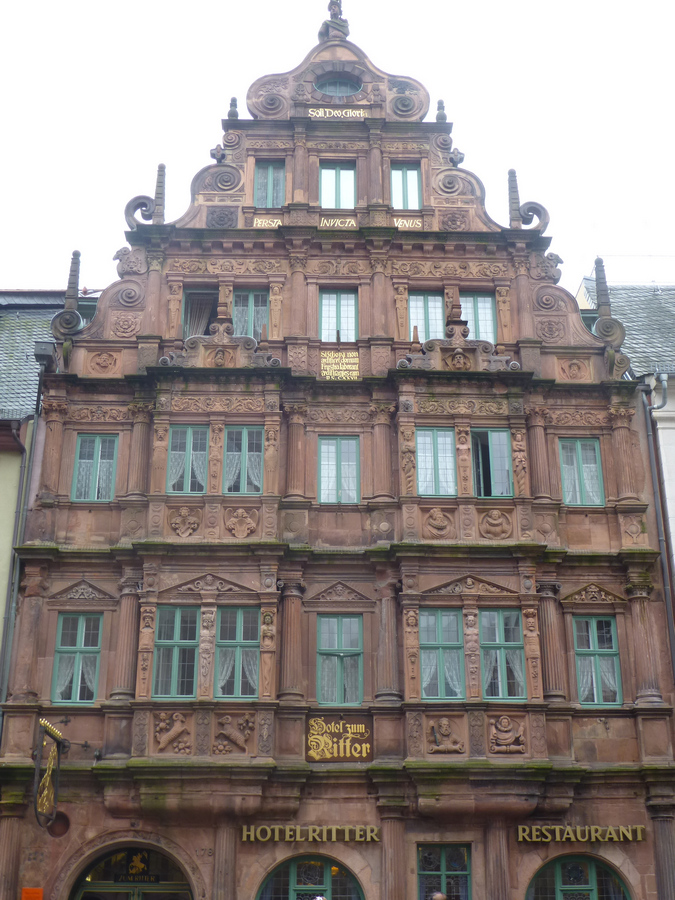
Just opposite the cathedral was the magnificent building of the knights, turned today into a luxury hotel, but fully preserving the exterior rich decoration. Built in 1592, this Renaissance building was undoubtedly one of the most beautiful in Heidelberg.
After the mandatory few photos of the building from different angles, we headed to the square of the City Hall. The town hall was built in 1701 on the site of a previous building, which was demolished. Today in the square in front of the town hall there was a statue of Hercules, who kept the tranquility of the square and the town.
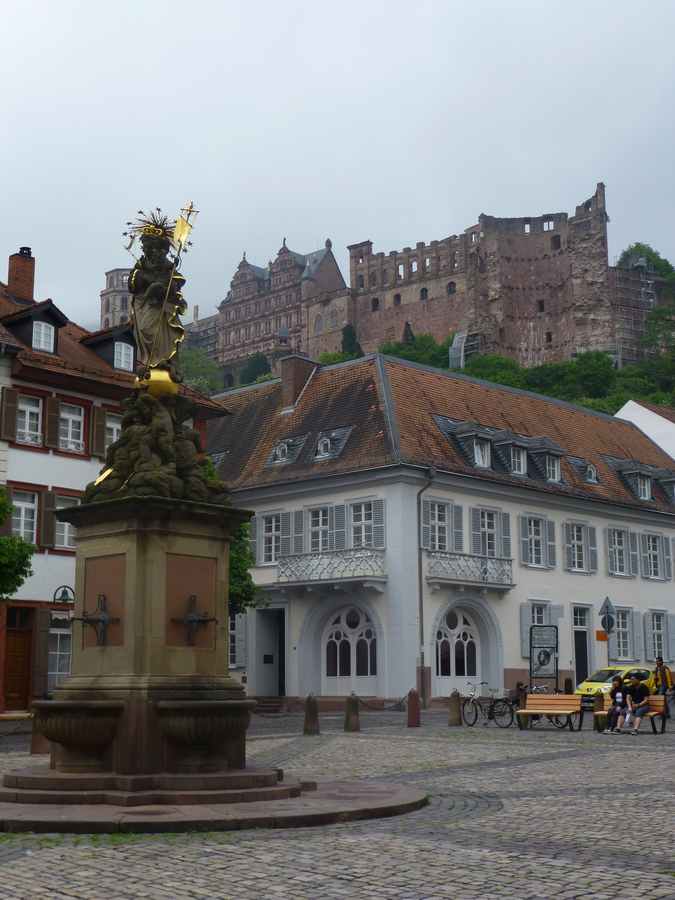
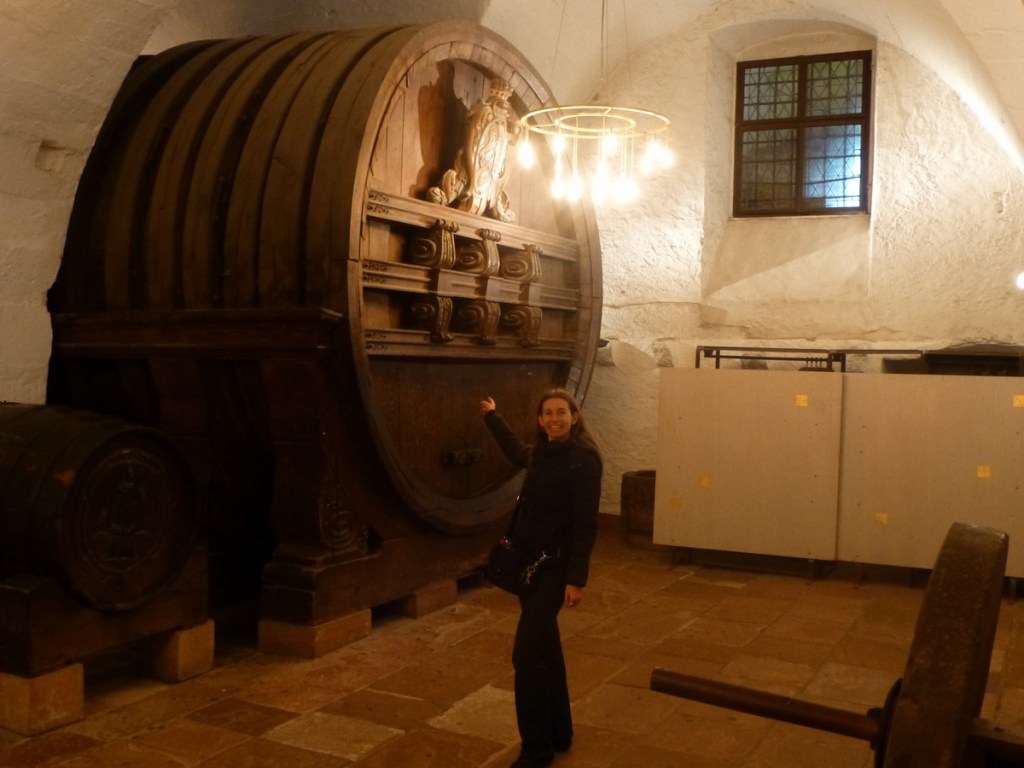
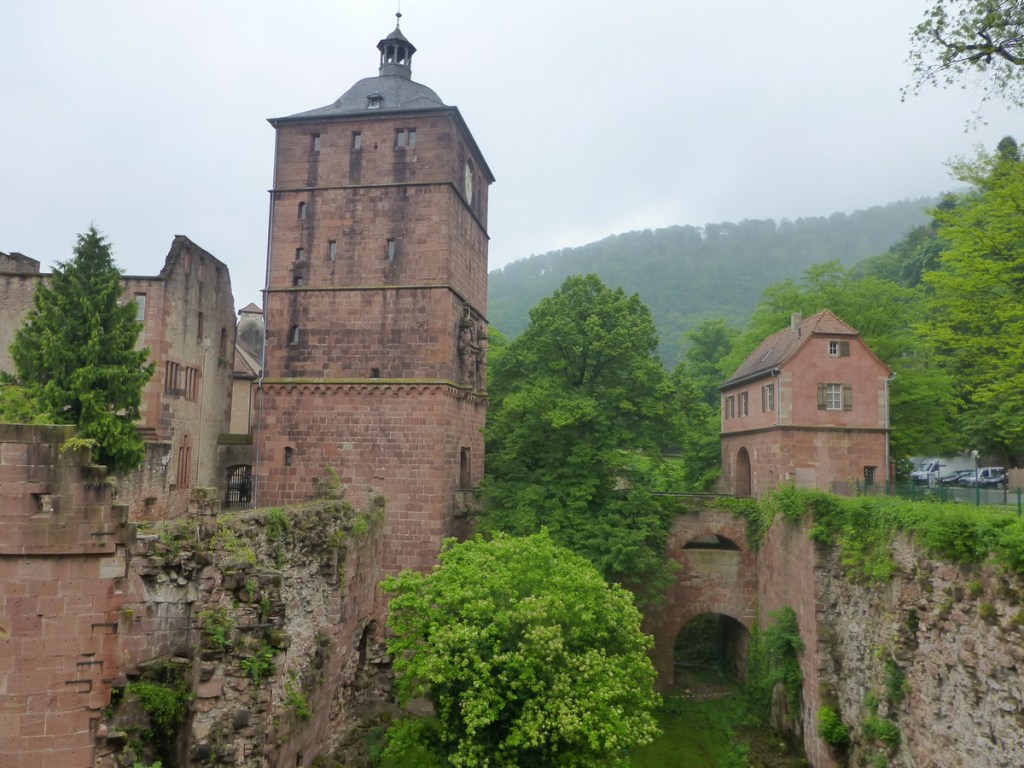
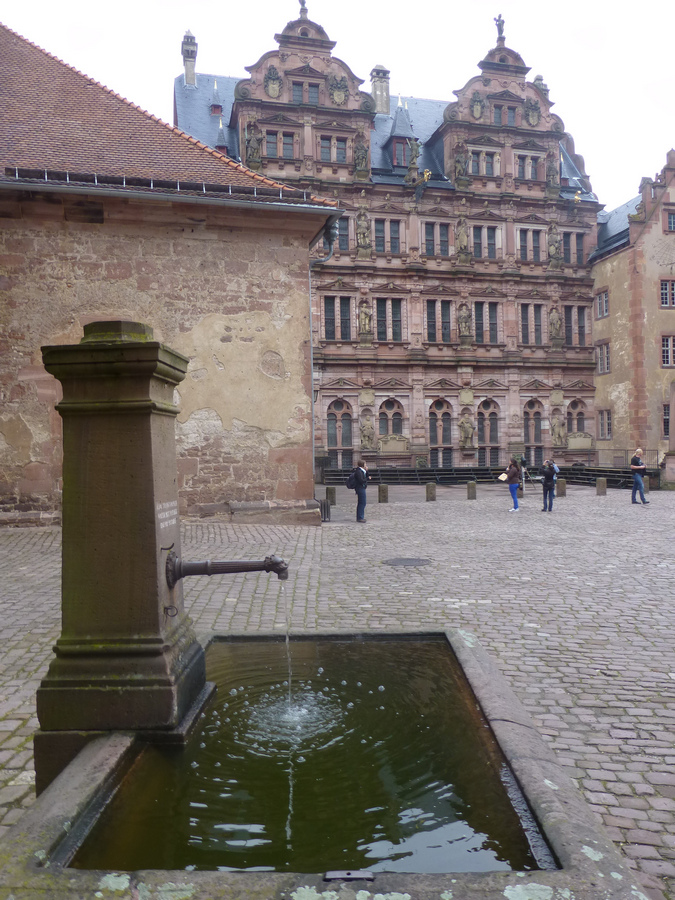
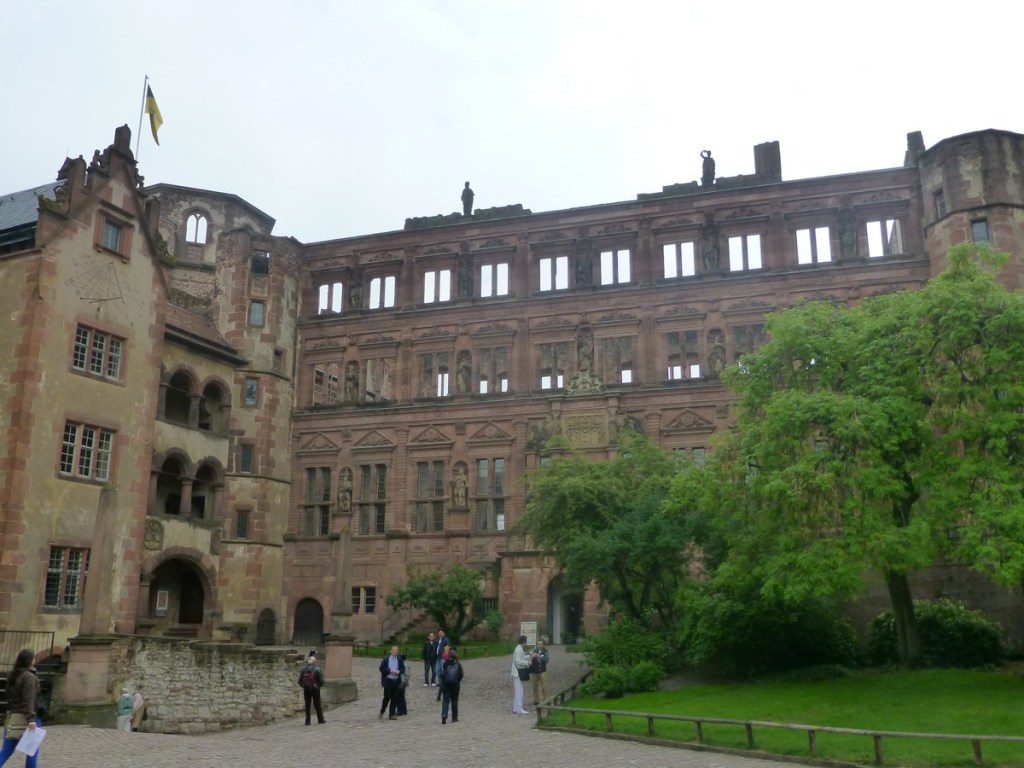
We continued along the City Hall building and went into another very beautiful square, which had a beautiful statue of Madonna with a child in her hands and a gilded wreath. The photos here were excellent, because besides the statue from the hill stood the beautiful castle to which we were headed. At the end of the square stood the funicular (cable car) that took us to the castle. With the funicular we could also reach Königstuhl, which was the highest hill in Heidelberg rising to 567.8 meters. In the afternoon, however, we had to catch the train to Nuremberg, so we were satisfied with just a walk on the famous castle of Heidelberg. The same was several times destroyed and rebuilt, and each ruler reconstructed it according to his own vision and according to his time. This gave the ruins a charm that the hundreds of photos could hardly capture. We walked around the various panoramic patios of the Gothic-Renaissance castle. The oldest buildings dated back to the 13th century. Much of the castle was in ruins, but entering the inner courtyard we were impressed by the other buildings. We entered the underground cellar where the largest barrel I had ever seen was exposed. According to legend, it collected the wines that the subjects paid as a tax. All kinds of wines were mixed in this barrel and hardly the combination was good, but at least the keeper of the barrel – the royal jester Perche no, appreciated it. His name was Perche no (from Italian Why not), because when offered a drink he always answered Perche no? However, once he drank a glass and died, people looked at what was in the glass – probably poison, but it turned out to be water – he was simply not used to this liquid. The barrel was really huge, according to the brochures it could hold 221,726 liters and was made of 130 oak trees. We had to climb a ladder to reach the top of it, from there was a panoramic platform, then we went down from another ladder, finding ourselves in front of a statue of Perche no.



I liked especially the medieval pharmacy in the castle, where everything was very well arranged in wooden or porcelain lockers.
Every summer over the castle there are numerous fireworks that create an amazing show called Schlossbeleuchtung (the lights of the castle). They are usually set on the first Saturday in June, the second Saturday in July and the first Saturday in September. The show begins with red lights that seem to recreate the fires to which the city was subjected in 1689, 1693 and 1764. Among the red playful lights begin fireworks, which in a period of 15 minutes shower the sky in all colors and shapes, bringing us back to the fairytale world of Heidelberg.

After the sightseeing the castle we went back with the funicular, to the city center, where we walked along the pedestrian street crowded with shops and people. It ran parallel to the Neckar River and was considered one of the longest pedestrian streets with its length of 1.6 km. There were many tourists of different nationalities, with young people prevailing – it is a university town after all.
The old and the new university were the next landmark that we covered with photos. The University of Heidelberg was the oldest one in Germany, opened in 1386, and today continues to work with twelve faculties. Petar Beron studied here, as well as many other Bulgarian students.


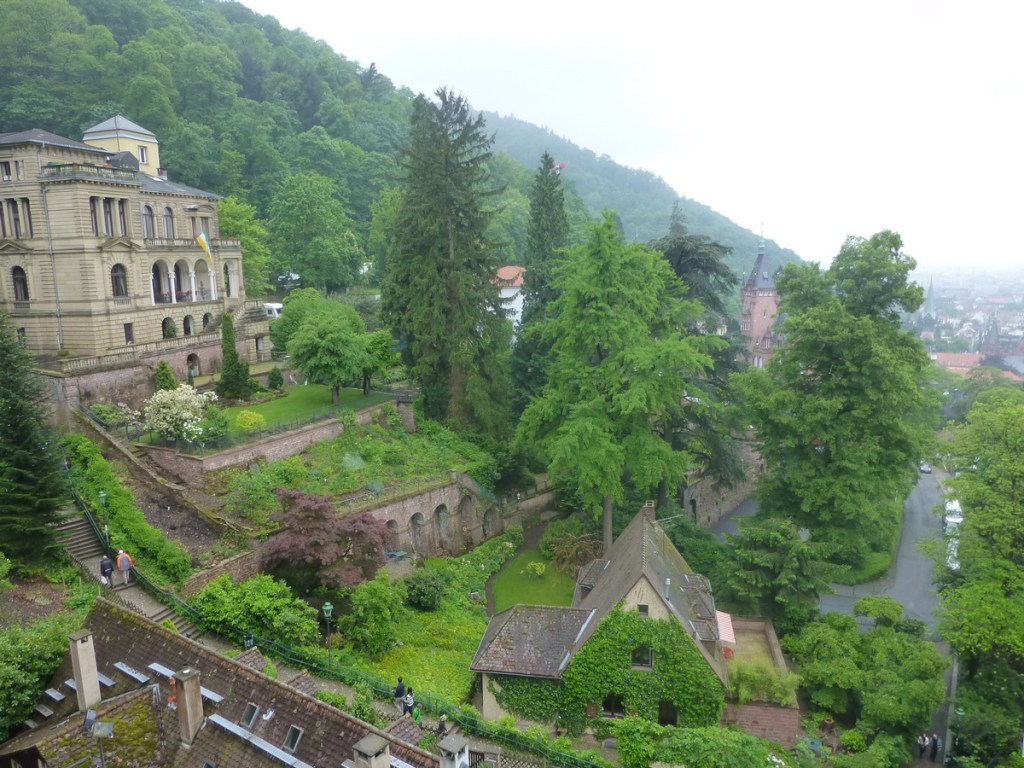
Time in Heidelberg seems to have stopped, preserving the beautiful medieval buildings. Our watches, however continued to work and remaining us that we have to go to the station and head to our next destination. Heidelberg is a real fairytale, we left the city speechless and with sincere admiration.

General information about Heidelberg:
Location: Heidelberg is located in southern Germany, in the Baden-Württemberg region, on the banks of the Neckar River.
Living area: 108.83 sq.km
Population: 149 633 people
Official language: German
Altitude: 114 m
Climate: continental climate
Time zone: UTC+1
Currency: euro (EUR)
Further information: http://www.heidelberg.de/english,Len/Home.html
Trip Tips for Heidelberg:
Best time to visit: all year round
Typical food and drinks: The Baden-Württemberg region is known as a “culinary paradise”. In Heidelberg you can try a great potato soup (Katoffelsuppe), asparagus dishes and baked ham (Schwarzwälder Schinken). The student town where Heidelberg has become also has many fast food restaurants (including many Chinese and Italian restaurants).
Places to visit: Old Town (Altstadt), Castle (Schloss), Ruprecht-Karls University (which is the oldest university in Germany) and others.
 TripTips