ZAGREB
(CROATIAN TRIP – PART 1)
author: Ana Boneva


The name Croatia sounded like colorful “kites” to me and I couldn’t wait to “fly” there and explore this country lying on the Adriatic coast. The name of the country had no Slavic origin, it turned out to be foreign, and the theory that the word HARAHVAIT was of Iranian origin had the largest number of supporters. However, I liked the theory more that the word comes from χωρα (in Greek meaning earth, and in Slavic – people) or it was the land of people.

The lands of today’s Croatia have been inhabited since the Neolithic era. The local population was called Illyrian, and in the 2nd century BC. The Romans captured them. In the 6th century, the Slavs came to these places, who accepted the rule of Byzantium as the successor of the Roman Empire. In the 9th century, the Croatian rulers managed to expel the invasion of the Hungarians and increased their territory to the Adriatic Sea. Prince Tomislav was especially glorified, who in 901 defeated the Hungarians and forced them to withdraw to the other side of the Sava River. Slavic culture was in its heyday. However, the last Croatian ruler died without an heir in 1091, when the Hungarians laid claim to the crown and the Hungarian king Coloman took power. The Hungarian monarchs ruled Croatia until 1526, until the lands were conquered by the Ottomans.
In the 19th century, patriotic Croats began to form a movement for political and cultural autonomy and secession from the Habsburgs, and they managed to achieve this only after the end of the First World War, when in October 1918 Croatia declared its independence and entered into a political alliance with its neighbors Serbia and Slovenia. Serbia and Slovenia received the name Yugoslavia. After World War II, Yugoslavia accepted the communist regime with Marschal Josip Tito as its main president. After his death in 1980, there were turmoil in the country and in 1991 Croatia managed to declare its independence again. In 2004, Croatia became part of the European Union, and in 2009 a member of NATO.
The landscape of this relatively small country (half of Bulgaria) occupying an area of 56,542 sq.km. The population was also half 4,535,000. Croatia, however, was proud of its natural diversity. 40% of the country was mountainous, with peaks reaching 2000 m in height – covered with forests and lush pastures. The country also covered the Pannonian Plain, also known as the Middle Danube Plain, which covered the lands between the Drava, Sava and Danube rivers. The most famous part of Croatia, however, remained the Adriatic coast with a coastline of 600 km, and including the coasts of all islands, the beach strip of Croatia amounted to 4800 km! Croatia was quite a long country and this made each trip longer. To get to it, we also had a long way to go by car.
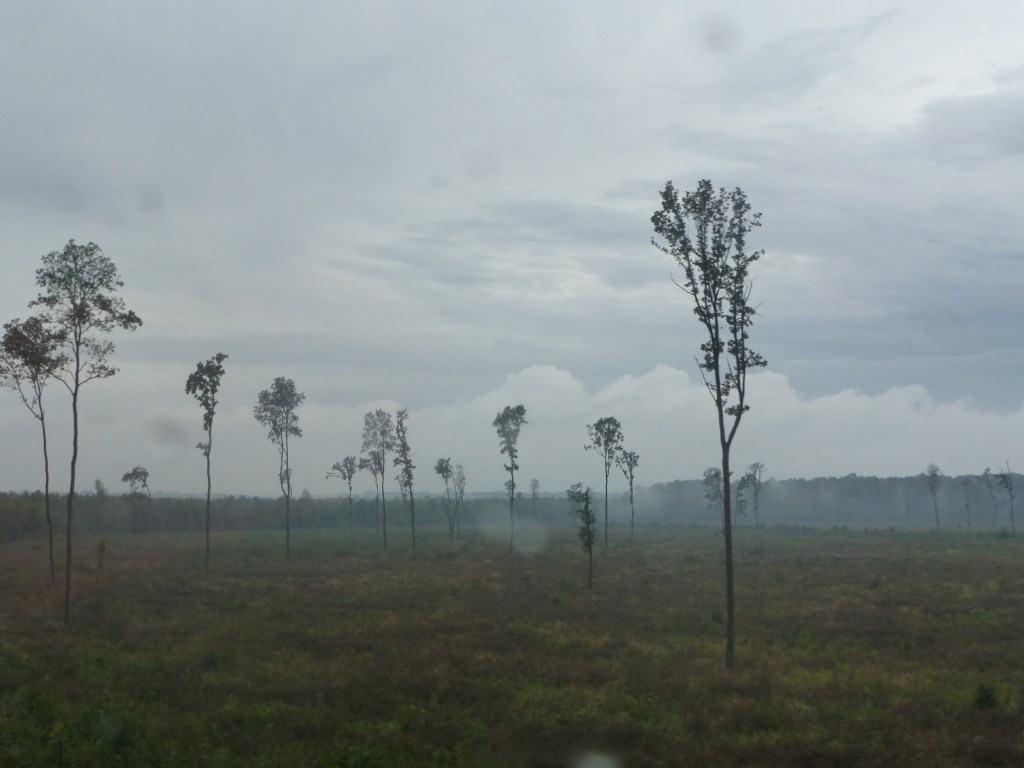
In the early afternoon we did reach the Serbian-Croatian border. It was raining outside, but there were no puddles on the perfectly paved Croatian roads like in Bulgaria. The road was surrounded on both sides by greenery, and from time to time we passed by a ghostly (foggy) forest.
At 130 km from Zagreb, the weather was so clear that we could already see the light blue color of the sky. In some places, however, we saw several flooded fields and we felt sad for the people who had planted here and were waiting for a crop drowned by the rains.

In the late afternoon we arrived in Zagreb, the city was slightly sunny, slightly cloudy – perfect time to explore. We entered the capital city from the western third exit of the highway, heading to the Cathedral Square.
Zagreb was a peaceful and beautiful city. It was divided into two parts: Upper and Lower Town. Gornji Grad (Upper town) housed some of the most important institutions such as the presidency, parliament and various ministries. They were housed in beautiful buildings that were restored, renovated or rebuilt after the strong earthquake in 1880. Some of the ancient palaces were turned into museums, such as the Croatian History Museum, which housed the magnificent Vojković Oršić Palace.
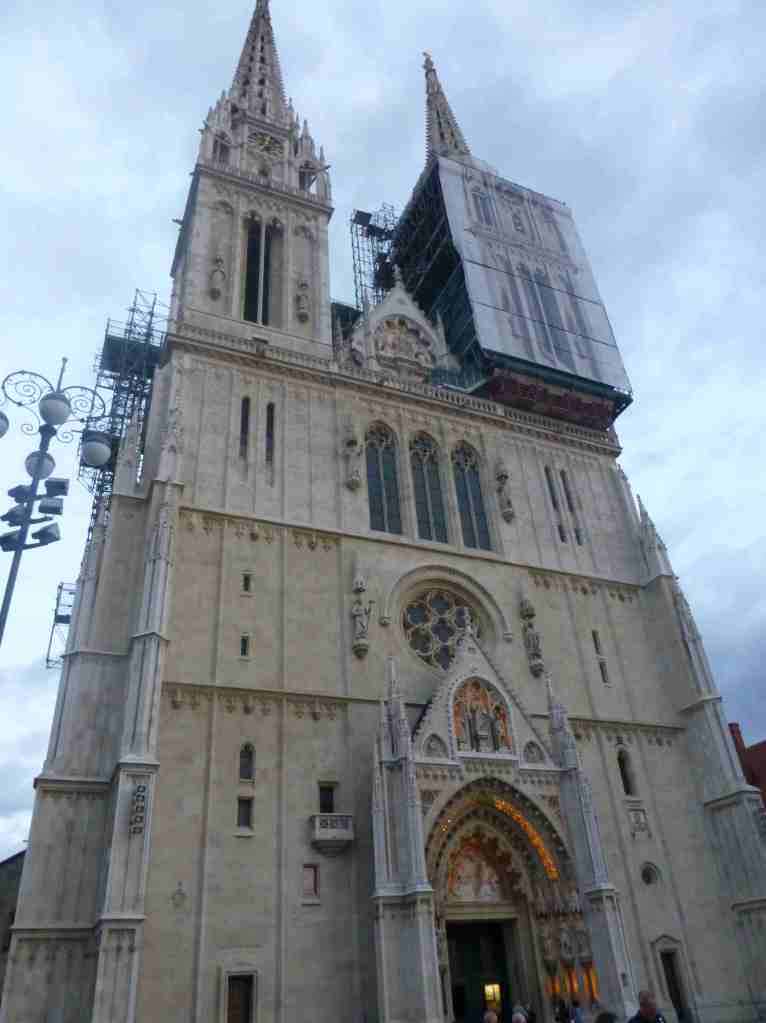
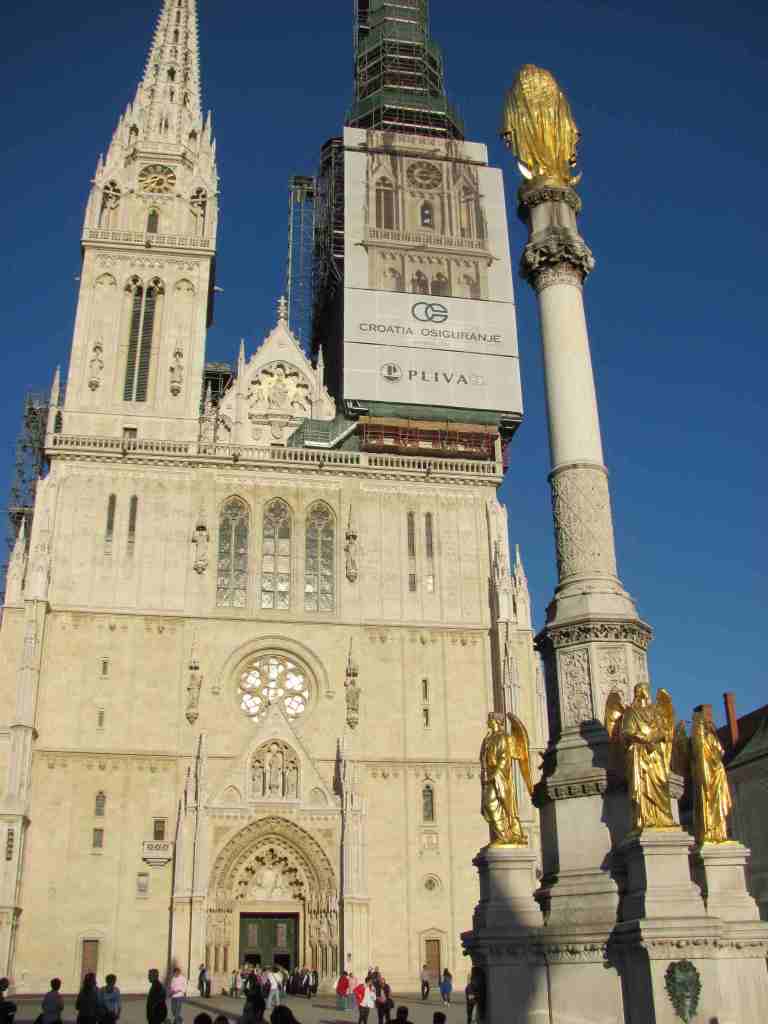
Even more impressive was the Cathedral of the Virgin Mary, which I saw for the first time illuminated at night – it shone as if it were made of gold. It dates back to the 11th century, but its façade was completely rebuilt in 1880 after the earthquake. On both sides there were towers rising to a height of 105 m. Especially beautiful photos of the cathedral were taken from the fountain of the Virgin with four angels erected in 1850 by a Venetian sculptor.
The icon of Virgin Mary, however, was not here. It was kept a little farther away, placed at the stone gates of the former city walls. According to legends, a painting of the Virgin Mary, which was hung on the door, miraculously survived the severe fire of 1731.
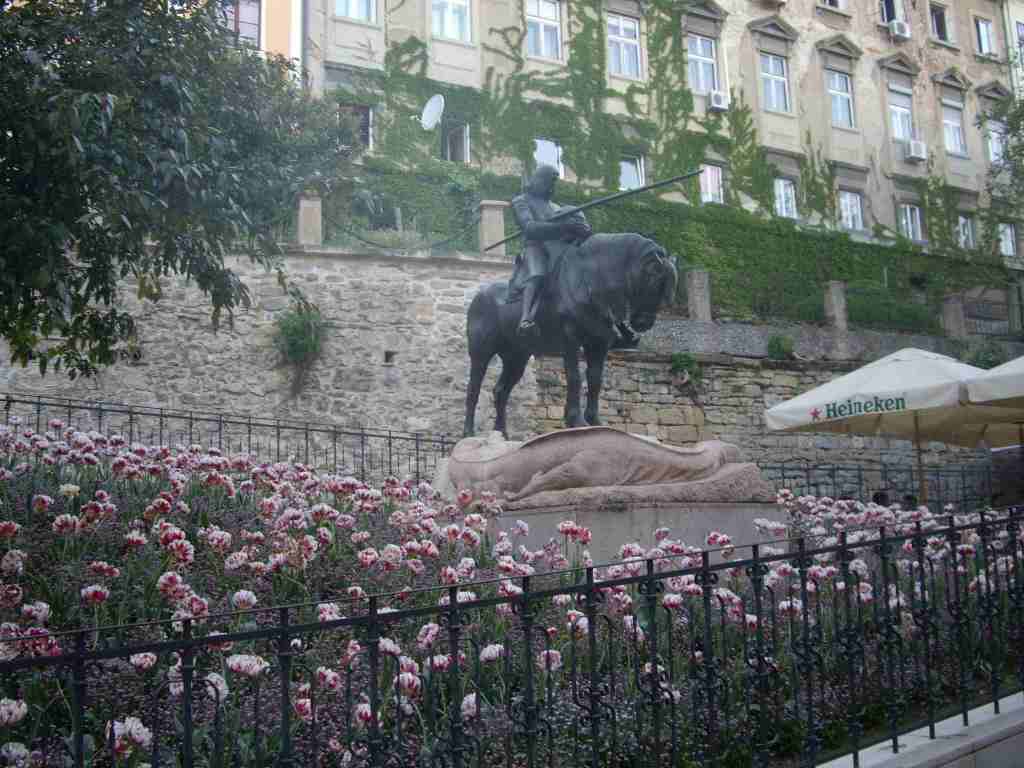
We stopped there too, first lighting candles in the cathedral and then heading to the opposite side of the street, passing by the market square. After that there was a street where there were literally only restaurants, but we left the rich selection of dinners and places to eat for later and headed up the stairs with the monument with the horse and from there to the stone gate, where we stopped for a while in front of the magical icon of the Virgin Mary. On the other side of the stone door was the equally famous Alighieri Pharmacy (Ljekarna Aligheri), which dates back to 1350 and was owned by Nicolo Alighieri, great-grandson of the Italian poet Dante Alighieri.


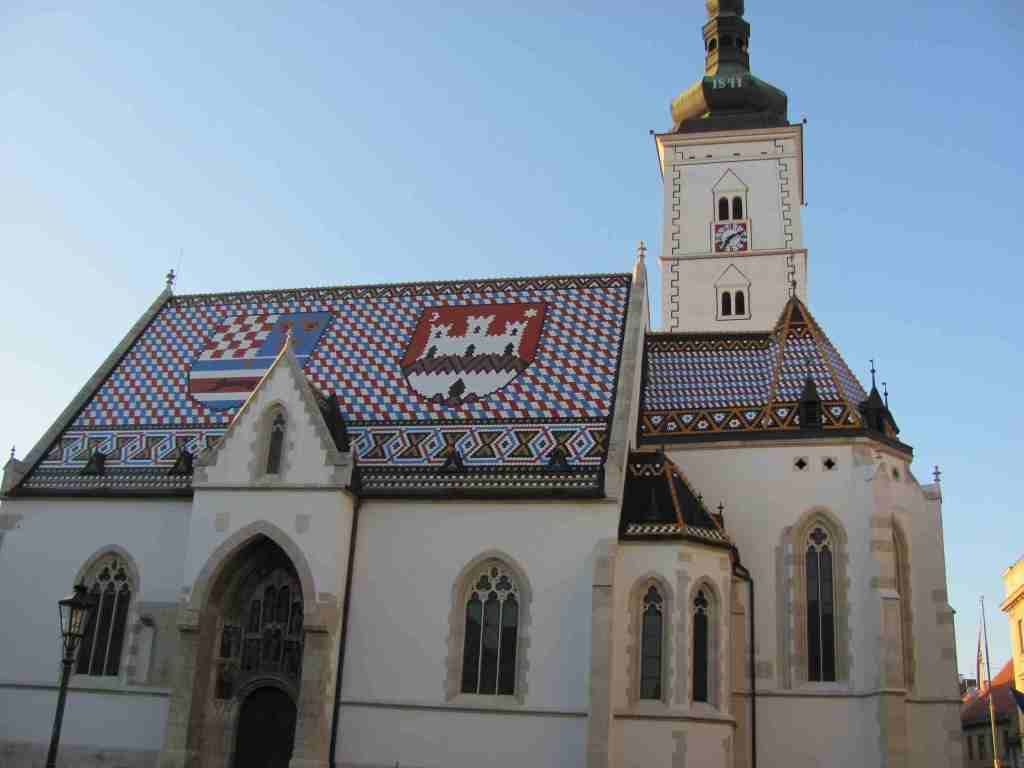
We headed to the old baroque church of St. Mark, first mentioned in 1256, when King Béla IV organized a fair and exhibition in the square in front of the church. It looked small covered with a huge roof, on which stood out the emblems of Croatia and Zagreb, beautifully painted with colorful tiles. There were people dressed in old-fashioned costumes on the square. We talked to one of them, who introduced herself as Marija Jurić Zagorka, the first female journalist in Croatia who lived from 1873 to 1957. In order to better understand the local people, it was good to go back in time and get acquainted with their heroes and respected personalities. That is why the people of Zagreb had created this unique atmosphere in the Upper Town, where among the ancient buildings, one could meet famous people from the Croatian past and imperceptibly be transported to past times, becoming part of the fairy tale. Each of them had something to tell us.


We passed by the baroque church of St. Catherine, built by the Jesuits and the church of St. St. Cyril and Methodius with the beautiful iconostasis. We stopped in front of the Lotršćak Tower or the Tower of the Ancestors dating back to the 13th century, which was one of the oldest buildings from the fortress wall of Zagreb. Every day from this tower a signal was given to close the city gates, and this tradition from the 12th century was preserved and every day at 12:00 noon, a cannon fired (instead of a cannonball) and thus paid tribute to history and the expulsion of the Turks. According to one of the legends, it was at noon that a cannonball was launched from this tower, which jumped over the Sava River and broke the silver tray with chicken, which the Turks were going to serve to the pasha. Fearing from more shoots, the Ottomans left their camp and abandoned the siege of the city. Until the middle of the 19th century, the inhabitants of Zagreb compared their clocks with this clock tower. Today it housed an art gallery and a souvenir shop. According to the reference books, it was worth climbing the long spiral staircase leading to the top of the tower, from where a wonderful view of the city was revealed.

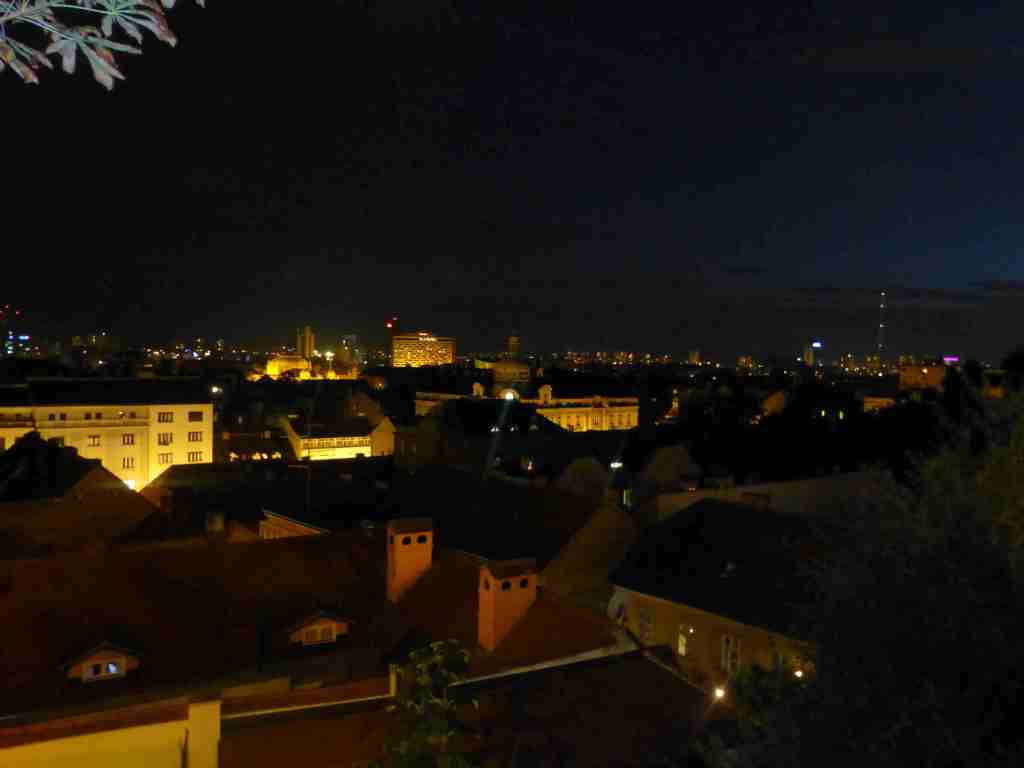



We were content with the view from its foot, where an interesting funicular stopped – a panoramic railway that connected the lower with the upper town, and took people to the top in just 64 seconds.
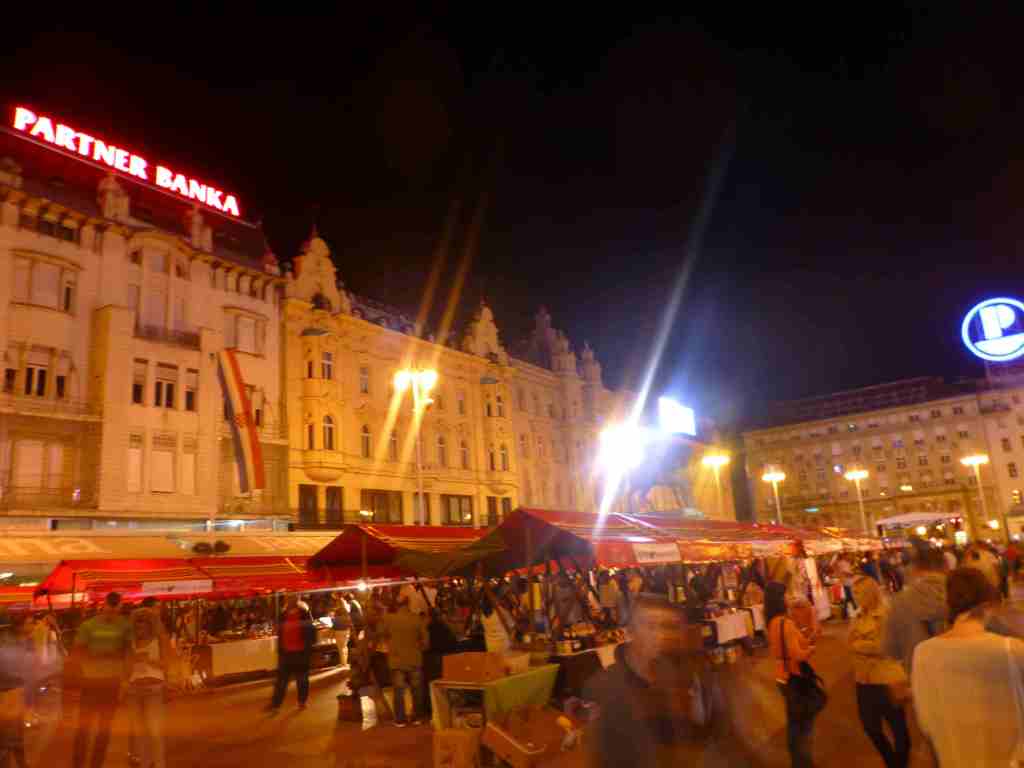
We reached the central square of Ban Josip Jelačać, which this time was crowded with stalls selling local food products, and at the end of the square there was a separate stage where folk songs were sung and people danced. The atmosphere and mood here were very pleasant.
A monument was erected on the square to ban Josip Jelačać (or Count Josip Jelačać) riding his horse, which was first erected in 1866 and then removed in 1947. In 1990 it was placed again, this time pointing south instead of north to the Hungarians, as it stood in the 19th century. The square itself, however, dates back to the time of the creation of the city, and according to one legend, Zagreb got its name on this square, when a soldier called a girl who was standing next to a nearby well and shouted to her: “Mandušo, scoop water for me” and since then the well has been called Mandušovac, and the city of Zagreb. Today, the Manduševac fountain was located in the eastern part of the square, a few steps from the real spring, with tourists and residents of Zagreb throwing coins into it for good luck. That evening the fountain was surrounded by people who watched the folk dances on the glamorous stage. This square was one of the busiest places in the Croatian capital, both day and night, and that day was a typical example of this.
On the way to the parking lot, we also took pictures of the small model of the city, which was probably carved in relief for blind people, but those who saw it also admired and enjoyed the view of the city as if from a bird’s eye view.
It was only after the walk that we headed to the hotel where we had booked only one night, because it was not our first visit to the Croatian capital, but it was another wonderful walk. Zagreb again managed to impress us with its beauty and tranquility, and Croatia was really colorful and long as a kite, and the next few days confirmed this, by overwhelming us with many cheerful memories.

GENERAL INFORMATION ABOUT ZAGREB:
Location: Zagreb is located in northwestern Croatia, on the slopes of Mount Medvenica, on the banks of the Sava River
Area: 641 sq.km
Population: 779,145 people
Official language: Croatian
Altitude: 120 m
Climate: temperate continental climate
Time zone: UTC+1
Currency: Croatian Kuna (HRK)
Additional Information: http://www.zagreb.com/
TRIP TIPS FOR ZAGREB
Best time to visit: all year round
Typical foods and drinks: Zagrebacki strukli (cheese pie), sir i vrhnje (resembling katuk), kremšnite (cream pita).
Places to visit: Cathedral, Ban Jelačić Square, Mimara Museum, Zagreb Art Pavilion, Gornji grad and Donji grad (Upper and Lower Town), etc.
 TripTips