SUKHOTHAI
THAI JOURNEY – PART 4


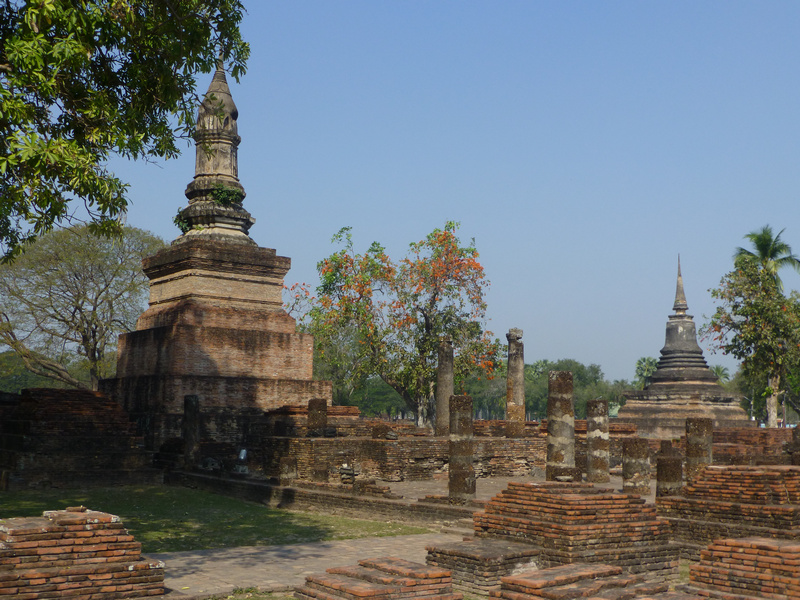


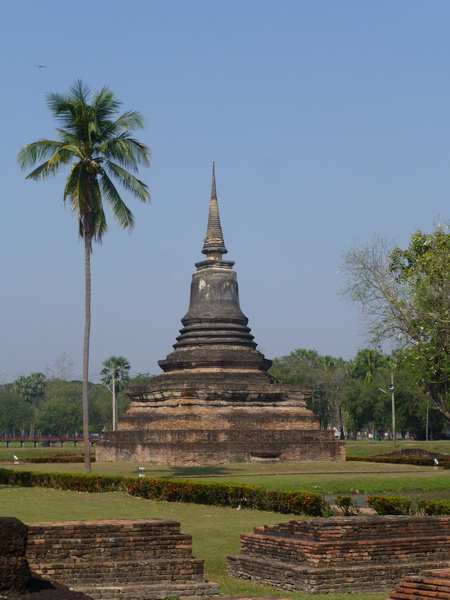
Sukhothai means “Dawn of Happiness” in Thai and in search of happiness we headed to this ancient Thai capital. Sukhhothai is to Thailand what Angkor is to Cambodia and Giza is to Egypt. It was the center of Thai’s first independent kingdom and the birthplace of the Thai nation. Here the Thais acquired their own script, own language, own culture and tradition. This city was not destroyed by war but was simply abandoned when Ayutthaya became the new capital of Thailand. Happiness was indeed preserved here, and with great enthusiasm we headed there, leaving at 07:00 in the morning from the city of Pitsanulok to the west in the direction of Myanmar.
Along the way, the tour guide told us more about the customs of Buddhism that is the largest and official religion in Thailand, practiced by roughly 95% of the population. For every family that has a boy, even today, it is a great honor for the child to study in a monastery for a while. In the past, there were no universities and schools, and monasteries were the only learning centers. Today, although there are educational instances, 70% of young people prefer to go to a monastery for a few months or a year, thus paying respect to their parents and respecting the tradition.
Our guide had spent 5 months in a strict monastery, learning that in Thailand some temples were very strict, others not so strict. The two types of temples could be easily identified. When monks talk to people and tourists, it means that the temple is not strict; when the monks are temperate, it means that it is strict. When the monks have separate beds, this is also not a strict temple. In strict temples, monks were not allowed to sleep on mattresses thicker than 2.5 cm. They were not allowed to watch TV or use mobile phones, or even smoke. Strict temples were usually located in the mountains, the monks wore dark robes and had no outside contact – neither radio nor newspapers. In strict temples, monks ate everything mixed – rice, meat, soup, vegetables, desserts – everything was mixed and so consumed, and only once a day. While in other temples the monks ate whenever they wanted.
We also learned more about the robes of the monks, which consisted of three things – the first thing is a robe-cloak called “pizarro”. Monks were not allowed to wear pants or any clothes under the robe. The second thing is a tank top from which the left shoulder is exposed. With these two parts, the monks could walk around and stay in the monastery. However, when they had to meet outsiders or go outside the monastery, they wrapped themselves with a 3-meter cloth (2 meters wide, without buttons), which wound around one shoulder and one side of a person. If it wasn’t properly wound, it slipped. Monks were allowed to carry a yellow-colored sewing needle with them to use if needed. If the clothes are ripped, the monk had to sew it himself. They were entitled to razor blades and also can have an umbrella to protect them from the sun and rain. Monks could also have a water filter, as they were only allowed to drink free-flowing water. The monk had no right to cook for himself. Every morning he went out and collected food that people gave him.
The ceremony of entering the temple was also very solemn. The whole family was gathered, and such celebrations were organized three times in a person’s life – first when entering a monastery, then at a wedding, and finally at his funeral. On these events, it is customary for guests to leave money, with everyone drinking Thai gasoline (the so-called local whiskey).
Many people enrolled in the monasteries for three months, but after the 10th day they give up and leave. According to the tour guide, however, even if they stay in the monastery for 20 minutes, it is good to observe the ceremony – it brings pride to the whole family. There is no fixed period in which a person can be a monk – it can be 10 days, 3 months or even a lifetime – one has to choose for himself. There are Buddhist women, but not in Thailand. There are two types of nuns here – one with shaved heads, and the other with hair. Monks must observe various laws, such as not killing any animals, not committing sins, etc.
The monks had no right to ask people for anything. Even when his mother came to the temple to see him, he could not tell her, “Mom, bring me some soap,” he had to tell her so much that she would think of it herself and bring him what he needed. For this purpose, he began to tell her how he got up in the morning, but he couldn’t wash himself well and his clothes smelled… And when his mother said to him, “Then I’ll get you some soap,” he thanked her heartily, and in general one learned good things in the monastery.
The tour guide’s story was presented with many dialogues and intonations in the voice, which made it fascinating and interesting. An hour after we left, we went through tobacco plantations, and in addition to good tobacco, Thailand was famous for one of the most expensive coffees in the world, which came… of the elephants. In this case, the elephants played the role of a “processing plant” – the coffee beans passed through their digestive system, there they were processed and then through the excretory system went outside… They were carefully collected, washed and continued the usual processing in the capital Bangkok. The same was done also with cats.
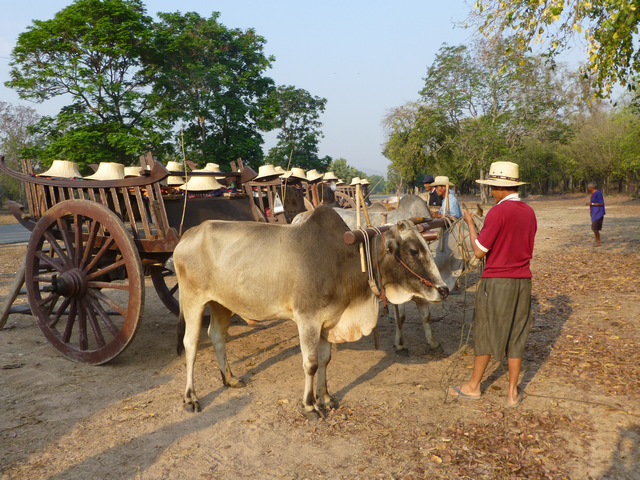


We approached Sukhothai, and before we reached the old capital city, the guide had prepared a pleasant surprise for us. In the middle of the road, the bus stopped and we had to continue with another vehicle, which turned out to be wooden carts pulled by Thai bulls. We were also given a straw hat to use during the trip, sitting 4-6 people in a cart.
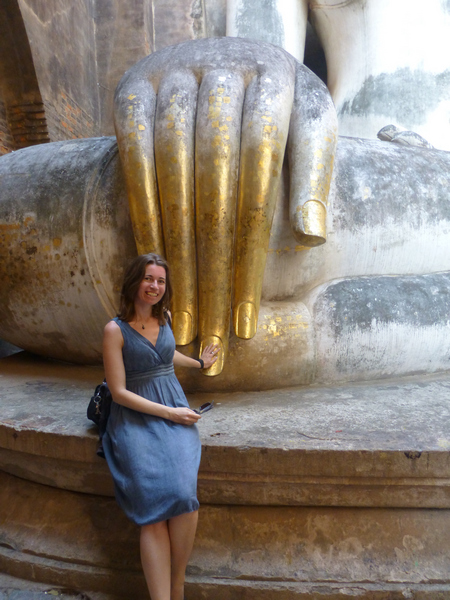
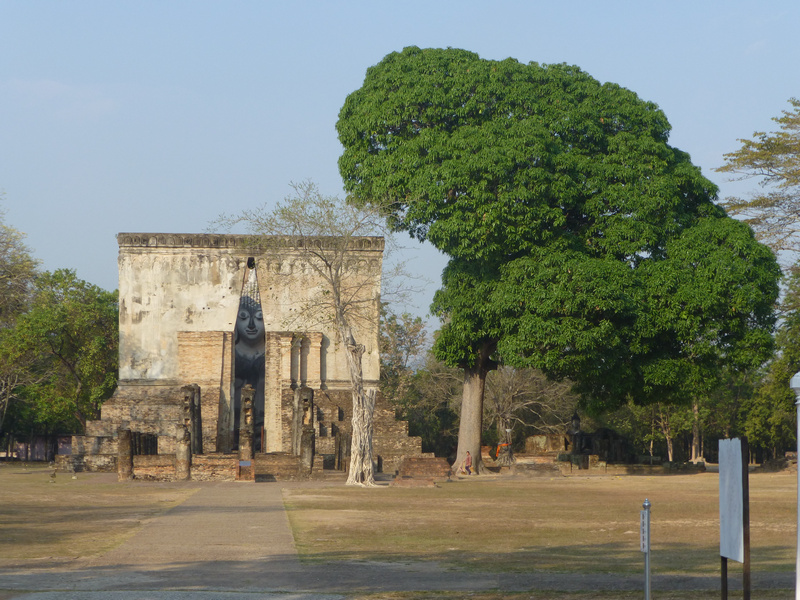
The experience was unique. The cart was shaking hard, the Thai hummed in front and occasionally pulled the reins of the cattle, which seemed to me to have very thin legs. Strongly excited we reached the temple Wat Si Chum (translated Temple of the Bodhi Tree), where impressive were not only the tall “bodhi” trees with orange flowers, but also the Buddha statue almost as high as them. The huge Buddha (15 meters high and 11 meters wide) was sitting in a pose Lotus, and his expression was known as Phra Acana or “the one who is not afraid”. The fingers of his right hand were lowered down to the goddess Earth, having a gold plating. According to legend, when the Burmese army attacked Sukhothai came across this statue and the soldiers fled as soon as they saw it. In contrast, instead of fleeing, tourists are increasingly coming here admiring the ancient ruins of this 13th-century temple.




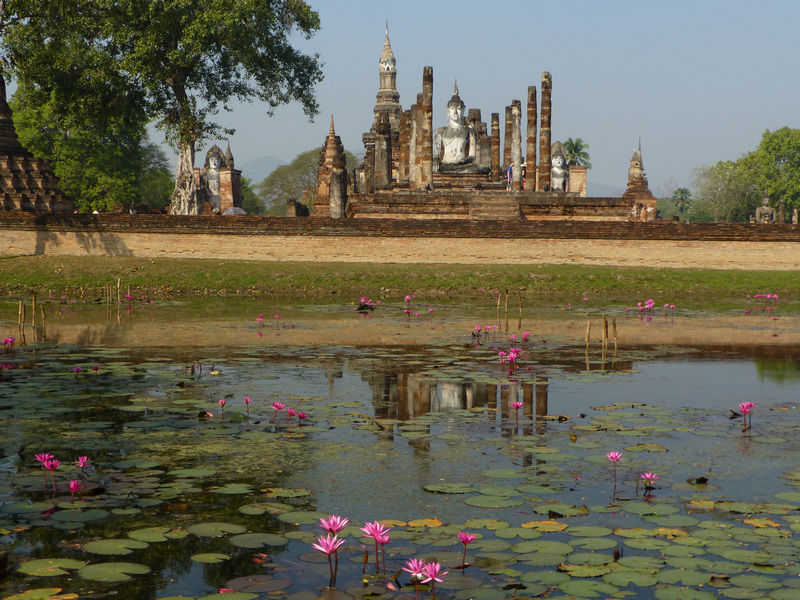


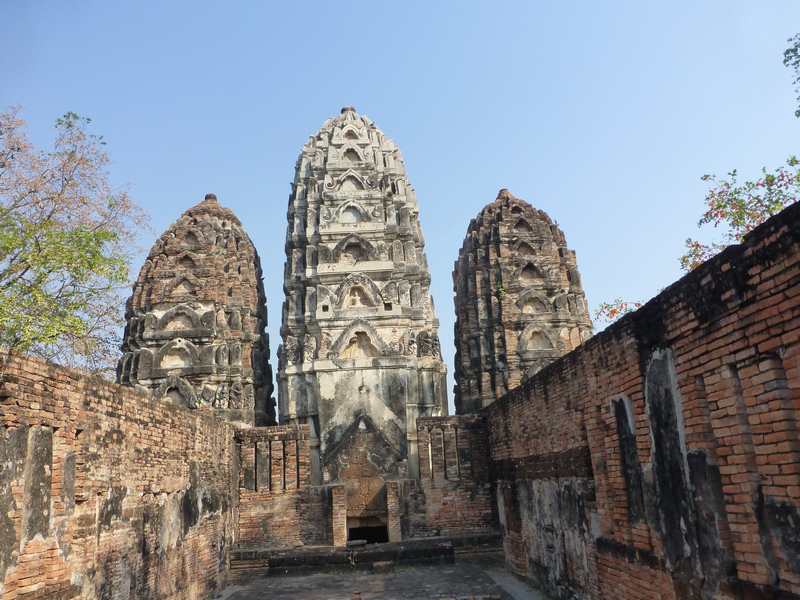


After the visit, we got back on the bus that took us to the main entrance of the historic park and the former glamorous capital Sukhothai. The guide had prepared a new surprise for us – bikes for rent. Our whole group – young or retired, confidently got on and rode the bikes. I hadn’t ridden a bike in 12 years, but the saying that riding a bike can not be forgotten, turned out to be surprisingly true. I had no problem with the bike, I just wasn’t confident enough to ride and take pictures at the same time. I also had to concentrate on the fact of driving in the left lane, as we were still in Thailand and although they claim that they were never an English colony they had adopted their driving rules. And so, among the other cyclists and a well-defined bike lane, my gaze was curiously diverted to the sides where there were separate lotus lakes, in which ancient ruins were located. It was stunningly beautiful and my bike moved unstable from all the distractions. In the end, I couldn’t resist – I stopped and took photos. I couldn’t capture the bird songs in the pictures, but everything else came out perfectly. The morning sunlight fell softly, and the mysterious temple ruins protruded from everywhere. My group was walking away and I tried to catch up with them. When I got to them, they had parked their bikes, and the guide was showing them a statue of a walking Buddha, something that was only in Sukhothai. I couldn’t park my bike, and finally leaned it against a tree and joined the group. Later, as we left this place and rode our bikes to the next temple, I realized what a big mistake I had made. On the tree, and now all over my bike, there were large red ants. One of the Germans helped me put them away, and then showed me how to remove and place the parking stand.
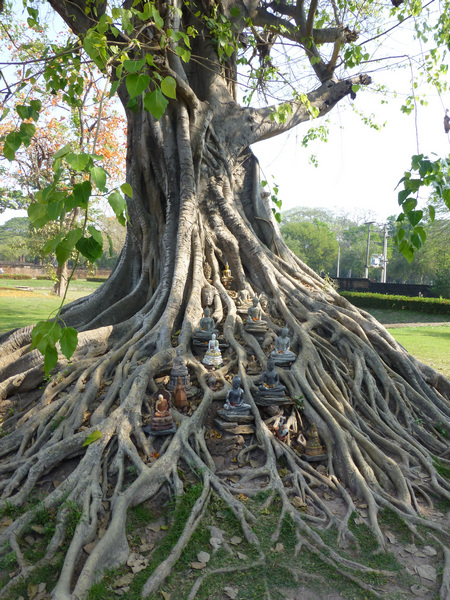
And so my bike ride continued more nervously than before, waiting to be bitten at any moment by any remaining and riding ant. Luckily for me, we soon stopped in front of another temple huddled in the shadow of a huge tree in whose roots were placed numerous statues of Buddha.
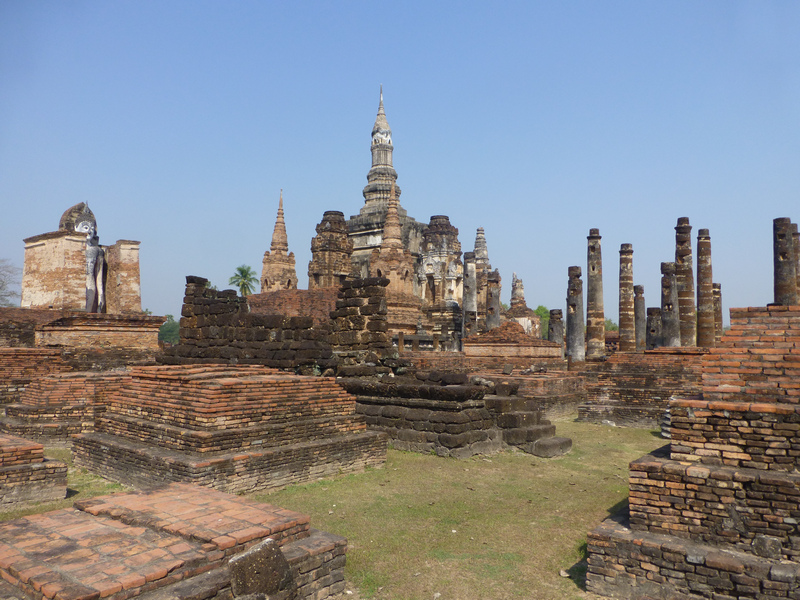
The historic Sukhothai Park covered a total area of 70 square kilometers, on which stood 193 ruins of the glamorous 13th-century capital. Here you could see the royal palace, twenty-six temples and hundreds of pagodas, all of which had a strong Khmer (Cambodian) influence. Even with bikes it was difficult to go around and see all the ruins. At 10:00, when we reached the Temple of the Great Lilies, the guide gave us 30 minutes free time. We headed to the other side of the lake, where one of the largest temples (or at least whatever was left of it) Wat Mahathat or translated as the Temple of the Great Relics was located. In the middle of the temple among the many columns stood a huge statue of Buddha. The temple dates back to the end of the 13th century, but the worship and admiration remained to this day.
Sukhothai was the first capital of the United Kingdom of Siam in 1238, and the population of these lands had previously obeyed the Khmer Empire in Angor. When their power began to decline, two Thai generals led their men against the Khmer and created their own kingdom of Sukhothai (the dawn of happiness), with one of these generals Intradit becoming the first ruler. The kingdom flourished for more than 200 years, and the city we cycled around was an important political and religious center. Eight kings ruled here, among which with the greatest importance King Ramkhamhaeng (1278-99) – the youngest son of the first creator (something like Bulgarian Asparuh, son of the Great Khan Kubrat supplemented with Bulgarian king Boris). Under his rule, Buddhism became the main religion in the country and the Thai script was first introduced. The power of Sukhothai began to decline by the 14th century, and at the end of the century the city became a vassal of Ayutthaya.


Our bus journey continued north to the mountain. Leaving Sukhothai, the guide also showed us ruins of the walls of the ancient city of Sukhothai stretching for miles. Around them there were also tall trees with orange and red flowers that bore the name The Red Cotton Tree (the red cotton tree). Its flowers were sweet and nectar was made from them, and the berries were dried and with them became a wonderful soup. In northern Thailand, many grew these trees precisely for the sake of seeds.
We travelled north in the direction of the city of Xi Sachanogloi and from there in the direction of Ming Chai – Preya – Ta Yau – Chang Rei. In addition to the complex names of the cities, the guide showed us from the bus and watermelon plantations, saying that a watermelon takes only 70 days from sowing to the finished product to ripen. There were red and yellow watermelons in Thailand. At 11:37 a.m., the mountain was already being climbed. There were many papaya trees along the way, tangerines and oranges. We stopped for a while at a gas station selling interesting birds, some of which spoke similarly to parrots, but looked more like small black magpies. The guide explained to us that there are many such birds in these places.
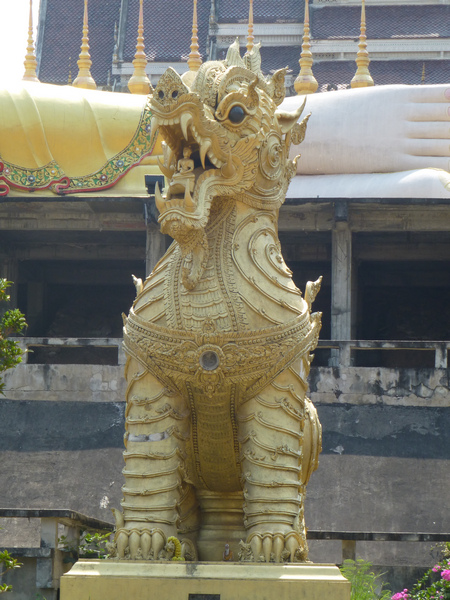
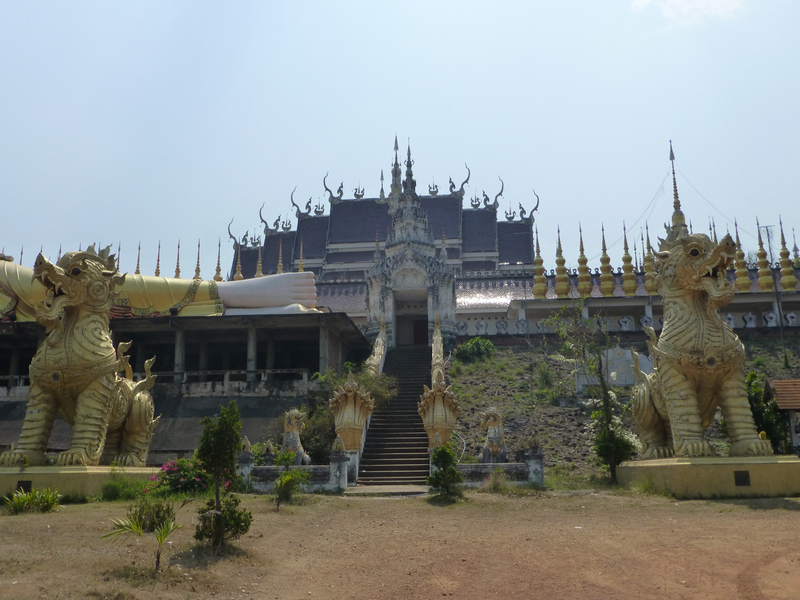
Then we made a short photo break in front of a newly erected temple, whose huge statue of a reclining Buddha was impressive. I particularly liked the golden statues of two dragons that guarded the entrance to the temple and in whose mouths, sitting on the tongue again stood Buddha. On the railing of the stairs again there were statues of the mystical five-headed snakes, but unfortunately we did not have enough time to climb the stairs and peer into the temple, which I liked very much.






We came to the so-called Province of Phrae. We had a lunch break at a roadside restaurant that was specialized in noodle soup. The menu was simple: noodle soup with meat and noodle soup without meat, drinking Coca Cola or water. The restaurant was located on the road, away from the village, the tables were small and round, with even smaller and round chairs around them. The shed was unstable, and in general the place was a little unsightly, but it was full, and as soon as a table was released, there were immediately people to fill it. There were many locals and tourists. The soup was really very tasty. The rice noodles and vegetables were fresh and gave a nice flavor to the broth, I ate soup with chopsticks for the first time. Noodle meat soup was made from pork tripe and it attracted so many visitors. On each table there was a tray with 4 spices: fish sauce, sugar, vinegar and chili, so everyone could flavor their soup as desired. For drinking, in addition to water, we also got some iced tea made from local plants, which the guide ordered with a lot of ice. It was refreshing and sweet, but with a taste I couldn’t compare to anything familiar.


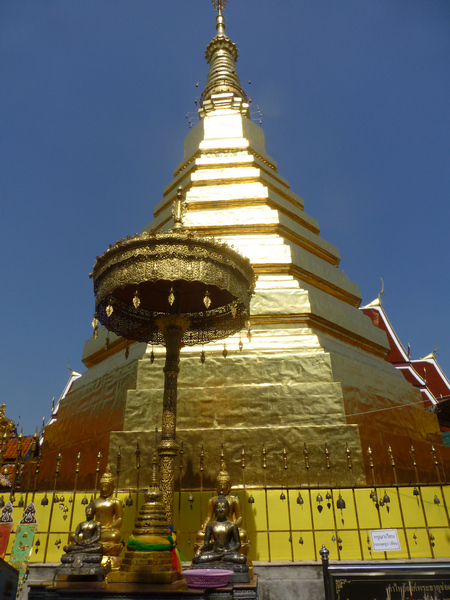
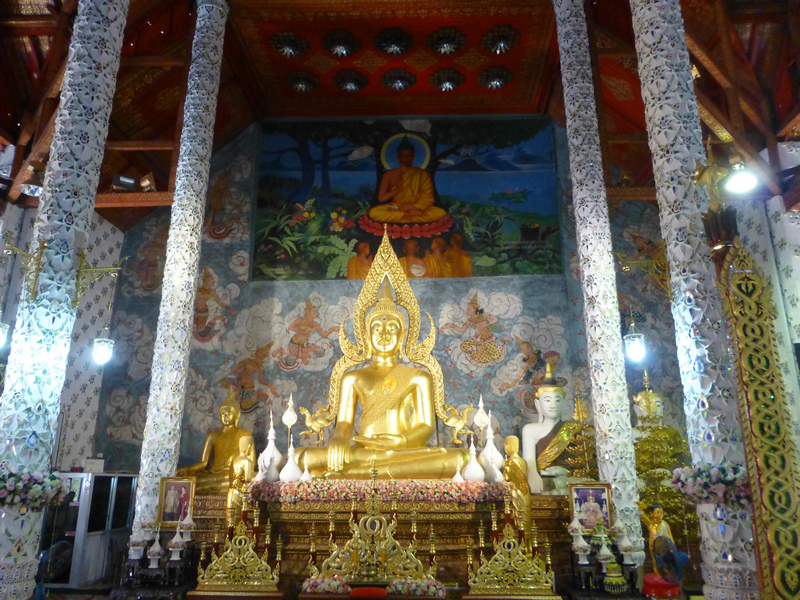
Our excursion program continued with the visit of the royal temple Phra That Cho Hae, which was located 28 meters in the mountains and was erected 700 years ago when the capital was Sukhothai. Especially interesting here were the colorful glass mosaics on the windows and the dazzlingly shining golden chedi rising to 33 meters. According to legends, part of the Buddha’s hair is kept in it. In the temple there was also a very beautiful golden statue of Buddha, and the yard was dotted with many flowers and statues. The next day a feast was going to be held in the temple, so the locals emphasized the golden decoration. On both sides of the road in front of the entrance there were flags, the same show where the upcoming solemn procession would come from. There were also many street vendors who offered honey in bottles.




At 2:40 p.m. we left the temple and continued our journey north. The guide explained that in this part of northern Thailand people speak a dialect, and in Thailand there are 12 dialects, which is very little compared to India, where the dialects are over 100. This northern dialect was expressed in the slower speaking of the people, in fact the locals did everything slower. Here, even crime was less, because criminals are too slow. Otherwise, the people of the north were very beautiful – with big eyes and black hair. Many men came from Malaysia and other countries, even from Europe, to look for a Thai woman from these places. The only problem women from northern Thailand had was that they wear too much make-up and couldn’t cook.
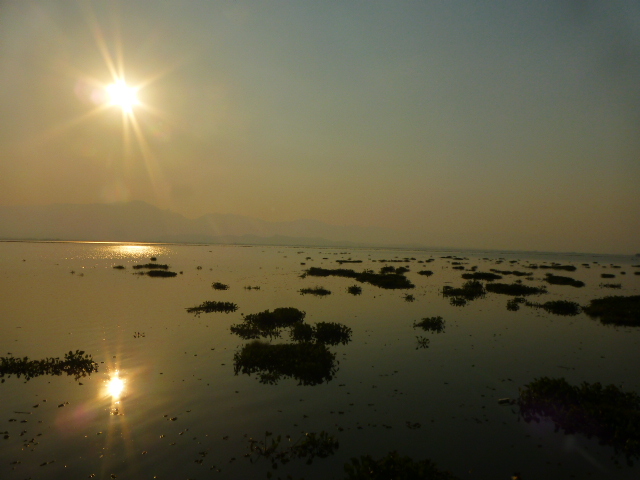
We moved slowly in the slow region of Thailand. On the side of the highway there were many beautiful pink flowers, which, according to the tour guide, needed very little water. If they were watered, they would no longer have this beautiful color. We moved in the direction of Lake Payao, which was the third largest lake in Thailand. First was the naturally separated Songkhla Lake in southern Thailand, covering an area of 1040 square kilometers, which, although it was called a lake, was actually a lagoon. In second place was the freshwater lake Bueng Boraphet located in Nakhon Sowan province, which we had long passed and in which the city of diamonds was located. This lake covers an area of 212 square kilometers and is often referred to as the North Sea. Not long after, we arrived at the third largest Lake Payao, located at 380 meters above sea level, and it was artificially created and spread over 15 km wide and 20 km in length.
At 16:30 we stopped in the city of Payao, on the shore of the lake, as in the past it was a famous university city and now there are still many young people here. With regret, the tour guide noted how many young people study, and then can not find a job and often university graduates sell noodle soup. We learned that the school is free of charge from preschool to high school (a total of 12 years), as the primary school consisted of 6 classes, and 6 classes of secondary school. Thailand’s teaching system was mostly similar to the English one, as many of Rama V’s sons studied in England and reintroduced this system. In all schools, children wear uniforms, on which in the upper corner is written the name of the school and the name of the child, and in private schools also the registration number. Uniforms help children learn together, not knowing whether they come from rich or poor families. And the names and school written help the children not to do stupid things after classes, because everyone can see which school they are from and what their name is, then call the director and report the irregularities. Girls were not allowed to wear long hair. The teachers used a bottle of Coca-Cola for a meter, and if the hair was longer than the bottle, it had be cut out.
Classes in Thailand began at 08:30, which gave the children enough time to move – the richer brought them by car, and the poorer ones came by bus or on foot. The children carried bags of food – usually the boxes contained rice on one side, poached egg or fish on the other side. At 8:30 a.m., the bell rang and everyone gathered in the school lobby, which was often used as a football field. Children are divided from first to sixth grade.
Then two students pass by with the Thai flag in their hands and stop at the Director and all start singing the national anthem. The Thai flag consisted of 5 horizontal lines – the top and bottom were red and symbolized the earth and people, the two whites between them represented Buddhism, and the blue line in the middle, which was twice as thick as the other lines, was for the monarchy (royal blue was much used by Rama VI, it was by his decree that this flag was invented and adopted).
After the hymn, pupils sit on the ground in the lotus position and say the five basic rules of the Buddha: 1) To abstain and not take the life of other living creatures; 2) To abstain and not to take what is not given to us (i.e. not to steal); 3) Abstain from sexual infidelity; 4) Refrain from telling lies; 5) Refrain from taking distilled and other intoxicating substances that lead to recklessness. They then sing a song in honor of the royal family and spend another 3 minutes in meditation with their eyes closed. Finally, marching as soldiers, they enter the classrooms. Students on duty warn when the teacher is coming, shouting “Class get up! Show respect to the teacher!” and the pupils stood peacefully and humbly greeted him on a good day. First the boys said “Sawadi-kab” (good afternoon), then the girls “Sawadi-ka” (good day). Then everyone sits down at desks and the class begins.
Thais, like us, study basic sciences such as mathematics, biology, religious education, and others. However, the Thais also studied many other subjects related to their way of life. They have cooking classes, how to prepare and serve food. It should be taken into account that Thai food is served without knives on the table, respectively, it must be well prepared. Students learn how to cut vegetables, fish and other foods. Their schools are large, they also have separate corners where they grow vegetables and students take care of them. At school, they also learn how to provide first aid, how to react to snakebites, etc. Almost everywhere English is taught, which children learn along with Thai. However, the Thai language was much more complex. The same consisted of 44 syllables, not letters, plus 22 consunants (consonants). The guide sang to us in a very funny way the song with all the Thai syllables, which the children learn similarly to the English song “A, B, C, D…”. Thai is a tonal language and the corresponding consonants can be pronounced up, down, front, back with different tonality, and so the same word can acquire different meanings, depending on the tone in which it is pronounced. For example, the word “kaaa” meant white, news, and rice plantation, with the tonality subtly felt in the voice of our guide. He also pronounced the word “zula” differently, which meant tiger, mother and sky. Particular misunderstandings occurred in the restaurant when foreigners wanted to ask for a spoon, but mistaking the tonality, they often called an elephant “Chang”. Then the tour guide jokingly told us that in fact the Thai language is very easy and proof of this is the sentence “We sell eggs”, which in Thai sounded “Kai kai kai kai.”
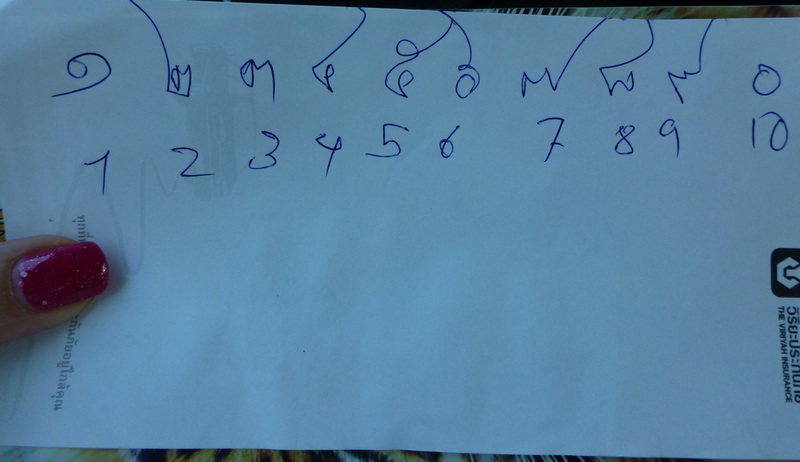
The Thais also wrote the numbers differently, as the guide put on the bus a sheet of paper on which he wrote the numbers from 1 to 10. The cops looked like distorted symbols and letters. These numbers were also written on their coins and banknotes, which had made it difficult for us at first.
Even before we get to Payao, the guide recommended us to try the Latte coffee there and the Vietnamese tea from Lotus, which were excellent. We also made a very pleasant coastal walk, and in one place they had a heart-shaped frame where people could take pictures against the lake. I liked the year 2558 the most. From the very beginning the guide pointed out that landing in Thailand it seems like we have found ourselves in the future, because the year is 2558. Although they had long accepted the Gregorian calendar (the one we use), the Thais had still preserved their Thai lunar calendar, which counted down the years of the Buddha era and accordingly began 543 B.C. Modern birth certificates contain both years, respectively, according to the Gregorian and Thai calendars. It was now the end of 2558, and I was walking along Lake Payao, wondering how quickly time had passed. In mid-April, the new year would come, but until then I enjoyed the sunny year 2558.


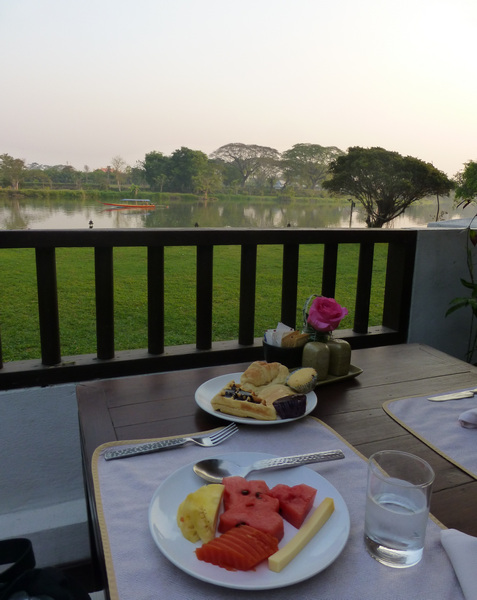
We had another hour to arrive at Chang Rei, and the guide again thickened our time with funny stories. We learned that in this artificial lake there were bred large fish called “walla”, whose weight could reach 300 kg, had a yellow color and were very tasty. Another local delicacy is the so-called “dancing shrimps”, which were prepared in such a way as to dance in the pan. In the evening we had to try the seafood in the hotel, but it amazed us with much more. The Legend Chiang Rai**** hotel was wonderful. Most rooms were located in private bungalows, each room had its own outdoor living area. Throughout the hotel complex there was a small creek on which many bridges were perched. Our living room had a comfortable sofa swing and a table in the form of a board, and it was very pleasant to swing outside and enjoy the murmur of the creek. The beds in the room were no less fabulous as the same were with canopies, and although that meant that the place was full of mosquitoes, the atmosphere seemed magical to me. Such was the food in the restaurant, as on the richly piled buffet tables there were all kinds of food. For drinking, I got coconut juice, which was served straight from the walnut with one straw. Our day was full of wonderful impressions and experiences, not knowing that tomorrow would even surpass it…


GENERAL INFORMATION ABOUT SUKHOTHAI:
Location: The Old Town of Sukhothai is located 12 km from its modern namesake. They are located 427 km north of Bangkok on the Yom River, a tributary of the Chao Phraya.
Area: 6,596 sq.km
Population: 37,000 people
Official language: Thai Altitude: 53 m
Climate: subequatorial
Time zone: UTC+7
Currency:
Thai baht (THB)
Additional information: http://www.thaizer.com/sukhothai
TRIP TIPS FOR SUKHOTHAI:
Best time to visit: all year round
Typical food and drinks: Thai food is famous all over the world, with the most delicious being of course “at home”. In Sukhothai, traditional foods are rice noodle soup and PadThai fried noodles with eggs, tofu and green onions.
Places to visit: Sukhothai Muang Kao is a UNESCO World Heritage Site. The best way to explore the entire park with ruins is by bike, as rented at the entrance to the historical park. The entire park covers 70 square kilometers and is divided into different zones.
 TripTips