CHANG RAI AND THE GOLDEN TRIANGLE
THAILAND ROUNDTRIP – PART 5

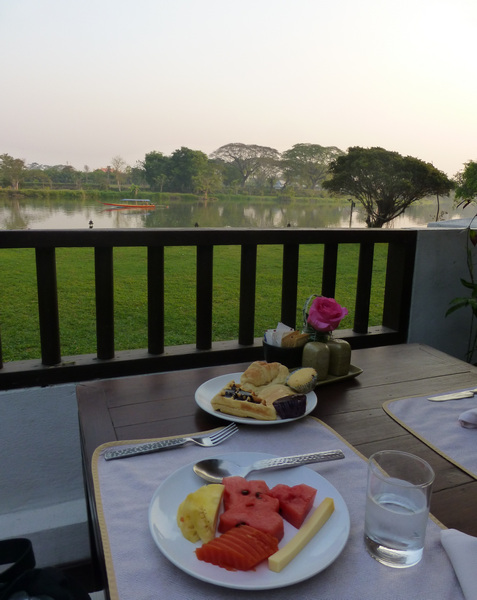

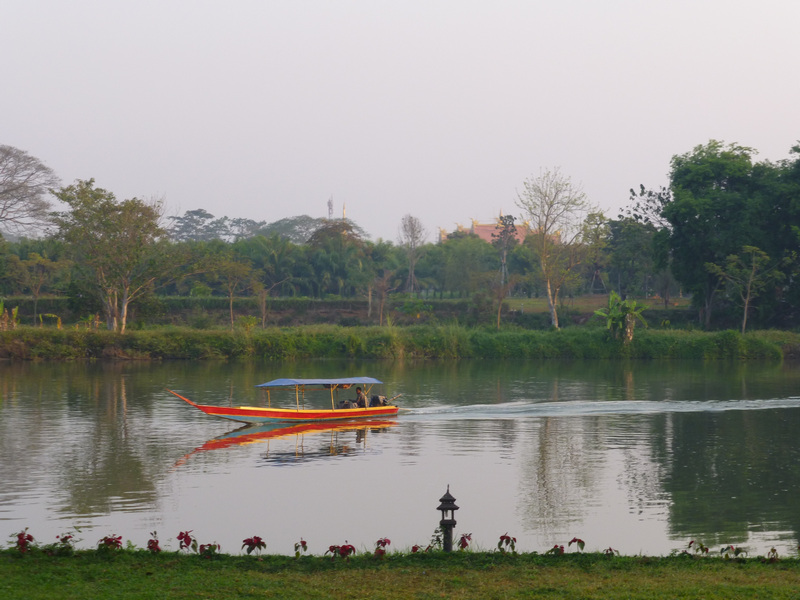

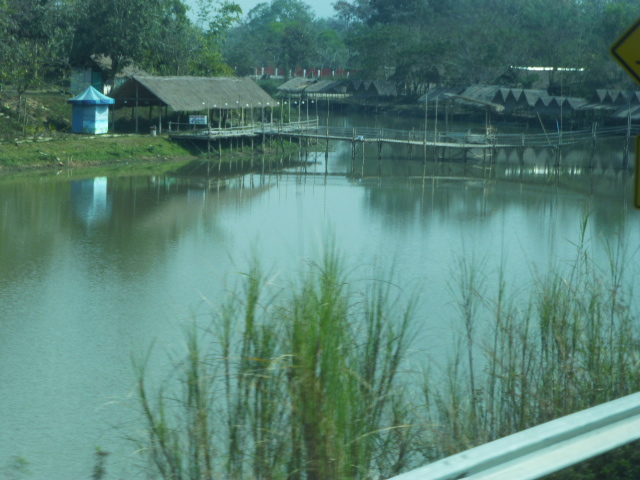
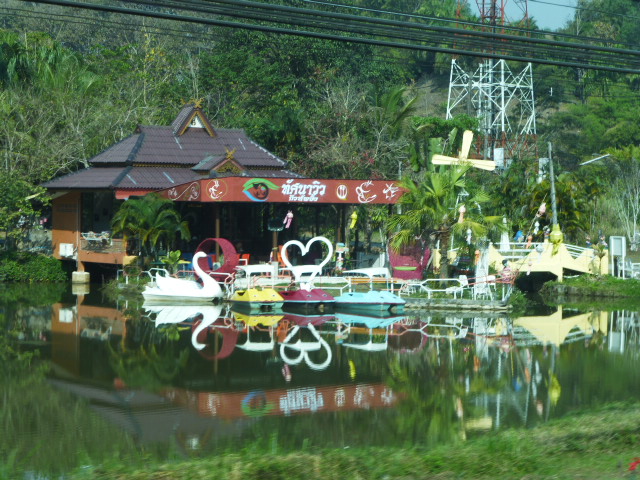



The morning in the city of Chang Rai was very calm and beautiful, thanks to the delicious and rich breakfast full with fruits, waffles with chocolate, pancakes, etc. and also because of the nice view that was revealed from the bank of the Mae Kok River. This river springs from Myanmar and empties into the Mae Kong River, along which we had a boat trip later that day. The departure by bus was at 08:00 in the morning or we had an hour more than usual. In front of the hotel entrance there were many parked rickshaws named “tuk-tuk”, which were the local taxis. Even though we didn’t get a ride on them, we took a lot of good pictures.
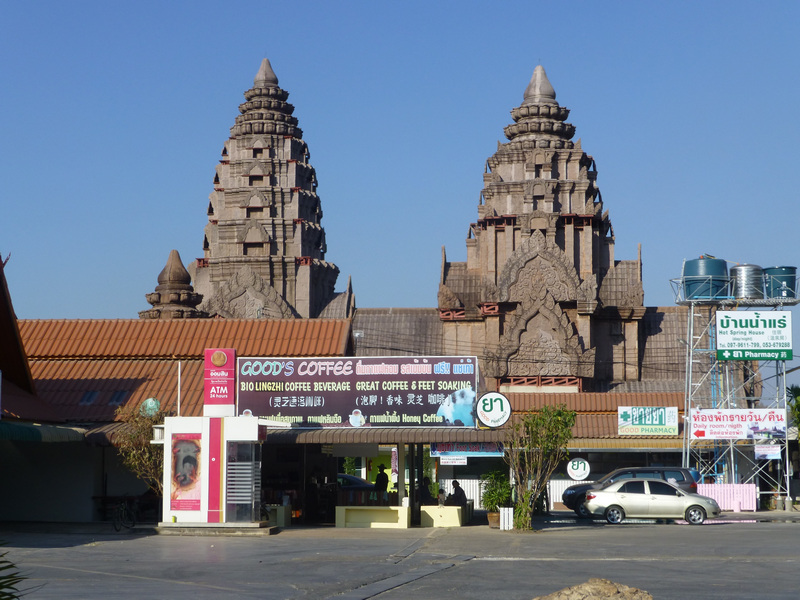
The city of Chang Rai was only 2 km from the hotel, and was famous for its sale of antiques. It was one of the oldest cities in Thailand, founded in 1262 by King Mengrai as a central location in the country’s first independent kingdom. But after only a few years, the king moved his capital to Lampoon, and then to Chang Mai. The abandoned Chiang Rai today was a medium-sized city located casually on the banks of the Kok River. Last night, while traveling to the hotel, we were able to catch a glimpse of its fortress walls dating back 700 years.
In the morning we headed north to the Mekong River, which flowed from the Himalayas and passed through many countries such as China, Vietnam, Laos, Cambodia, Thailand and from there flows into the China Sea. The length of the river is 4350 km, making it the 12th longest river in the world. The river had many names, the most famous being the Mekong, derived from the Thai words Mae Nam Khong and meaning “mother of waters”. In Cambodia, it is called the Tonie Sap or the Great River. In China, it was known as the Yellow River. In Thailand, it was also known as the sad river because it has caused numerous floods and disasters in the past, especially during the rainy period. This river was now much calmer because dikes had been erected. Thailand and China, however, have long argued over this river, as the latter tried to divert it from its bed and so the water did not reach Thailand.
As we traveled north, the guide told us to pay attention to the people from the mountain who were not Thais. Some of them came from Tibet and China and live high in the mountains on the border between Thailand and Burma. In Myanmar they often had problems with the mountaineers who wanted to be independent, but the parliament in Burma did not allow this and sent people, to control them. As for Thailand, they help these people, especially during the dry period when there is a shortage of water, Thailand also provides them with food. In the past, it was these mountain tribes who were known for growing drugs. People came to them and gave them seeds and agreed to buy the whole crop. High in the mountains no one watched what grew, and the climate was favorable for plants with purple flowers and white milk, from which opium was made. From 10 kg of opium becomes 1 kg of heroin. It was exported from Thailand to Amsterdam and from there to the United States. This business created a bad name for Thailand. Today, the cultivation of drugs is officially banned and measures are taken to stop this trade. There are also many campaigns to teach people about the harm of drugs. The Thai king passed a statute to buy the crops of the mountain people, whatever it was, as long as it was not the illegal plants.
In Chang Mai, where we were going to spend the night, there were many mountain people working there. They had ID cards issued by Thailand, but nationality does not say Thailand, but mountaineers. In the mountains lived different tribes, including that of women with long necks. I had seen pictures of women trying to lengthen their necks with bracelets. I always thought, they were from Africa, but it turned out that they live in northern Thailand. We didn’t see them, but I don’t regret it either, because I genuinely felt sorry for the women who put themselves through it. They live in bamboo houses, although they receive significant financial support. Like our gypsies, they tried to have as many children as possible in order to get more benefits and have more votes in parliament. Their clothes were usually black with gold ornaments, and by the hat it could be seen whether the woman was married or not. When the hat has a sharp tip, it means that she is not married, but when she is flattened, she is a wife.
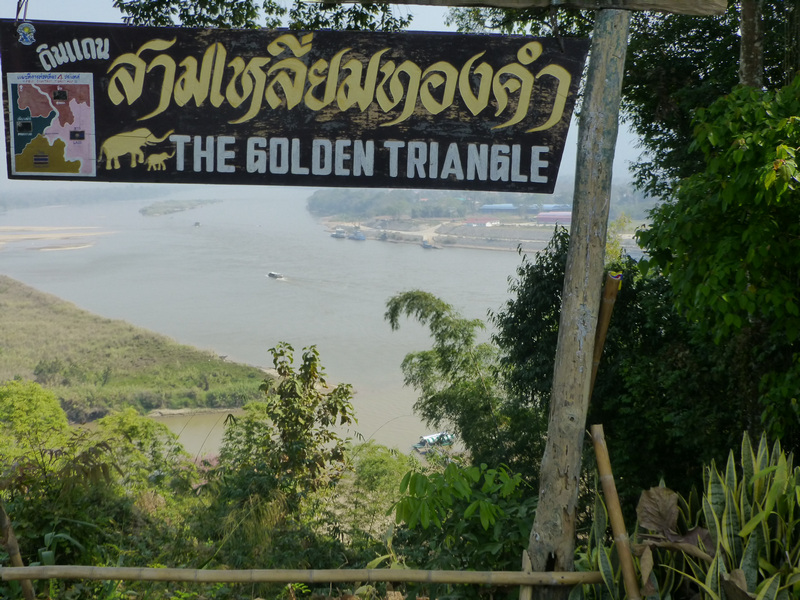
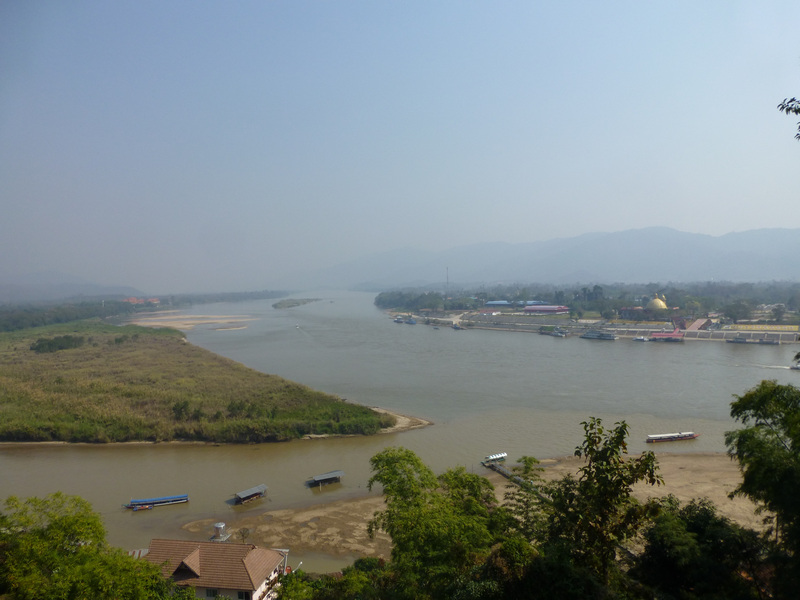
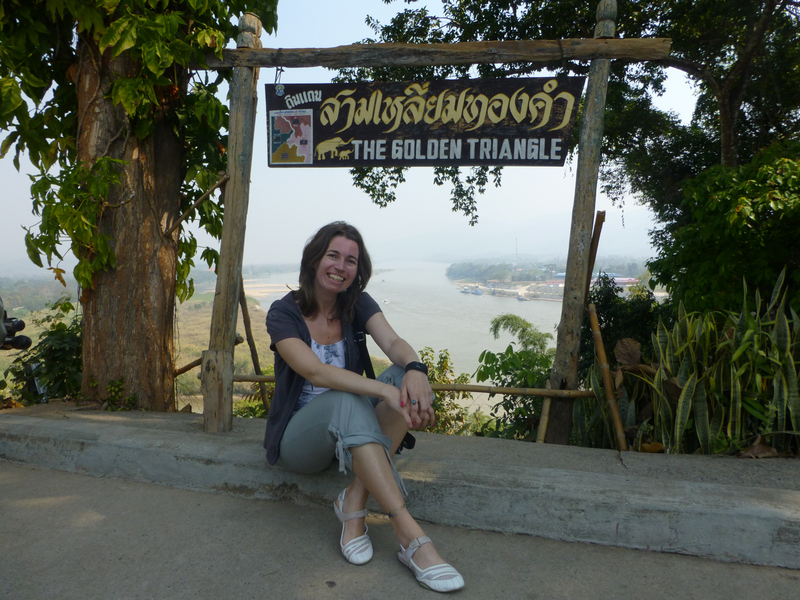
On the way, our bus suffered a small breakdown, but in less than 20 minutes it was fixed and we did not have to change the bus. We safely arrived on the banks of the Mekong River, just where the Riac River flowed into it, a place known as the “golden triangle“. Three countries bordered here: Thailand, Myanmar and Laos. The golden name, however, did not originate from the golden statues and temples, which were not lacking here, but came from the large volume of opium and drug production, which were traded in gold. According to our guide, this was one of the largest opium producing areas in Asia and a relatively dangerous area where drug trafficking and sale was still known. Years ago, when he brought tourists here, he had to make lists of the data of all travelers, as some of them remained in the mountains. Today the control was tighter, when we came and we saw many policemen stopping and checking the cars. And tourists interested in drugs could visit the world’s only opium museum.
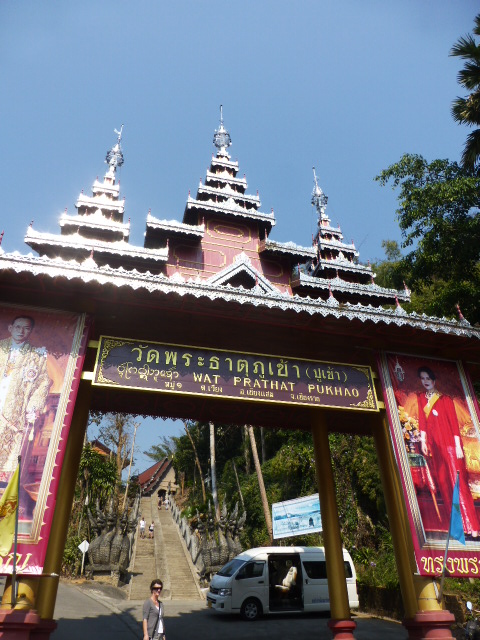
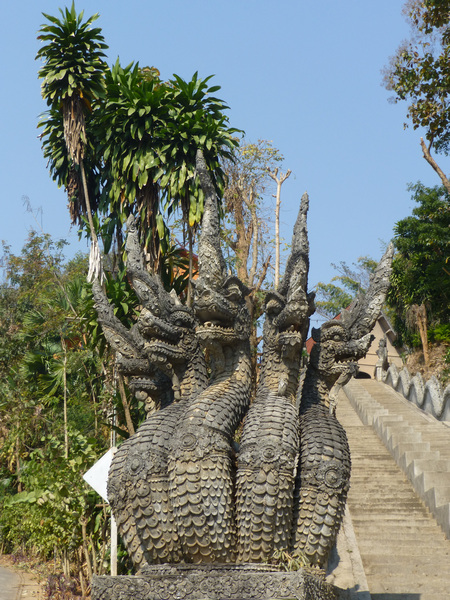
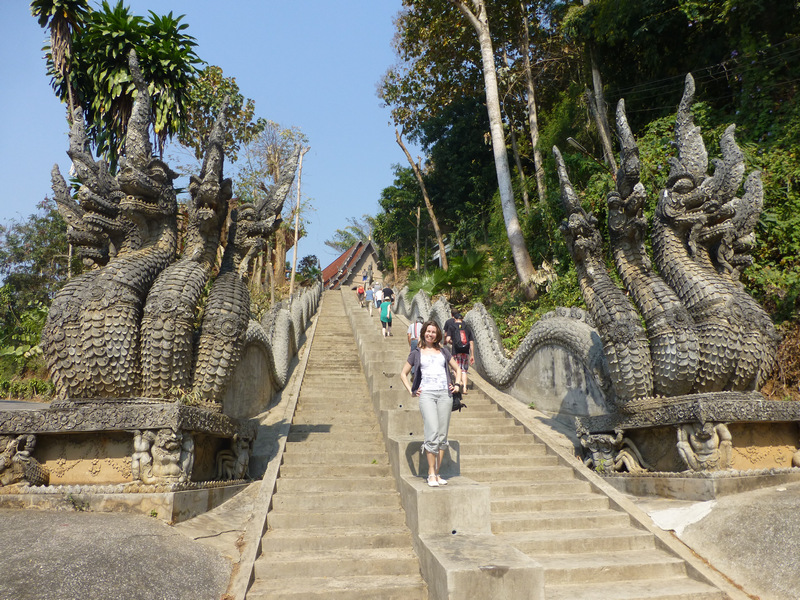
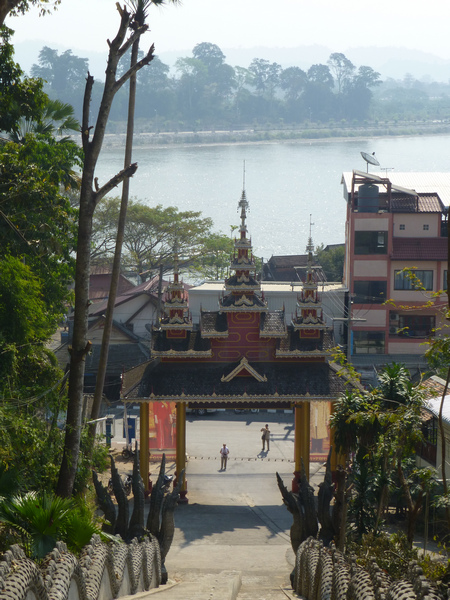
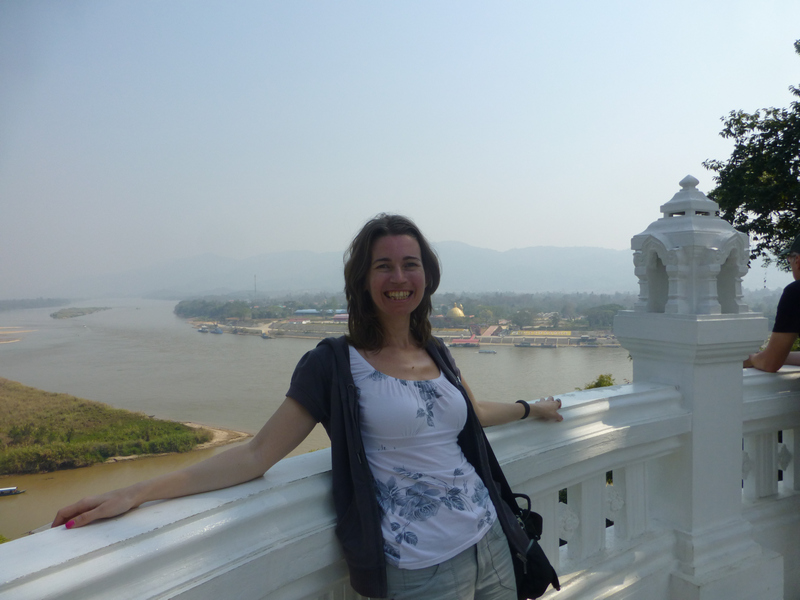
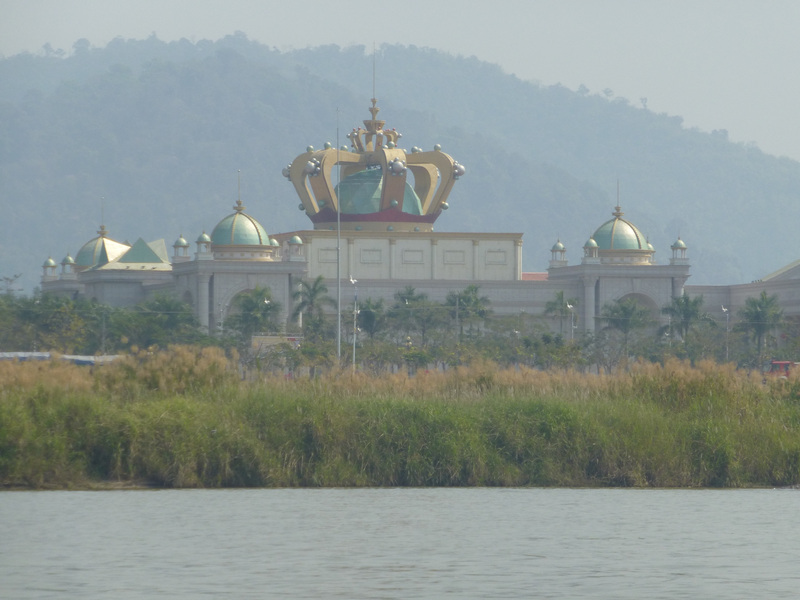
In our program it was not included, but we had a very pleasant boat trip along the Mekong River and taking pictures of the banks of the three countries. Particularly interesting was the coast of Burma and Laos, from where were many casinos. On the side of Thailand there were temples and greenery. Interesting were the specialties that were sold on the Lao side, but which we could not see or try, such as snake schweps (a drink with a snake in the bottle) and schnapps with Tiger testicles. I liked the boat trip very much, and just before starting it, we climbed 100 steps that led to a temple on the hill, from where there was a wonderful view over the Golden Triangle. The rivers really formed a triangle and it was interesting to see three countries from one terrace. We had no right to go down to either Laos or Burma, but we got magnets from Thailand as a souvenir from all three countries we might one day visit.
After boarding the boat at 11:00 we headed to Myanmar. On our left side remained the border of Thailand with Burma, and only 270 km away was China. According to our tour guide, with our boat we could get to China in 7 hours, with a faster ship the ride would be shortened to 4 hours, by swimming it would take us a few days. The tour guide recommended us to go to Myanmar (which until 1989 bore the name Burma). Although it has always been under a military dictatorship, in recent years under the leadership of Aung San Suu Kyi, the daughter of General Aung San, the country has tried to introduce democracy. Ever since she was a little girl, Aung San Si Chu has been taught that she must introduce democracy in her country, studied abroad, married an Englishman with whom she has two sons studying in London. All students supported her and she won the 1990 election decisively, but the military refused to cede power and declared the election invalid. The sad thing about this story was that she had no right to leave the country, nor even to visit her husband in London, when she got this right, her husband had already died. However, it has a firm character, and with her efforts the international relations of the country have been improved. Whereas Myanmar used to trade only with China, now sales were open to the whole world. The country is extremely rich in natural resources including oil, natural gas, precious stones (rubies and sapphires), rice, there are many beautiful beaches. The capital Naypyidaw is modern and beautiful.
The guide also presented us the “small” in his opinion Laos country, which was actually twice the size of Bulgaria, and whose shores we also saw from the boat. In the distant past, their kingdom of Lansang encompassed large areas of present-day Thailand. Although the kingdom flourished in the 16th century, its large territories were difficult to defend against aggressive neighbors. Internal conflicts also helped the kingdom to disintegrate and divided into three parts, which gradually became vassals of Siam. Siam, in turn, ceded some of these territories to France and they remained under French protectorate until the middle of the 20th century. The country was still under communist rule and had the closest ties to Vietnam. Lao was not so different from Thai and the guide told us that he was able to read Lao, and probably their languages were as close as Bulgarian and Macedonian. The capital Vientiane was also a very beautiful city.
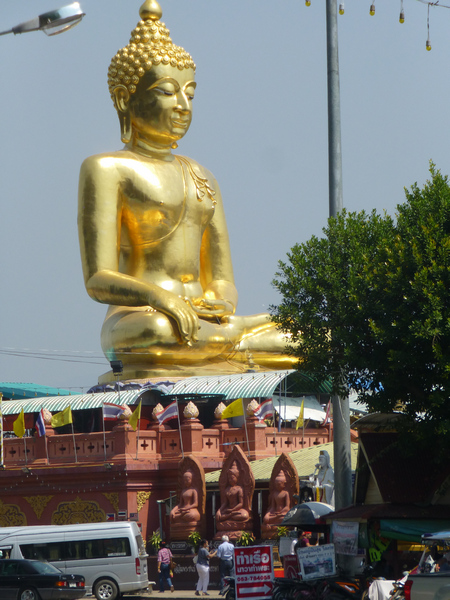
On its border with Thailand, Laos has a large island in the river, which the guide showed us and presented as the property of the Chinese mafia. It has almost everything — a casino, hotels, a restaurant, a place to have fun with women of 5 races, a golf course, even an airport — they call it Asian Las Vegas. There were many drugs from which the Chinese mafia became rich. A lot of Chinese came here before. It’s not that popular now. At 11:30, when we passed by boat, the island seemed deserted to us, and yet we were happy to take some pictures. Much nicer photos became of the huge Golden Buddha, which was erected on the Thai bank of the Golden Triangle.
We passed different boats, and we saw a ship that served as a gas station and refueling for the other ships, with gasoline in Laos being cheaper than the one in Thailand.
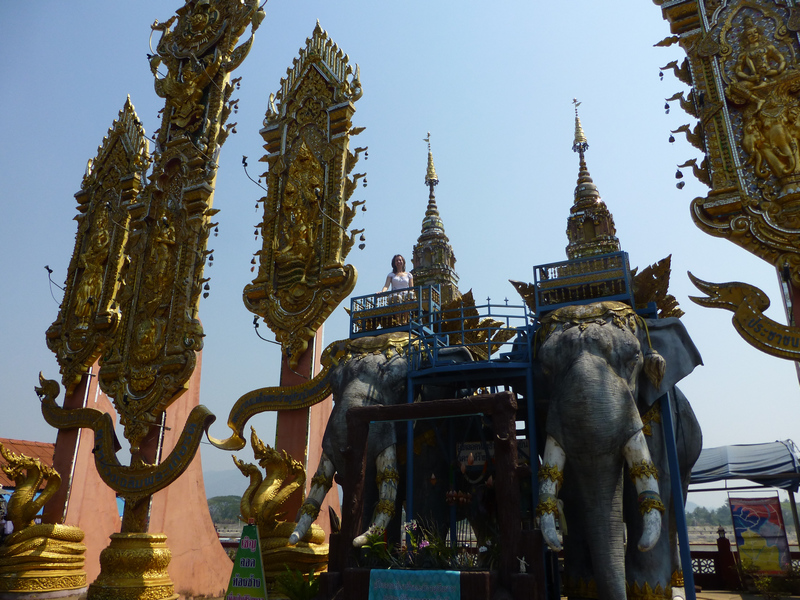
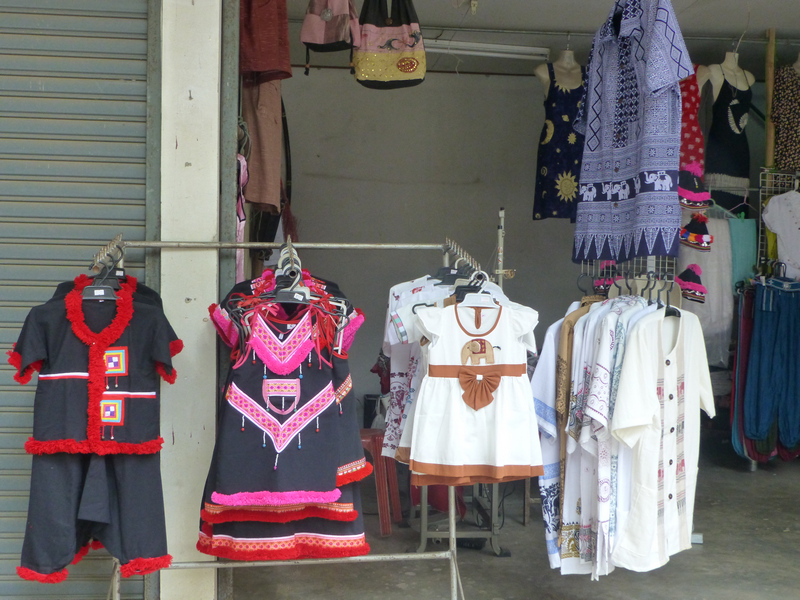
After the boat we had an hour for a walk and photos of the coast, where there were many street vendors. We managed to take pictures with some huge models of elephants, which was a rehearsal for our upcoming real ride the next day.
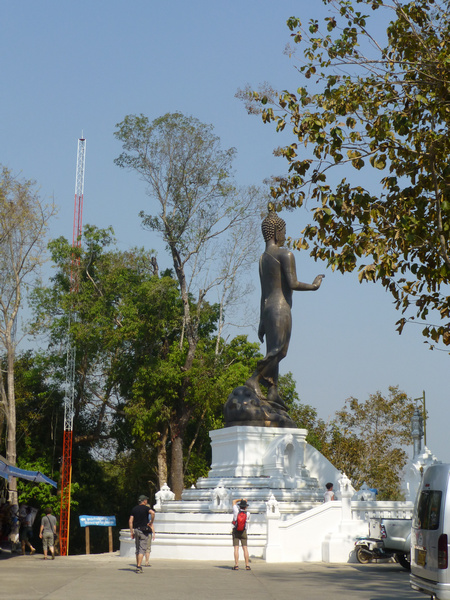
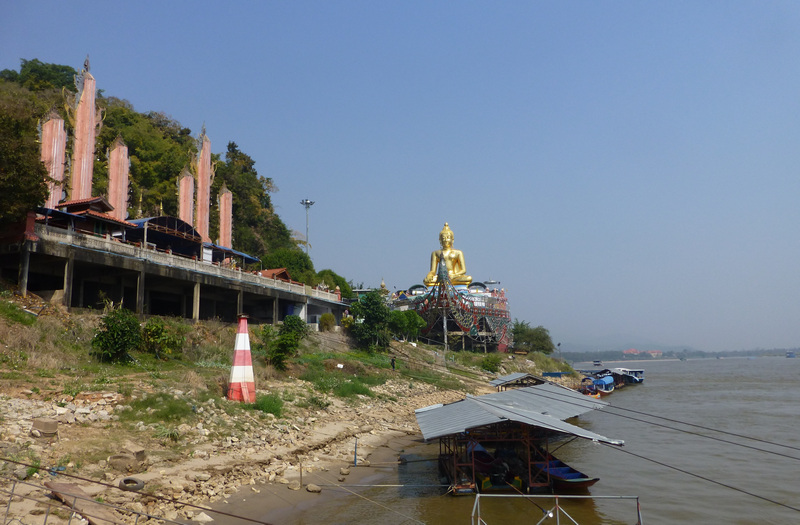
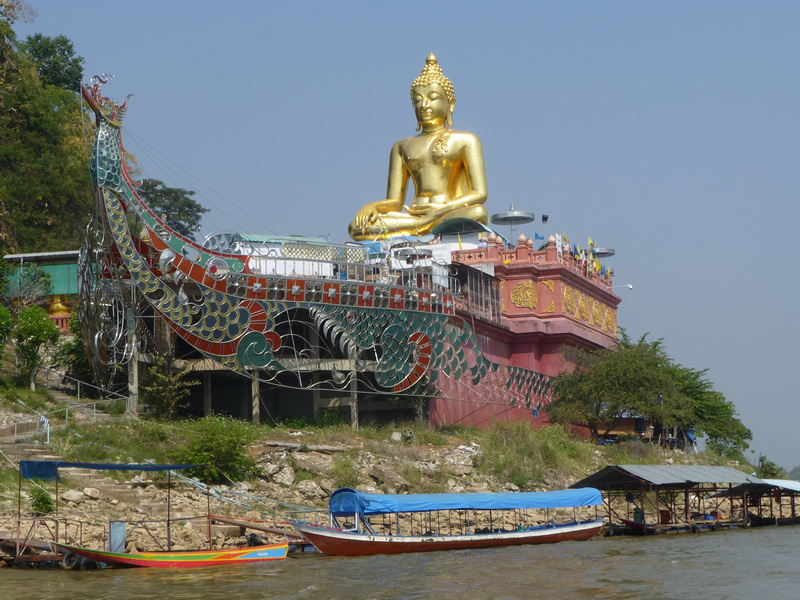
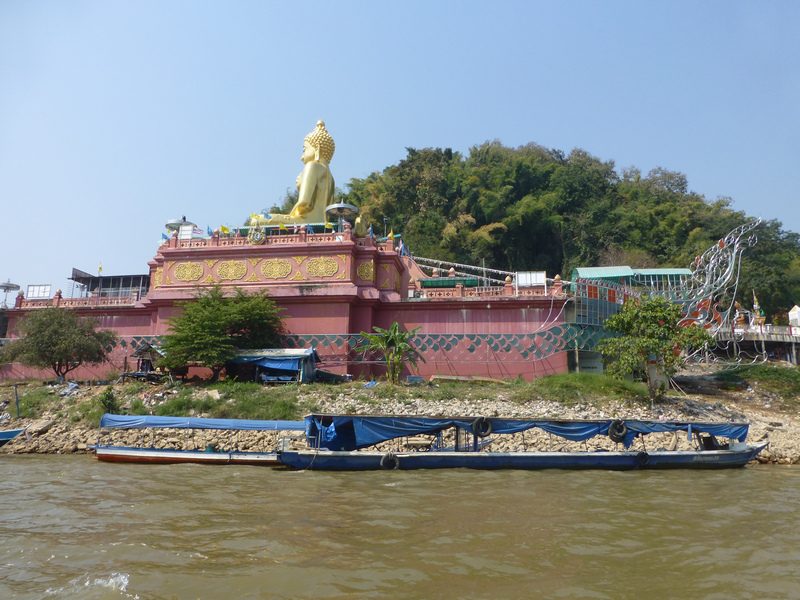
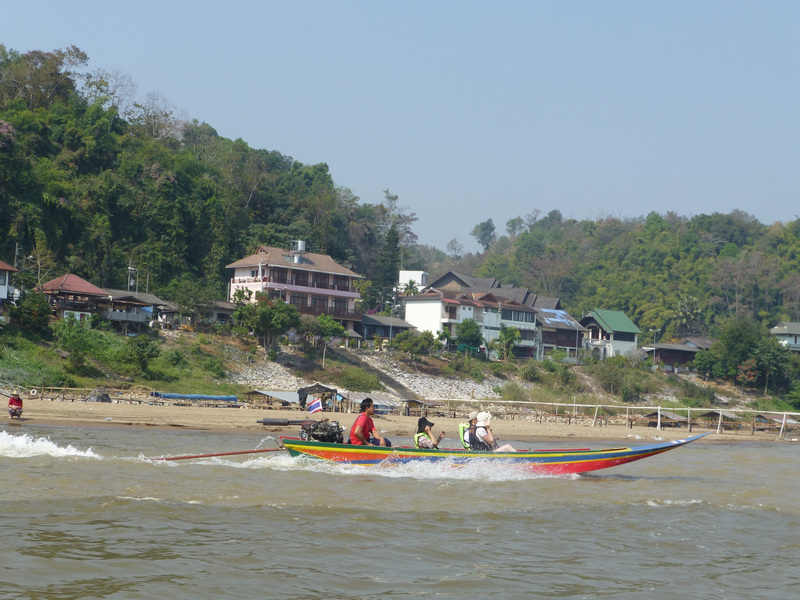
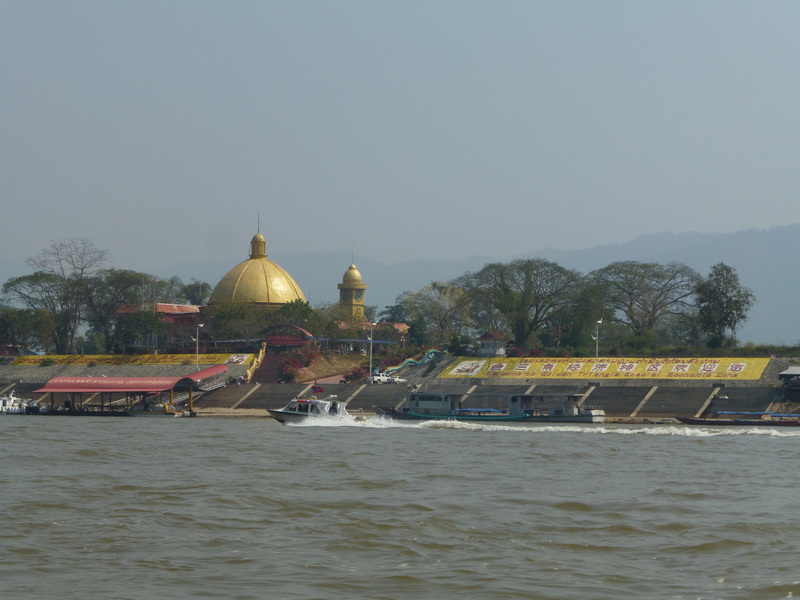
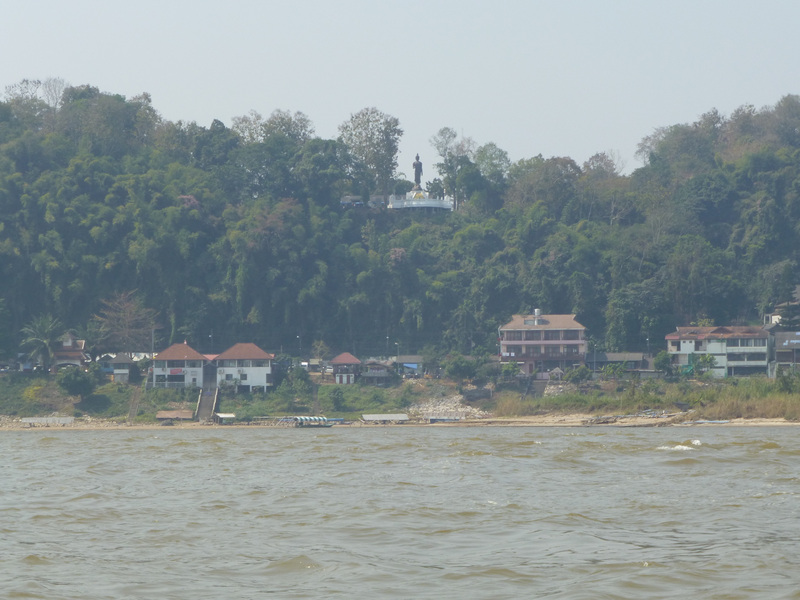

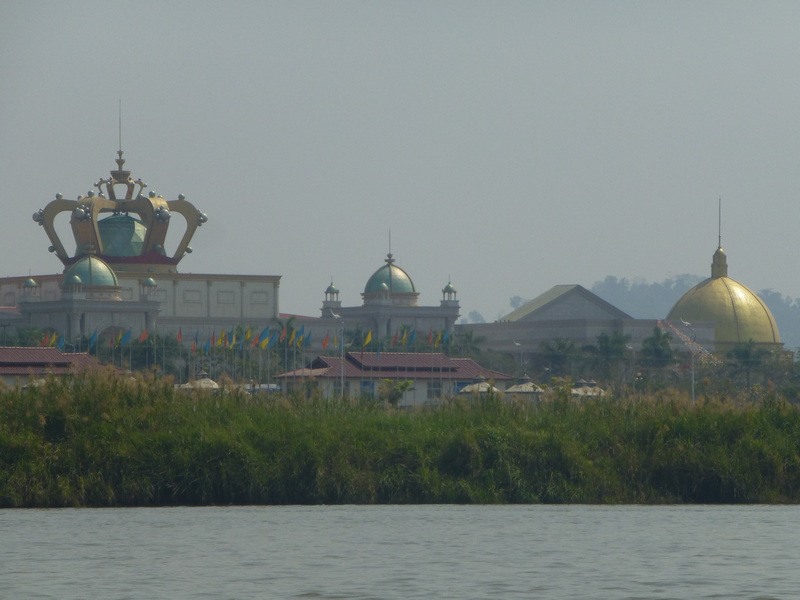

On the way to the boat from the bus we saw a funeral, and the guide told us that the Thais do not like to be buried, like the Indians who dropped the bodies into the Ganges River. Thais saw death as the beginning of a new life. You never know what’s going to happen tomorrow, so you have to do good things today and deserve a better next life.
Along the way, we also saw many pineapples growing at the foot of the mountain. Pineapples in northern Thailand were smaller in size, but very sweet, juicy and with excellent quality. Throughout my stay in Thailand, I can only praise their delicious fruits, especially pineapples and mangoes. The guide showed us from the bus the rice plantations in Northern Thailand, and we learnt that the rice here was thicker and was called glued rice. Previously, tobacco was grown on these lands, but due to the increased import of cigarettes, local production has decreased.
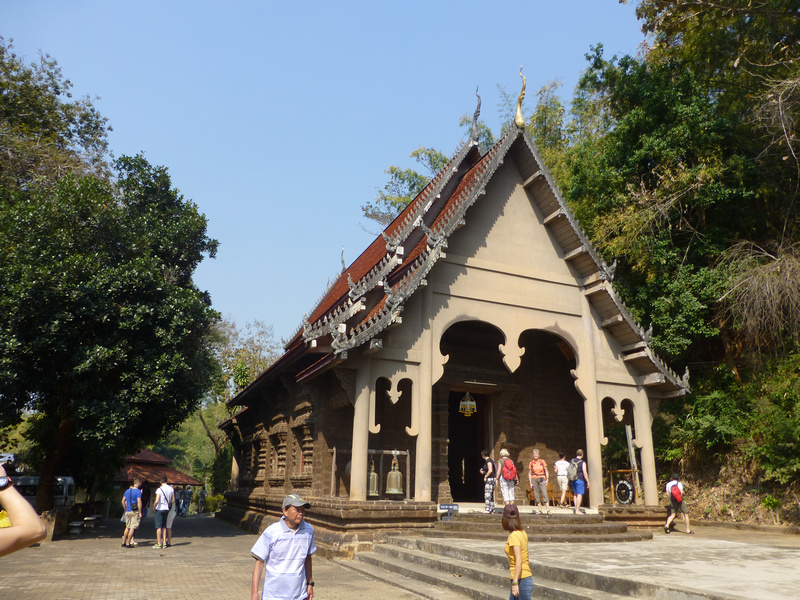
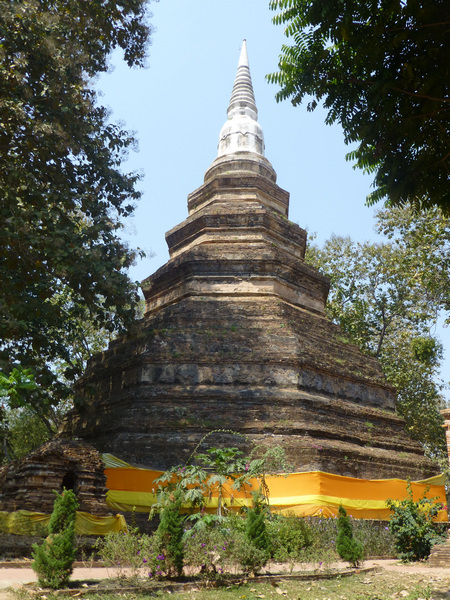
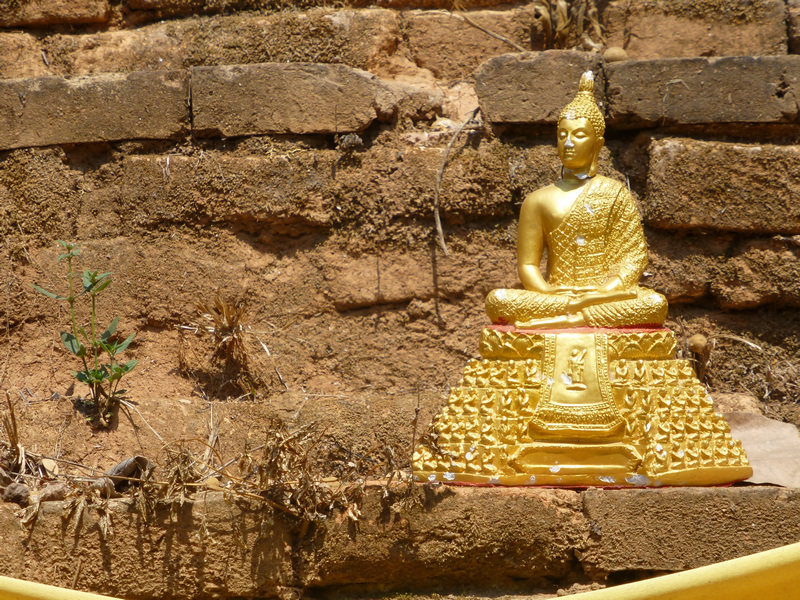
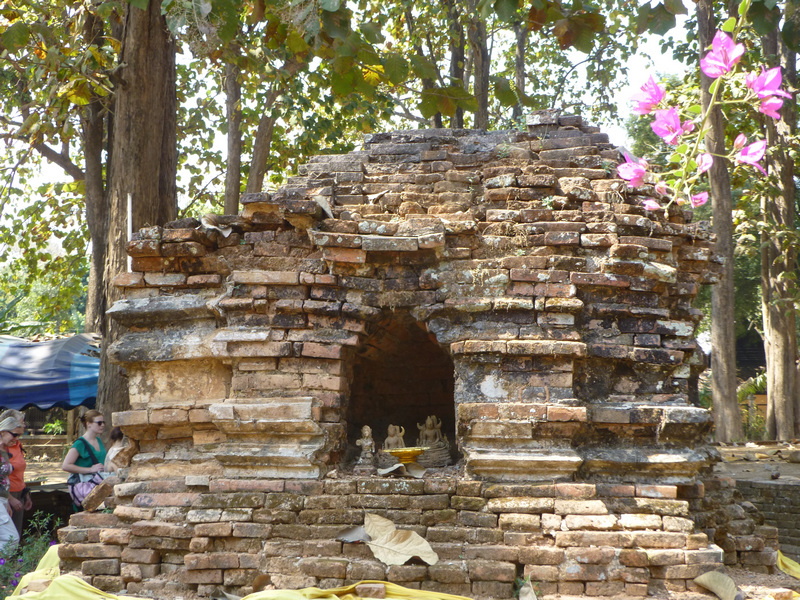
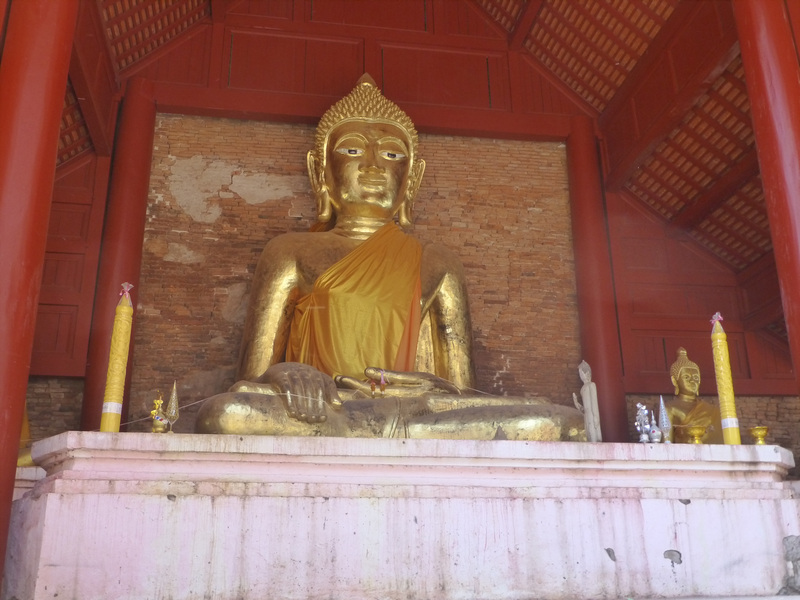
A 15-minute ride from the Golden Triangle there was an ancient temple dating back more than 700 years named Wat Jadeeloung. It was in the process of being restored, being built in the same way as many years ago with wooden sticks. Around the temple there were tall trees with thick stems, which, according to our guide, were sacred and 1000 years old. The royal cheddies, which were quite dilapidated, had to be the tallest. They were built of bricks and did not resemble the others. The temple was located in Chiang Saen, which was the first capital of northern Thailand. The city had an old city wall with moats and then another wall, similar to Sukhothai. We learned that people from Laos often come here to shop. We didn’t have time to go shopping, just to take pictures. Right next to the temple there was a large sign pointing to a café with the alluring name Heaven on Earth’s café.
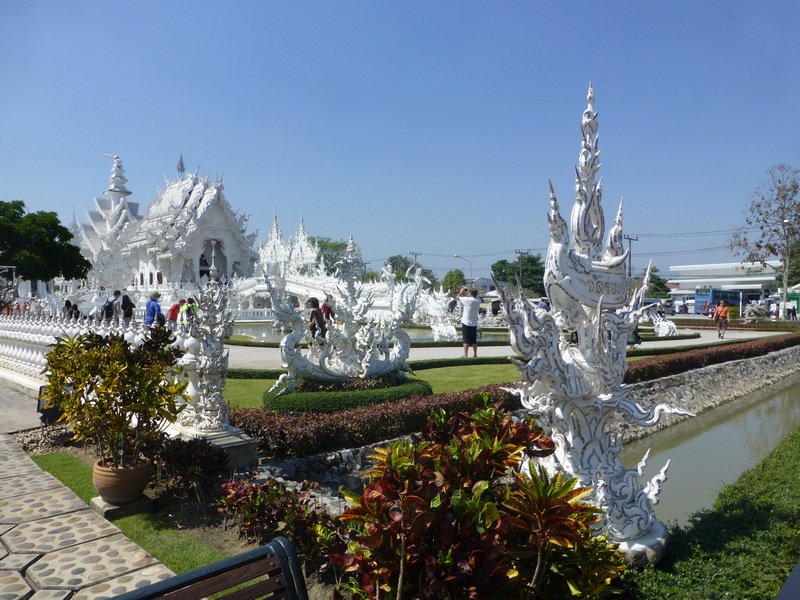
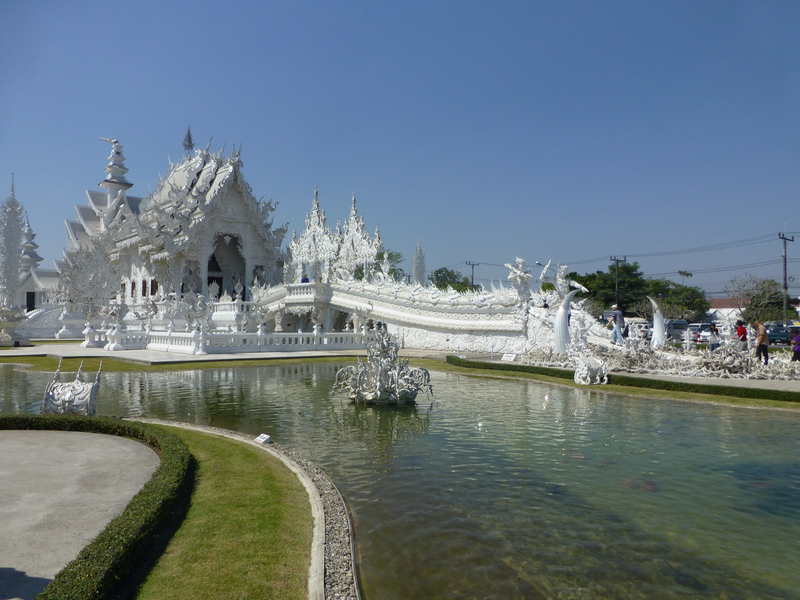
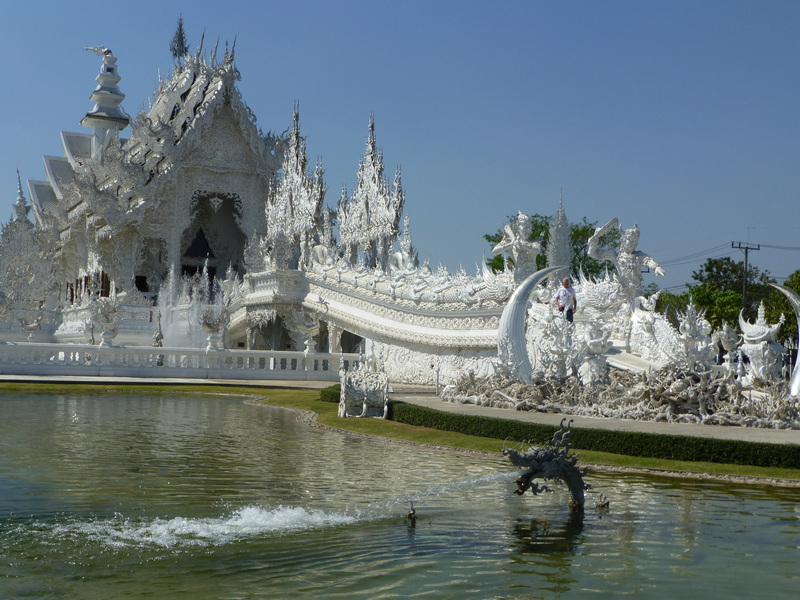
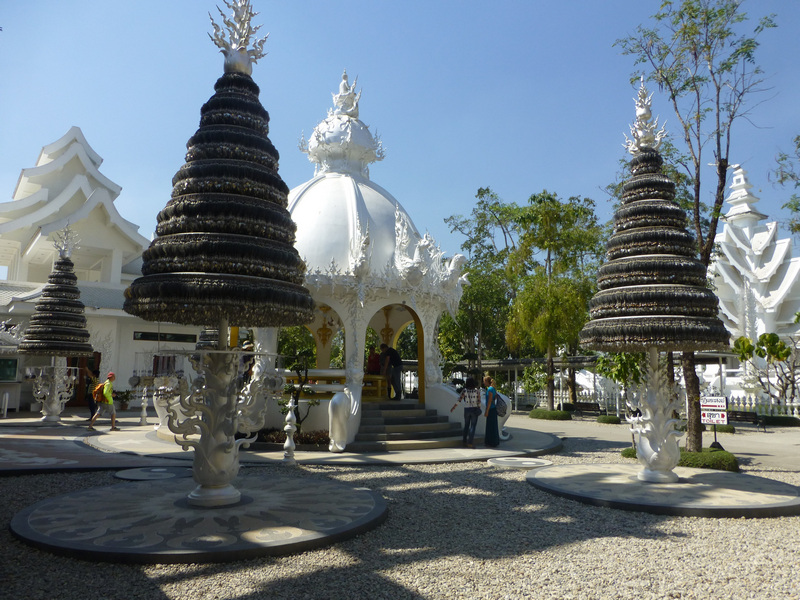
We headed to another earthly paradise – the White Temple, which was 1 hour ride away. At 13:00 we arrived in front of the fabulously beautiful and snow-white temple Wat Rong Khun. The temple was relatively new less than 20 years old, opened in 1997. Previously, another temple with this name was erected here, but it was in terrible condition and before demolition. Then a local artist Chalermchai Kositpipat with his own funds began to restore the temple giving it today’s fairytale look. According to our guide, many people found the temple kitschy, but for me it was exquisite. In order to enter it, one had to walk down a white path, on either side of which there were many human hands protruding – they represented the dead people praying and trying to get out of the earth. Then followed the bridge that represented the road to heaven and from it entering the temple. Photography was forbidden inside the temple, but the photographs on the facade were far more beautiful. The images inside were indeed modernist and strange, but the small figures of Superman, Merlin Monroe, Michael Jackson, Arnold Schwarzenegger and others didn’t intrude so much on the grandiose and beautiful Buddha statue. The entrance to the temple was guarded by angels, and dragon heads protruded from the lake. The reflection of the temple and the bridge in the small pond was very beautiful, and just when we thought that nothing could impress us anymore, we came to the golden toilets.
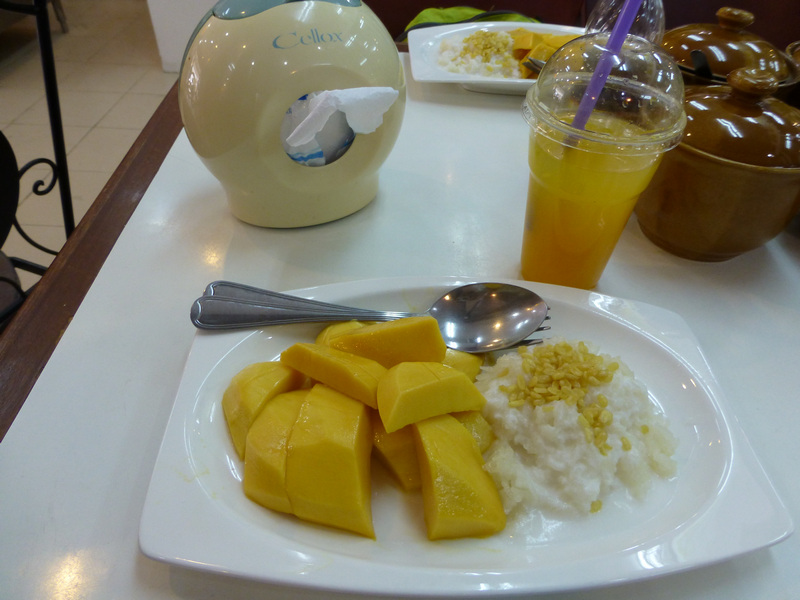
They were a huge golden house with curved roofs and many doors, which were not from royal apartments, but for luxurious toilets. Before entering the toilet, people took off their shoes and put on slippers placed in front of each door. And inside it was beautiful, but the facade outside, like the white temple, completely delighted us. The little free time we had left after the many photos, we dedicated to spend in a restaurant that the guide recommended and where we tried the famous glued rice with mango, with delicious mango juice. The taste was very similar to Bulgarian “sotlisash”, but without sugar, the sweet mango fruit, however, fully compensated this and although it was a main course, it also filled as a dessert.




After lunch at 2 p.m., we left the White Temple in the direction of Chang Mai. Along the way, the tour guide told us more about the royal family of the Chkri dynasty, who have ruled the country since 1782. The dynasty was founded by Rama I, who was a military leader and chose the name Chakras as the emblem of his dynasty. King Bhumibal Adulyadej, who is the world’s longest-reigning ruler took power back in 1946. His story began with Rama VII, who was the poorest king. When he died, his wife called her son from abroad to come to his father’s funeral and took up the post as Rama VIII. Her son, who first studied at the military academy in Germany and then medicine in America, returned, but refused to take the throne because his health was not good and he did not have a long time to live. So his brother became the king, but he ruled for only one year, after which he had a heart attack in the palace we had visited in Bangkok and died. Then the throne was taken by today’s ruler, the youngest brother, only 19 years old.
The king met his wife in Switzerland, where he spent several years before ascending the throne. In fact, he was first in love with Sirikiti’s older sister, but as he didn’t have chance with her, he proclaimed Sirikiti as his queen. They have four children. The first was a princess. Who turns 65 this year. She first studied in Bangkok, then went to America, where she fell in love with an American. She married him and bore him 3 children – one son and two daughters. Before long, however, her son died, and her disagreement with her husband led her to return to Thailand with her children, living in the palace in Bangkok. Currently, she is leading a good project bearing the slogan “To be number one”, which is aimed young people not to take drugs and play more sports.
The king’s second child is a son who turns 62 this year, and he did not study in Thailand but in Australia – a military academy. After completing his studies, he returned to Thailand, where his mother forced him to get engaged to her brother’s only daughter. The prince did not like his cousin like that, but he married her at the insistence of the mother. His wife gave birth to a daughter. But he wasn’t happy, because he was deeply in love with a Thai actress whom he later married and had 5 children with her – 4 sons and 1 daughter. However, things didn’t go well with them either. There are already 17 years in which the Thais have not seen and do not know anything about what happened to the actress and the four sons, the prince returned to the palace only with his daughter. Four years ago, the prince met a girl who was very beautiful, but without education, and he enrolled her at Cheng Mai University. She bore him a son, but things didn’t work out here either. The image of the prince gradually began to be removed from the posters of the royal family, as there were all over Thailand. The prince was last known to be in love with a new girl with whom he had a child, but it was a secret whether it was a boy or a girl, and all three lived in Germany.
The third child of the current ruler was a princess who turns 60 this year but is still unmarried. She studied in Bangkok, not abroad, with Thais most fond of this princess. She most often represented her father and mother, and also successfully led a project to help poor people. When the king was ill, she replaced him as an official representative.
The ruler’s last child was again a princess who married a Thai soldier in Bangkok, but later they left for America. Two daughters were born there, but the princess was not feeling well and returned to Thailand with one of her children. Her other daughter stayed with her husband, who opened a large Thai restaurant in America. She is still seriously ill today and people rarely see her, as she is in a wheelchair every time.

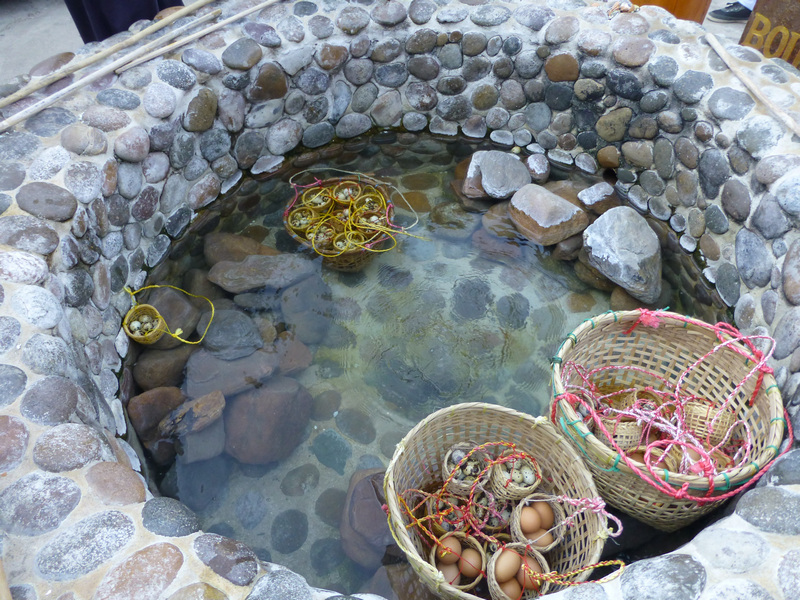
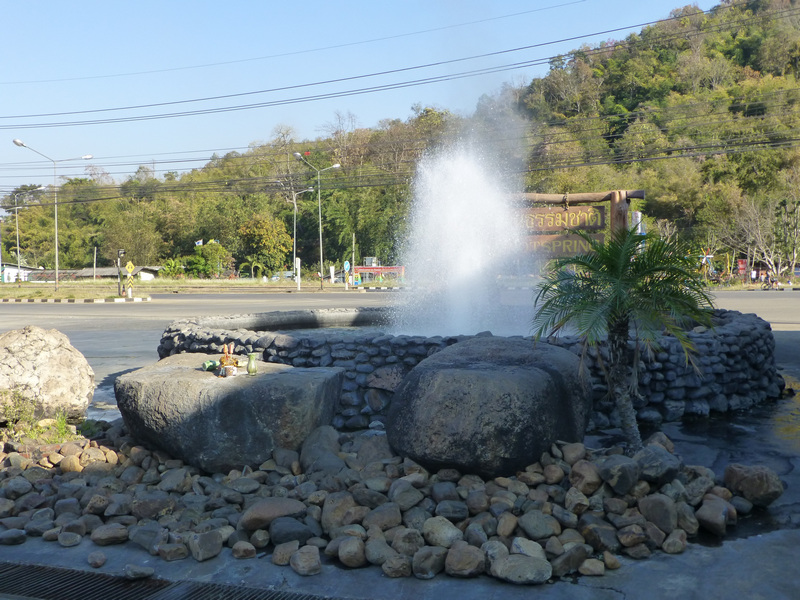
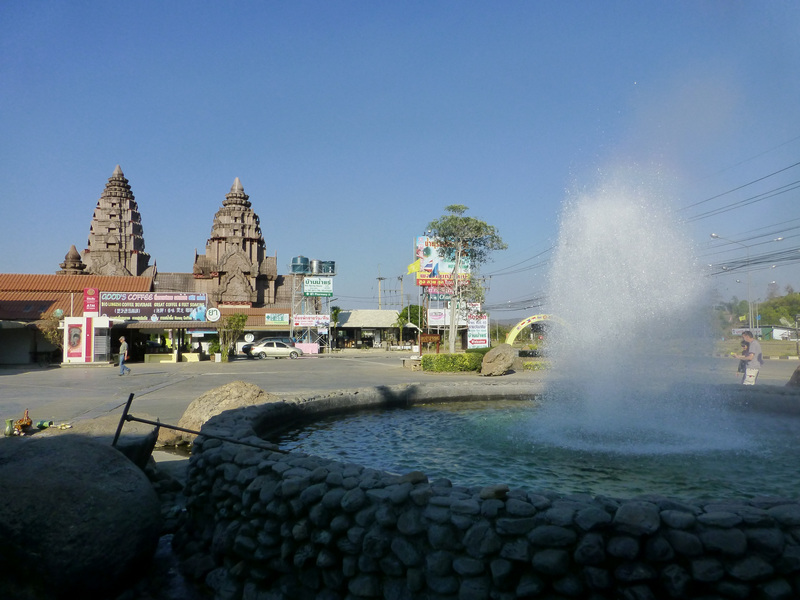
The conclusion from all these stories was that even if you are a king with power and money, still it is doubtful that you have a happy life. And although we had not yet found complete happiness, we fully enjoyed our journey through beautiful Thailand and imperceptibly reached the hot springs of Thaweesin. The sharp smell of mineral water wrinkles our noses, but gradually we got used to it, and together with the crowds of people we headed to the few separate ponds where we could dip our feet in the healing warm water. However, the water turned out to be warmer than I imagined, and my feet refused to soak there. I preferred to walk around the other stands and stalls, as interesting was the offer for 20 bahts to dip and take out a boiled egg from the same mineral water in which I refused to soak
After 30 minutes of free time, we boarded the bus again, getting closer and closer to the second largest city in Thailand – Chiang Mai.
GENERAL INFORMATION ABOUT CHANG RAI:
Location: Chang Rai is one of the largest northern cities in Thailand, located in the valley of the Mae Kok River, a tributary of the Mekong. The city is 860 km from Bangkok and 200 km from Chang Mai (the second largest city in Thailand).
Area: 23.49 sq.km
Population: 69 888 people
Official language: Thai
Altitude: 390 m
Climate: subequatorial
Time zone: UTC+7
Currency: Thai baht (THB)
Additional information: http://www.chiangraiprovince.org/
TRIP TIPS FOR CHANG RAI:
Best time to visit: all year round, especially festive during the Thai New Year in April.
Typical food and drinks: Thai food is famous all over the world, as the most delicious is of course “at home”. In northern Thailand it is worth trying glued rice with mangoes. Other local delicacies are tripe with chili, Sai Oua (Thai sausages of pork), Khanom Jee (rice noodles, most often served in the form of soup) and others.
Places to visit: There are many temples worth visiting in the Chang Rai area, such as Wat Phra Kaew (Monastery in the Bamboo Forest), Tham Tu Pu and the Buda Caves, the modern white temple Wat Rong Khun, the hot springs of Thaweesin, etc.
 TripTips