BANGKOK
THAILAND ROUNDTRIP – PART 1





The elephant walked slowly and confidently along the sloping road, shaking the tightly tied wooden seat on which we were sitting. The height we were at did not reduce the tottering, but the feeling of riding an elephant completely elated us. My smile was almost as big as the elephant. I was in Thailand, the land of a thousand smiles, riding an elephant, an animal, with which the Thais likened their country to the geographical map – a profile of an elephant looking to the West, with the southern part representing the trunk. The elephant represented wisdom and power, these qualities helped Thailand resist foreign invasions and keep the country uncolonized unlike its neighbours. Thailand was equally distant from China and India, with immigrants from China and trade with India having a strong impact on the country. Thailand is bordered to the northwest by Myanmar, Laos to the northeast, Cambodia to the east and Malaysia to the south. The country covers an area of 514,000 square kilometers, roughly the same as Spain (504,645 square kilometers).
During our 11-day tour we saw some of the most beautiful places in Thailand, and the good impressions left us with a desire to return to this magical country. Our tour through this treasure trove of sights, temples and aromas began with the huge and wonderful capital city.
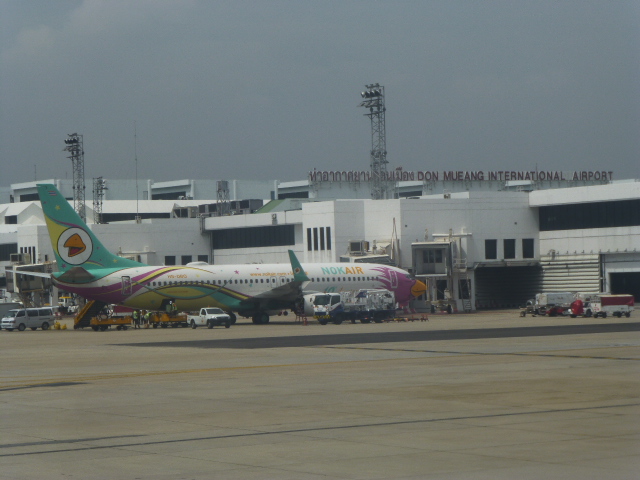
We landed in Bangkok on a flight of the low-cost airline Air Asia, and our plane left at the old airport of Bangkok Don Mueang International Airport. From the airport we ordered a taxi, which for 800 baht (44 BGN) for an hour (due to the big traffic jams and distances) took us to the hotel.
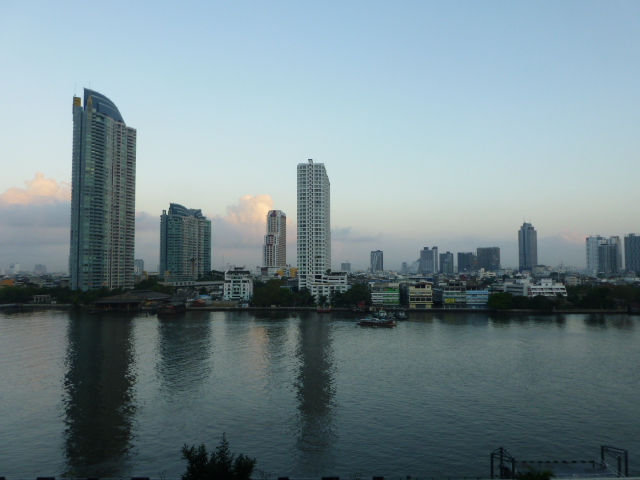
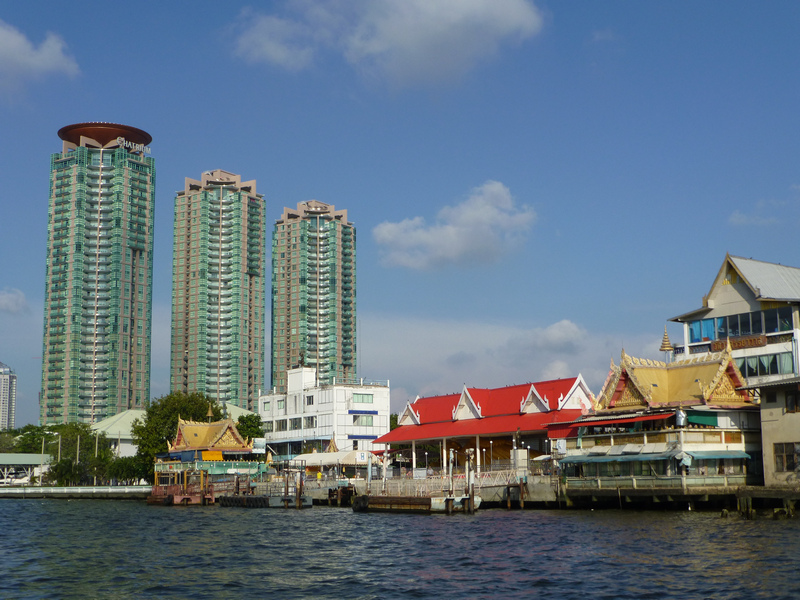
Hotel Ramada Plaza Menam Riverside Bangkok fascinated us, especially the view from the hotel room – we saw the huge Chao Phraya River and tall buildings on the opposite bank. Instead of watching them from the window, we took one of the free boats of the hotel, which every 30 minutes brought people to the city center. We enjoyed the ride and visited several street markets. We knew that Bangkok was famous with its trading traditions, which are as centuries-old as the religion here. It turned out that here is the largest market in the world – Chatuchak, which is a labyrinth of narrow streets leading to over 15000 boots that sell a divers array of merchandise and food, for which people must bargain. We didn’t succeed to visit it, but the many street stands we saw were enough to try bargaining over some souvenirs.
It was very hot. According to the World Meteorological Organization, Bangkok was one of the hottest cities in the world with an average annual temperature of 28 C.
At exactly 18:00 we went back to the hotel to meet our German group and our amazing tour guide. Our group consisted of 20 people from different parts of Germany and Austria. The tour guide briefly presented us the program for the next day, turning our attention to be dressed properly in order to visit royal temples so we should be with covered shoulders, long skirts without slits, and for men long trousers, as well as shoes that are easy to take off, as we would have to take them off several times. He also recommended us to exchange money at the flower market, where the rate is better than the one at the hotel.
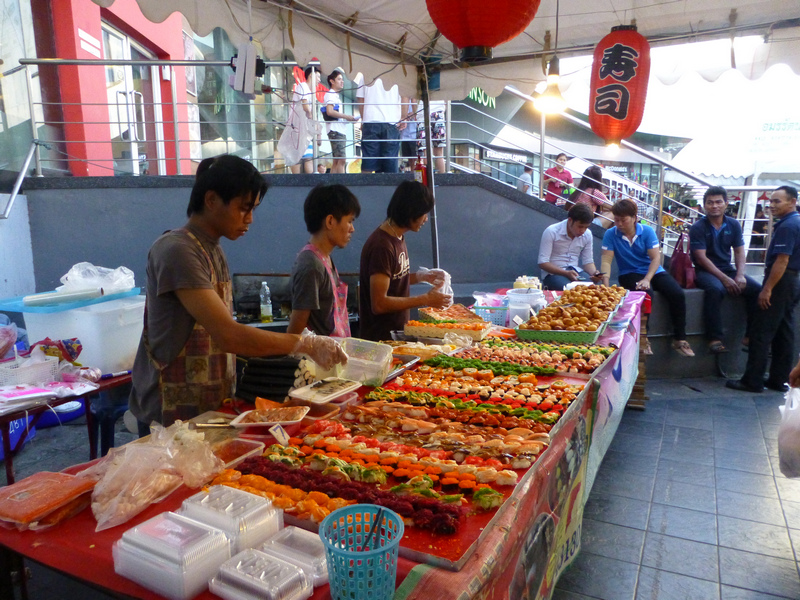
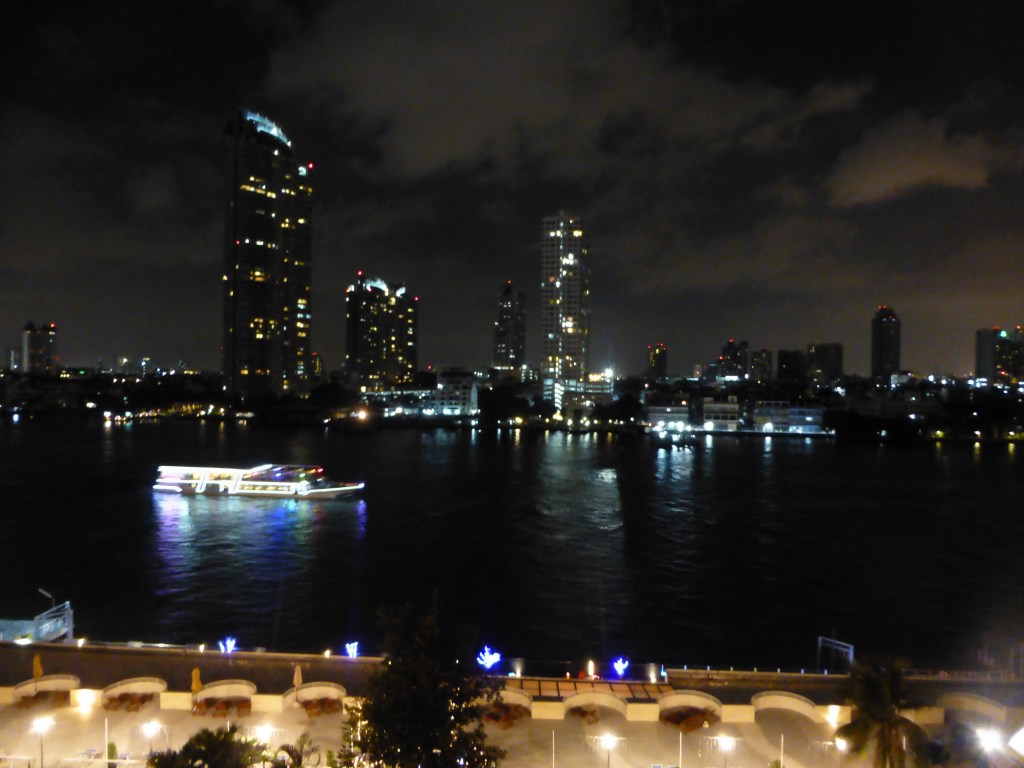
After all the directions, the guide accompanied us to the restaurant in the hotel, which amazed us with the diverse buffet tables. The only better view was the view of Bangkok. We sat on the terrace at a table, overlooking the Chao Phraya River and the illuminated boats passing by. The tall buildings on the opposite bank were also illuminated and among the aria of light we tasted traditional Thai food. I emphasized the shrimp with rice, as well as the very tasty sushi. It turned out that not Japan, but Thailand is the homeland of sushi and definitely this was the most delicious sushi I had tried so far. The variety of desserts was also great, with especially tasty Tiramiso, which melted in the mouth. We had a nice walk along the river and then restorative sleep in the comfortable beds of the Ramada Hotel.
Bangkok was not only the largest city in Thailand, but also the city with the longest name in the world. It turned out that although the name Bangkok means bang – “riverside village” and kok – “wild olive”, this was not the full name of the city. The full name consisted of 169 characters and sounds: Krungthepmahanakhon Amonratankosin Mahintharayutthaya Mahadilokphop Nophosin Ratchathaniburirom Udomrathaniwetmahasa Amonphiman Awatansathit Sakkathatiya Witsanukamprasit and means: City of Angels, Great City of the Immortals, Magnificent City of Nine Gems, Seat of the King, City of Royal Palaces, House of Incarnate Gods, erected by Viswakarman at the behest of Indra.
Bangkok is also known as the “city of temples”, as there are over 400 temples, almost on every street. Since we could not visit them for a day, we decided to look at them while spending money. It turned out that all the temples painted on the Thai coins were actually located in Bangkok. The currency in Thailand was baht, with 1, 2, 5 and 10 bahts on coins, and 20, 50, 100, 500, and 1,000 were on notes. On the 1 baht coin was painted the temple of the emerald Buddha – located in the Grand Palace Wat Phra Kaew; At 2 baht was Wat Saket, the temple on the mountain; the 5 baths – Wat Benjamabophit / Marble Temple and 10 bati – Wat Arun or the wonderful temple of the sunrise
Our morning tour began with a visit to one of the most sacred Buddhist temples in Thailand Wat Phra Kaew – the temple of the emerald Buddha. While traveling by bus to the temple, the guide briefly told us the story of Bangkok, which since 1782 became the fourth capital of Thailand. The previous capitals in the country were Sukhothai, Ayutthaya and Thonburi, and during the 8-day excursion we would visit them all without Thonburi, which was located on the other side of the river next to Bangkok.
The history of Bangkok was not so ancient, it began sometime around the 15th century, when the city was under the rule of Ayutthaya. The strategic location of the city at the mouth of the Chao Phraya River quickly increased its importance, and after the fall of Ayutthaya, King Thaksin moved the capital of the country to Tonburi, on the west bank of the river. Due to the marshlands, the successor of King Thaksin moved the capital to the left bank of the river, into Bangkok. The guide explained us that the local rulers were all called Rama, after the first ruler, and the Thais accepted this name as a title, unlike the Germans, who associated Rama only with the name of a brand of margarine.
Bangkok covers an area of 1500 square kilometers (or three times as much as Sofia), with about 12 million people living here, 6 million registered and remaining coming and working here. There were also 1 million Chinese living in Bangkok, and according to the tour guide, they are not as happy as the Thais. Thai people, for example, smile constantly and believe that they are rich enough, while the Chinese always want to be even richer. Most of the Chinese came here fleeing the communist regime, they are especially proud when they have a beautiful daughter, who gets married with a Thai man and thus obtained citizenship. The tour guide himself was married to a Chinese woman. Thais celebrated the New Year three times a year, once on December 31, once with the Chinese in February, and then in April they celebrated the Thai New Year. But it is not the many holidays that make Thais so happy, but the history that had saved their territory from foreign invasion. It turned out that Thailand was never conquered by other nations. The guide proudly presented us all neighboring countries of Thailand that were European colonies at the time. To the west, Thailand borders Myanmar, even further west of it remains India – both countries were once English colonies. South of Thailand is Malaysia, also a former English colony. To the east are Cambodia, Vietnam and Laos, former French colonies, and to the southeast is Indonesia, once a Dutch colony. Only Thailand in the middle remained independent over the centuries.
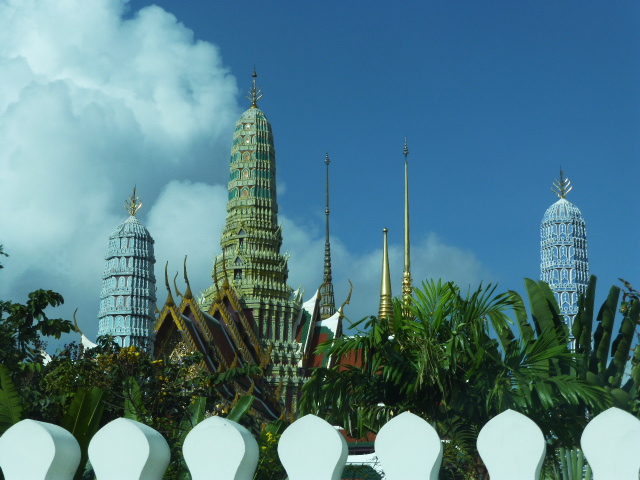
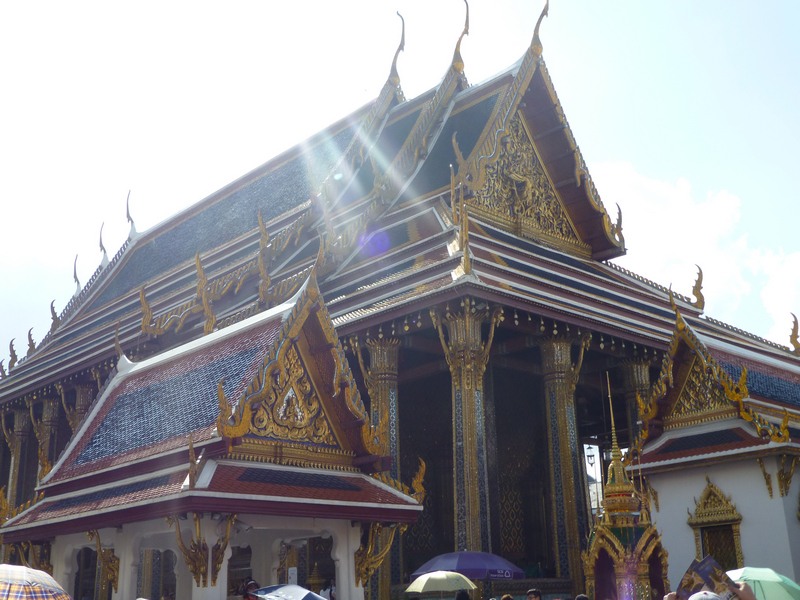
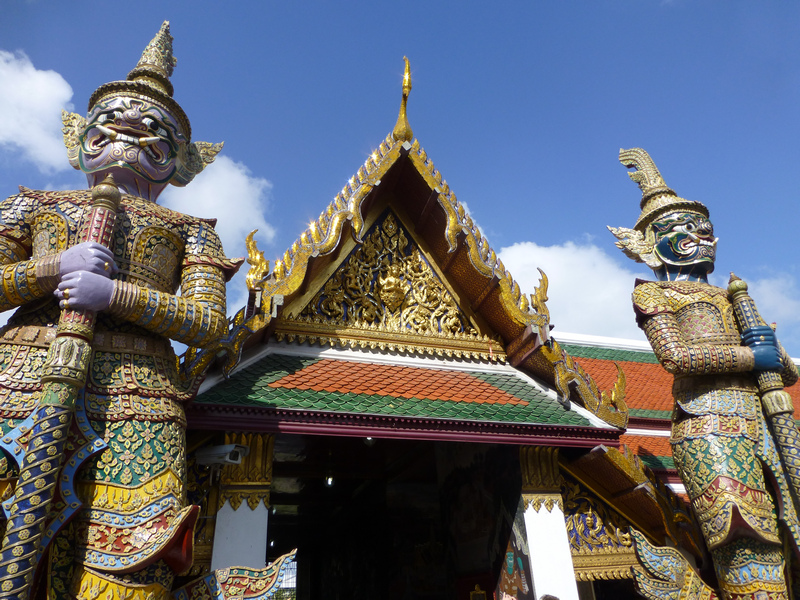


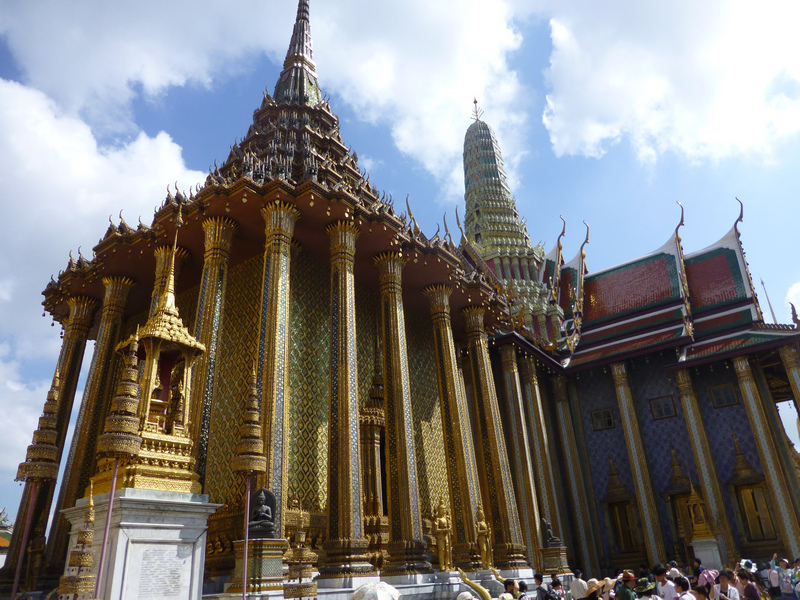

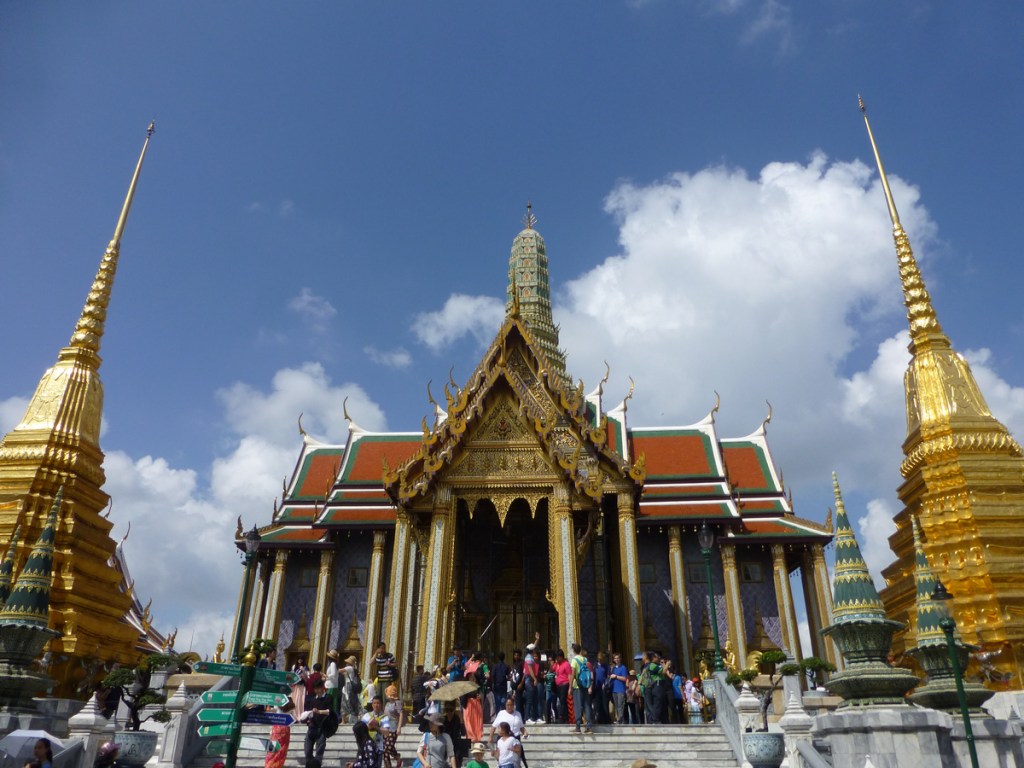
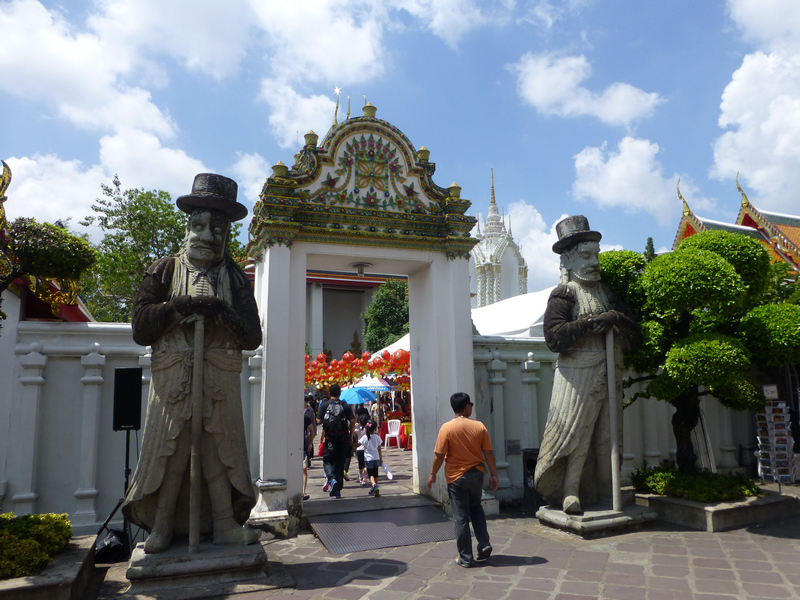
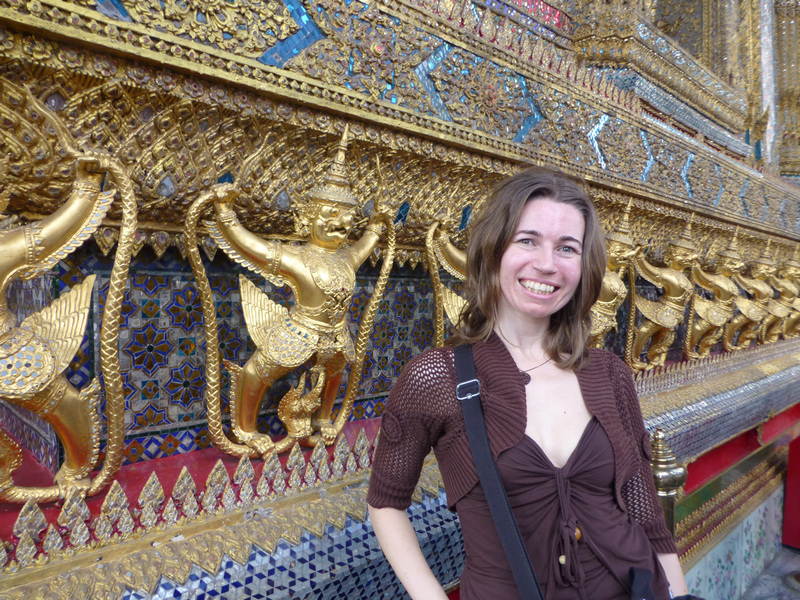
Wat Phra Kaew Temple was located in the historic center of Bangkok, behind the white walls that protect the royal palace. The temple houses the statue of the emerald Buddha, who 5 centuries ago unknowingly emerged from India during the reign of King Rama I, whose dynasty continued to rule to this day with King Rama IX. The statue was only 66 cm tall in dark green, in Thai, the word emerald meant a dark green color, not a gemstone. I was personally impressed more by the huge figures that guarded the temple.
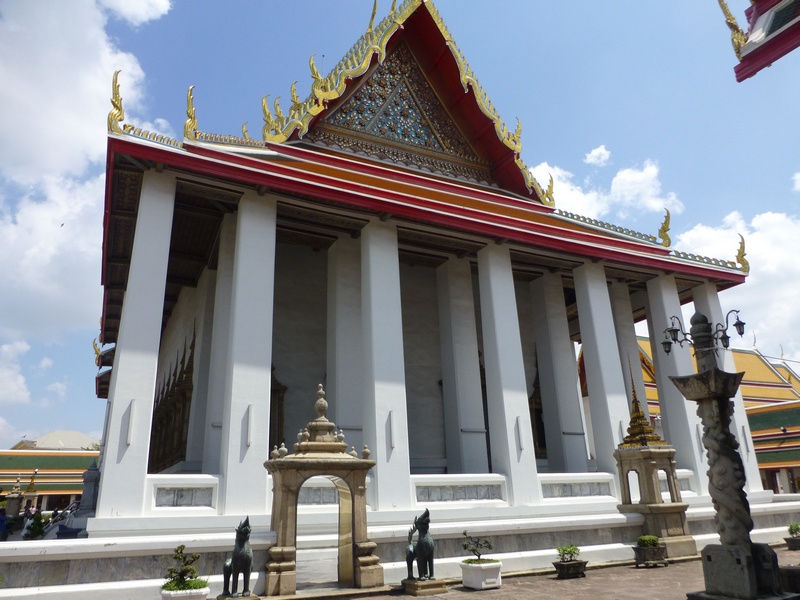
The tour guide introduced us to the main buildings that each temple complex has. The most important and holy building was the “bot”, often the most impressive building, with lavishly decorated doors and shutters, as the bot served as a gathering room and religious ceremonies and ordination were held here. To enter these buildings we had to take off our shoes and walk around it barefoot.
The initial leaving of my shoes outside greatly worried me and I toured the bot very quickly, glad that my shoes were still there. After the eighth day in Thailand, after no stolen shoe, I walked much more slowly and calmly. On my first day, however, I quickly left the sacred temple, praying that my shoes would not be stolen in it. Right in front of the bot there was a small fountain with lotuses. Visitors took the shredded lotuses, immersed them in the water and sprinkle some water over them. We did the same, praying for health and happiness.
Another important building in the Thai temple complexes was the so-called “cheddy”. They originated in India and were domed monuments originally intended to preserve sacred Buddha relics—texts, statues, and bits of bones. The cheddy of this temple were gilded – the color of the sun made it sacred. According to legend, it was in a similar cheddy in the Wat Pa Yia Temple (the monastery of the bamboo forest) in the city of Chang Mai, in 1434 a strong lightning split it and from there appeared the emerald Buddha. The statue was brought to Bangkok for safekeeping, and not long after, the King of Chang Mai wanted the statue back, but gave up when the elephants carrying it stopped and did not want to continue. He saw in this omen and brought back the statue.
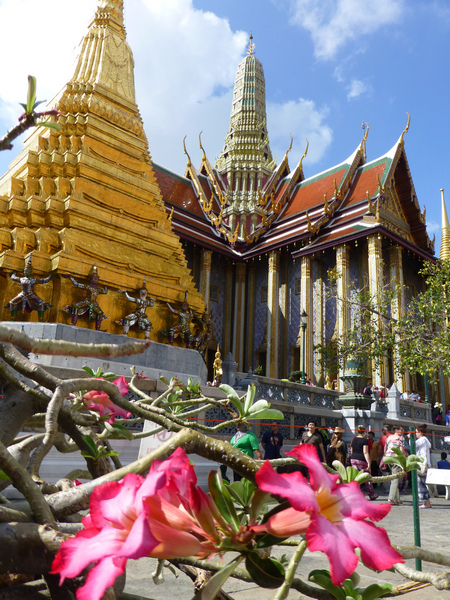

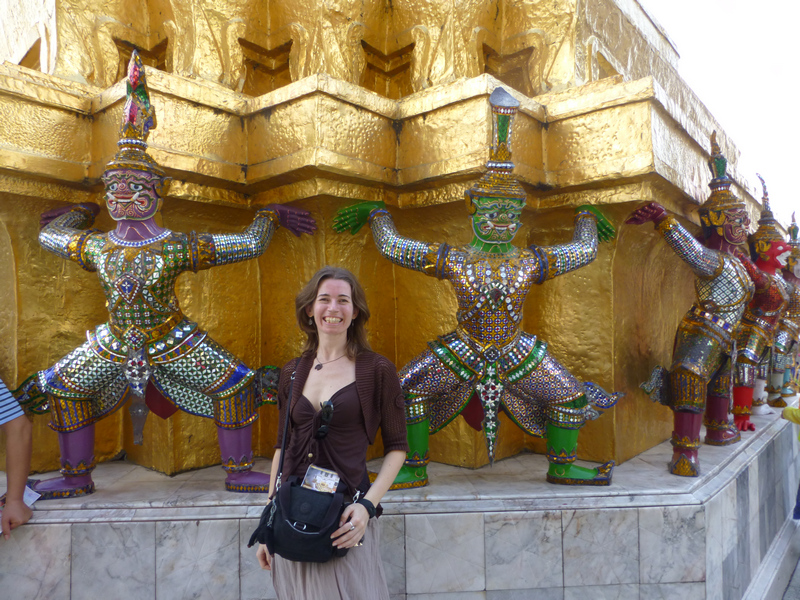


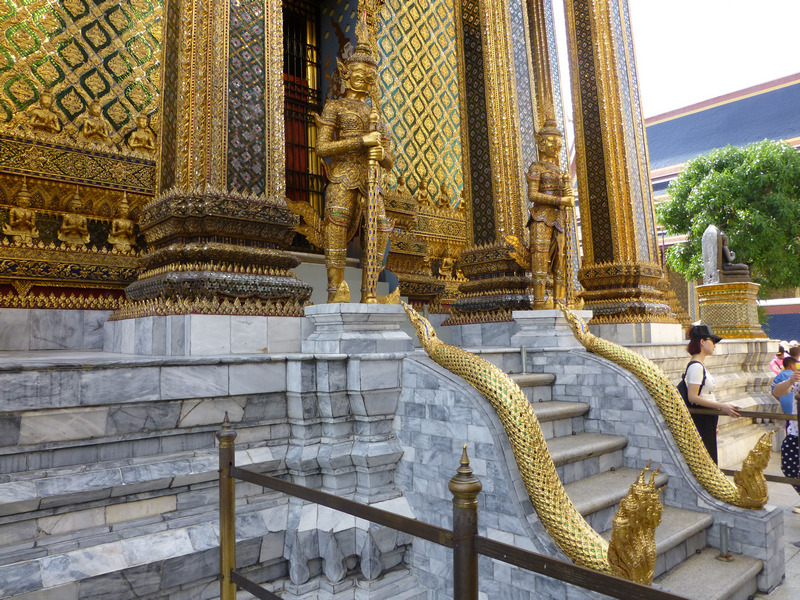


After the temple, we visited the exquisite royal palace, which was the official residence of the king of Siam, and later of Thailand. Today it continued to be a place for important meetings, but King Rama IX himself had moved to another palace. The “old” palace was erected in 1782 by order of King Rama I, when the capital of Thailand was moved from Tonburi to Bangkok. We walked through the royal palace, consisting of numerous buildings, gardens and museums. Then we went outside the white walls, and on foot we headed to the next temple, located in the immediate vicinity.
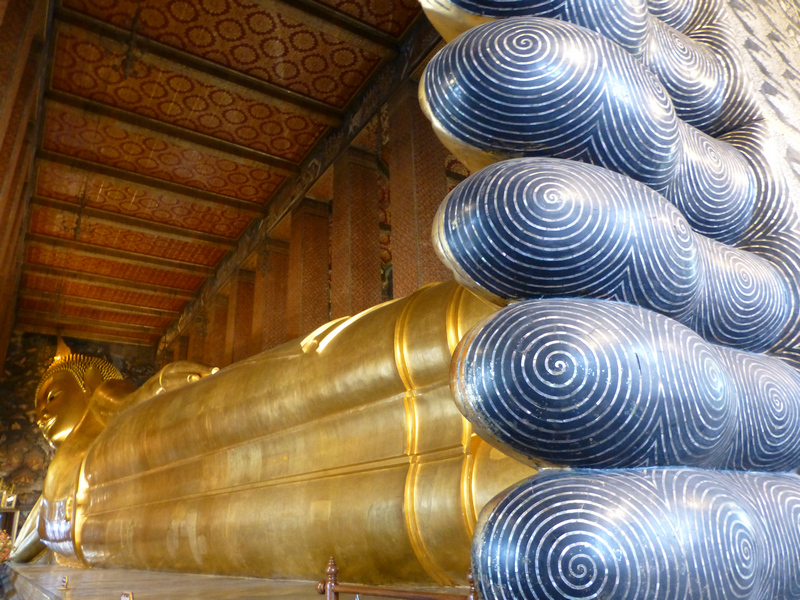
We visited the largest temple in Bangkok Wat Pho – the temple of the reclining Buddha. The name Wat Pho came from the Indian monastery where the Buddha was believed to have lived, being the largest and one of the oldest temples in Thailand. In fact, the temple was erected long before Bangkok became a city. Its size we could judge by the huge statue of the reclining Buddha – 46 meters long. Here the guide explained to us the three poses, which Buddha occupies on all reclining statues. The first was the reclining Buddha with open eyes and legs parallel to each other, which meant that the Buddha looked at us, as was the long statue in this temple. The second posture is with closed studies and again parallel legs and feet, meaning that the Buddha rests. The third posture is with eyes closed and the feet diverge, which means that the Buddha is in a state of nirvana.
Since its inception, this temple has been an important center for the development of Thai medicine, it is believed that it was here the first place in the country offering training in Thai massage. This ancient skill continues to develop today, as the temple offers 10-15 day courses led by professionals. However, the guide recommended us to try Thai massages in northern Thailand, where the prices are much better than in the capital, and the quality was the same.
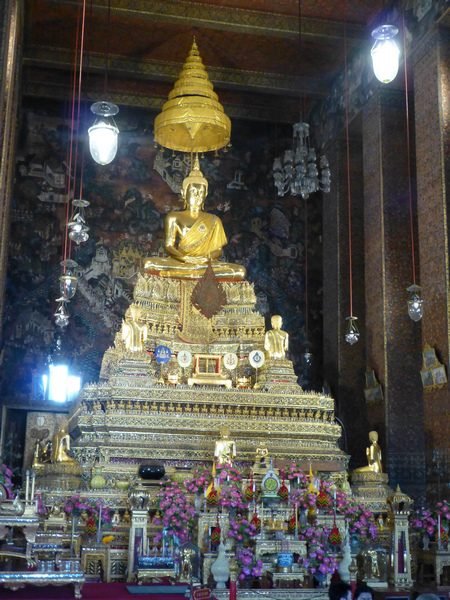
We walked around the temple complex admiring the lavish “bot” and the flower-decorated mosaic “cheddy”, as well as a gallery with almost 400 statues of the Buddha in classical Ayutai style erected in front of them. The tour guide explained us how to distinguish Thai Buddhas from Indian Buddhas, and the main difference was the long hats or raised hair that Ayutai and Thai Buddhas have. The postures and placement of the Buddha’s hands also had important symbolism. In the statues, the Buddha is mostly seated. in the Lotus pose, often his hands are parallel, placed on top of each other, which means that he meditates. When the right palm is relaxed and points upwards, it means that the Buddha invites people to pray with him. When Buddha’s index finger and thumb merge, it means that he is currently learning. When the right hand is raised to the chest and the palm is visible from the front, it means that it symbolizes a shield and means that the Buddha protects us.
Later, the tour guide told us about the meaning of each finger of the hand. For example, the thumb shows the person and when only the thumb is shown, it means that you are number one. The index finger shows the outside world and therefore serves to point. The ring finger bears the name that you have no right to vote and therefore the rings are placed on it. The middle finger shows the golden mean, something we have always had to strive for. If we eat a lot we will have problems with the abdomen, if we eat a little we will strive – so we must observe the middle line.
I got very interested in the symbolism of the fingers and later I read more on the subject. It turned out that the movement of the thumb requires a large part of the brain, so it was believed that the thumb personifies personality and is associated with self-control and desires. People with longer thumbs usually have more control over the world around them. The smaller thumb shows accordingly, that a person is more dependent on his surroundings and it influences him. The difference in the size and shape of the thumb shows logic and decision-making.





The index finger, also called Jupiter’s finger, serves as a guide and ambition. This finger shows the direction we have taken. The shorter index finger indicates a lack of ambition.
The middle finger is the finger of Saturn – it is the wisest and most serious finger. This is the finger that makes us ask ourselves deep questions. It helps us to be structured and disciplined. A shorter middle finger (its length is less than the width of the palm) means a lack of discretion, but a too long middle finger indicates a lack of spontaneity and warmth.
The ring finger is the finger of the sun and helps us to rise and share. It is the finger of courage and destiny. When it is too short, there is a lack of passion and people are too anxious or insecure. When it’s especially long, people like to attract attention and manipulate others.
The little finger is the finger of Mercury. It helps us communicate better. A short little finger usually shows naive people, and a longer one shows good speakers as well as good liars.
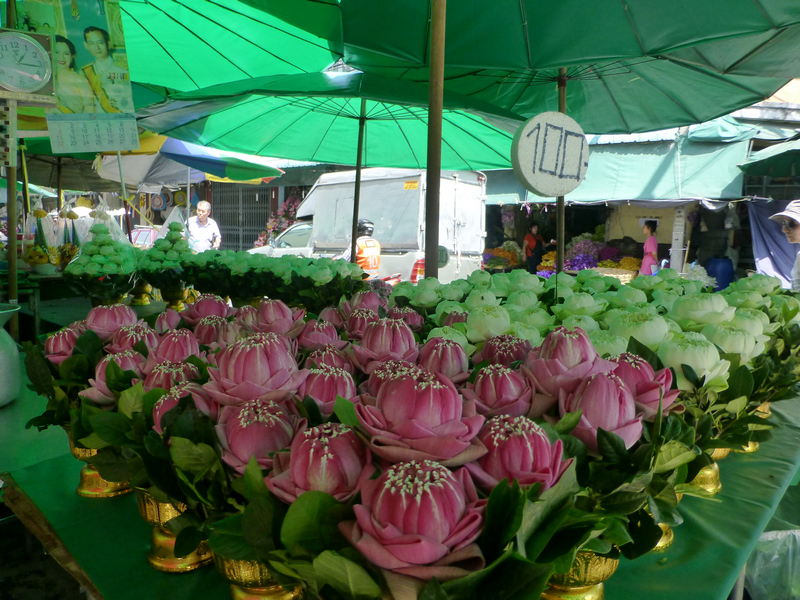

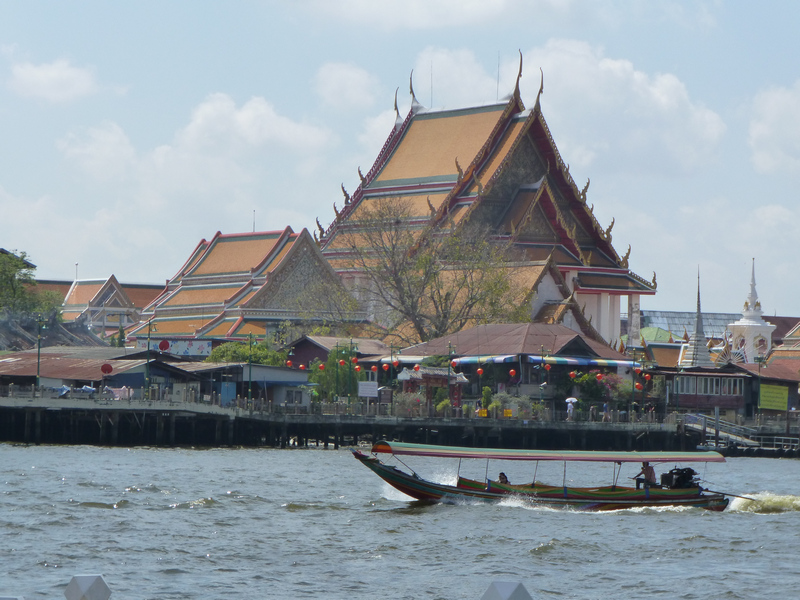
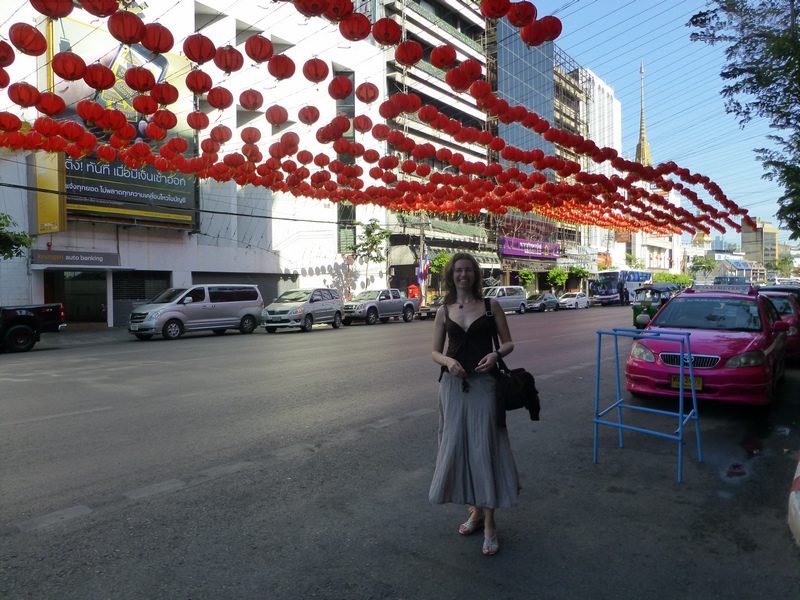
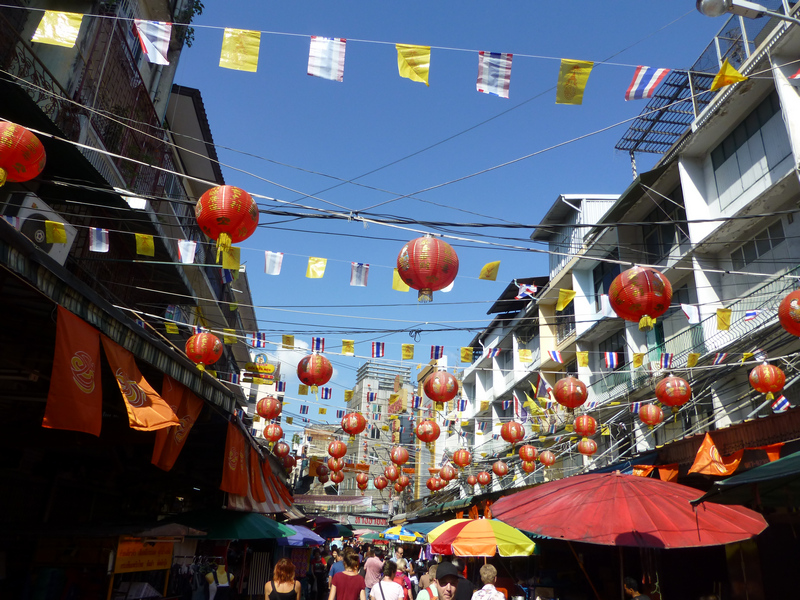
Leaving the temple Wat Po we headed on foot to the flower market. From the thousands of stands there were wonderful aromas and diverse colors. In addition to the familiar flowers in our country, such as roses (a large bouquet of roses here cost about 1 euro!), there were also different orchids and lotuses (the huge lotuses in a pot costed 100 baht or 2.5 EUR). We learned that Thailand is one of the largest exporters of orchids in the world, and later during our excursion in Chang Mai we will visit an orchid reserve. We crossed the colorful stands and headed to a small pier for boats, and here there was an exchange desk where almost the whole group exchanged money.
We boarded a boat, which took us to a restaurant on the riverbank, where there were large buffet tables and several other groups of tourists. I especially liked the rice chips, as well as the variety of desserts and sweet pastries accompanied by miniature but very tasty bananas the size of a human finger. The tour guide told us that in Thailand people love sweet things and even overeat with them, which led to sugar sickness, which was unfortunately the most common disease here.
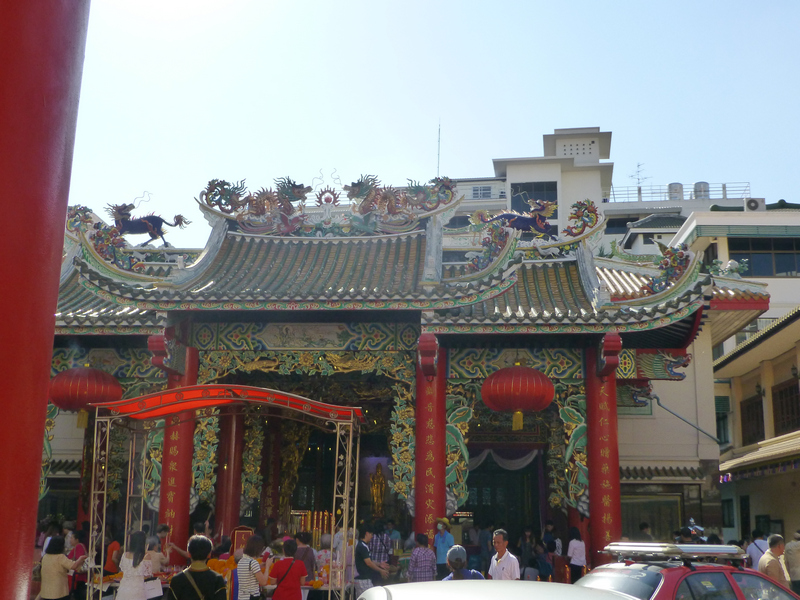
After a delicious lunch, we continued our walking tour of one of the oldest neighborhoods in Bangkok – Chinatown. This is actually the largest Chinatown in the world. It is home to about 1 million Chinese, most of them second or third generation. The neighborhood was lavishly adorned with red lanterns and flags, probably left over from the festive New Year, that was a few days ago, or the decoration may be permanent to distinguish it from other metropolitan neighborhoods. Trade stalls were everywhere, selling almost everything from food to clothing. At the end of the main street we were waiting for the bus, which picked us up and took us back to the hotel.
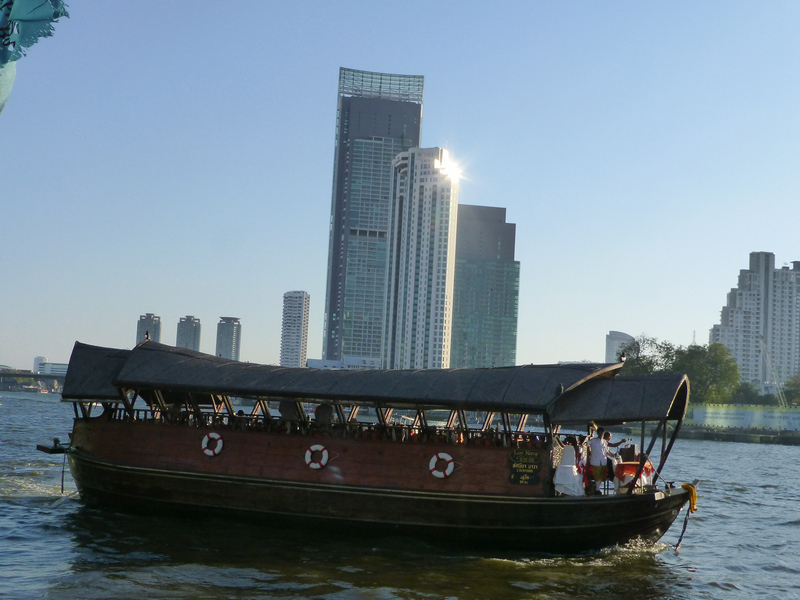
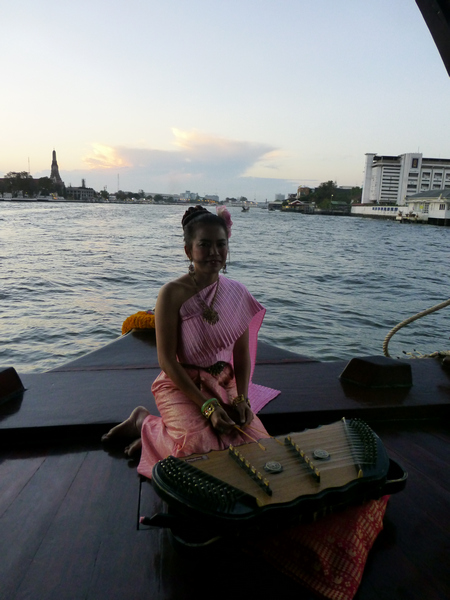
By the end of the day we had free time, but instead of using it for sunbathing and lounging by the hotel’s outdoor pool, we signed up for a boat dinner and a night tour of Bangkok’s canals. We wanted to feel why they called Bangkok – the Eastern Venice, and to see the preserved canals with beautiful houses on its banks. The Loy Nava night cruise was described as a 5-star experience. But personally, I was disappointed with the food, service and seats.
The tables were arranged so that only one from two people could enjoy the coastal views, and the other must watch the boat interior, which was not that impressive. While we were being served the food, the waiter spilled some of the soup, but he never wiped the tablecloth. There were dancers who presented two dances and that was the whole program. In order to take pictures of the beautiful landscapes, I had to get up and stand almost all the way, hardly eating the tasteless food, which could not be compared to the delicious dinner in the hotel. I definitely would not recommend these boats, otherwise in the river we passed many other illuminated boats whose passengers seemed more satisfied.
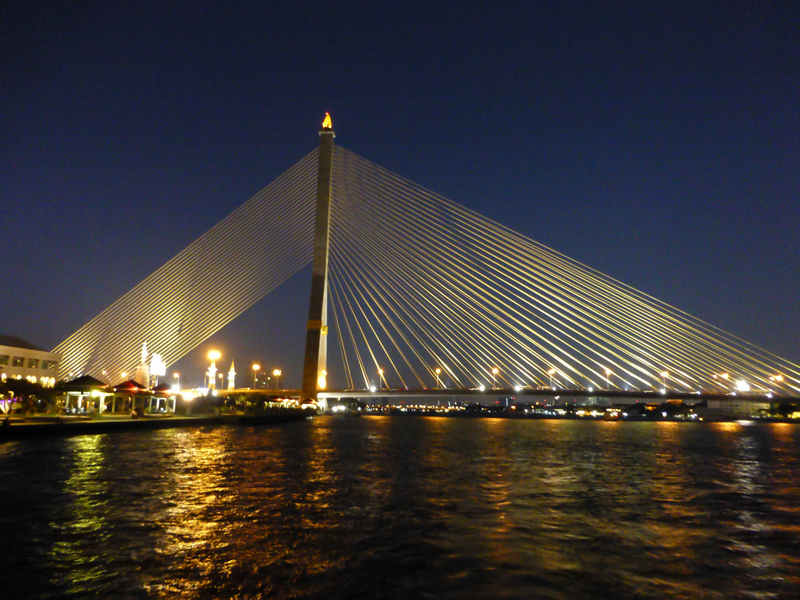
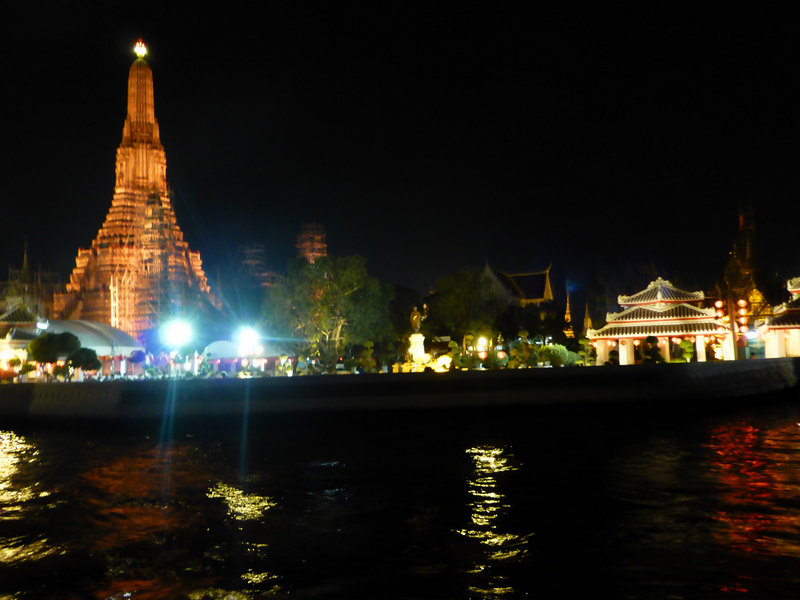
Unlike the Loy Nava cruise, midnight Bangkok fascinates me. All bridges, temples and buildings were lit up and playfully reflected in the water. Especially beautiful were the Wat Pho Cathedral and the Royal Palace that we had visited in the morning. The Rama VIII rope bridge, under which we passed, was illuminated and then we made a circle and came back. On our way back from our side we saw the beautiful temple of the sunrise Wat Arun, which was shining like the sun, ready to meet the sunrise. This temple was erected on the site of the ancient Chinese temple wat Cheng. During the reign of King Taksim, this temple received royal status and was named after the Indian goddess of dawn Aruna and recreated Mount Nehru as the center of the universe. The four smaller towers around the main building symbolize the world’s oceans, and the four pavilions – the four winds. .
After the cruise, we headed directly to the hotel to pack our bags and prepare for tomorrow’s early get-up. The last night in Bangkok we fell asleep with the bright lights and images of this modern city that managed to preserve its ancient traditions and culture. There were many more places that we could not visit like the floating markets, but this was the best, we left the city with good impressions and with a desire to visit it again.



GENERAL INFORMATION ABOUT BANGKOK:
Location: Bangkok is situated at the confluence of the Chao Phraya River into the Gulf of Thailand.
Area: 1 569 sq.km
Population: 9 100 000 people
Official language: Thai
Altitude: 1.5 m
Climate: subequatorial
Time zone: UTC+7
Currency: Thai baht (THB)
Additional information:http://www.bangkok.com/
TRIP TIPS FOR BANGKOK:
Best time to visit: all year round
Typical food and drinks: Thai food is famous all over the world, and the most delicious is of course “at home”. While in Bangkok, be sure to try: Khao Pad – fried rice, Tom Kha Kai – coconut soup with chicken, Hoy Tod – shrimp omelet, and why not the more unpretentious Moogata – the Thai barbecue that is sold on the streets
Best places to visit: Royal Palace, Wat Po (the oldest and largest temple in Bangkok), Wat Arout Temple, floating market, Lumpini Park (the largest park in central Bangkok), Ocean World Siam (whose aquarium has more than 30,000 aquatic creatures) and many others.
 TripTips