MEXICO
PART 9 – MEXICO CITY – BEYOND PERCEPTIONS
author: Ana Boneva

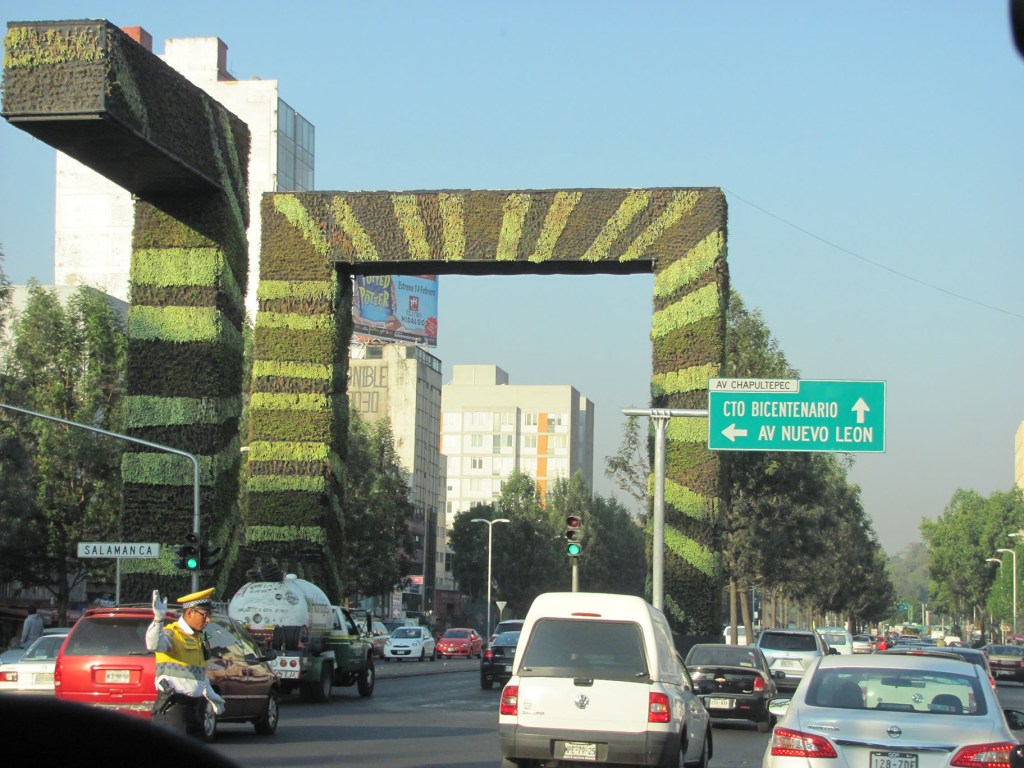


The airport of Mexico City surprised us with the speed of service, as our suitcases were distributed and disembarked before us. After all, our flight was domestic and we were in Terminal 2, Terminal 1 for international flights was bigger and busier. A bus took us to the Zona Rosa Hotel****, which is housed in a tall glass building in the Zona Rosa neighborhood, on Liverpool Street, with nearby streets also bearing the names of European cities. The great boulevard next to the hotel was called Florence, and it intersected with London Street. On the other side of the boulevard were Warsaw and Prague streets, respectively.
The next day we started our organized tour around the city, and we were impressed how huge Mexico City is. Its territory is about 1485 sq. km with a population of over 20 million people. The city rose to 2250 meters above sea level, making it not only one of the largest cities in the world, but also one of the highest capitals. Subsequently, I read on the Internet which are the 10 capitals located at the highest altitude and these are respectively: 1) La Paz / Bolivia at 3640 m; 2) Cuito / Ecuador (at 2850 m); 3) Thimpu / Bhutan (2648 m); 4) Bogotá / Colombia (2625 m); 5) Addis Ababa / Ethiopia (2355 m); 6) Asmara / Eritria – a country in Central East Africa (2325 m); 7) Sana’a / Yemen (2250 m); 8) Mexico City / Mexico (2240 m); 9) Nairobi / Kenya (1795 m); 10) Kabul / Afghanistan (1790 m). According to these statistics, Sofia ranked 47th with its 542 meters above sea level.
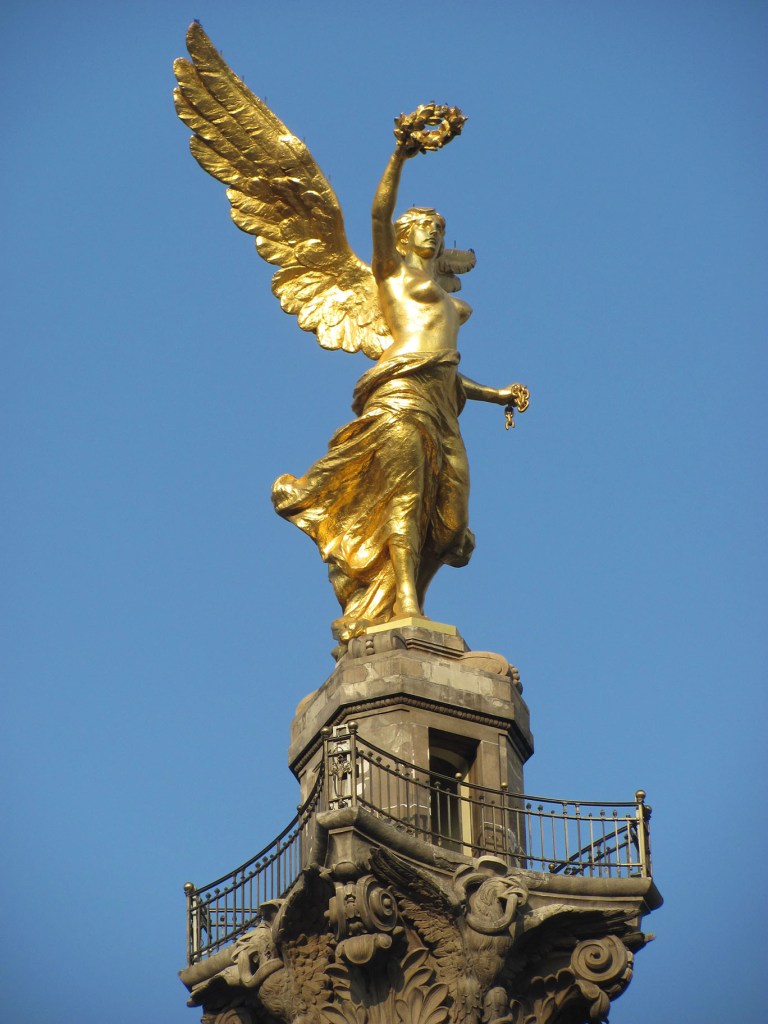
The bus took us 200 meters away from the hotel to the monument of the Angel of Independence (El Angel de la Independencia), where we got off for a short photo break. The monument was a 36-meter high column with a golden angel on top and was erected in honor of the declaration of independence of Mexico from Spain. At the base of the column there were bronze sculptures symbolizing respectively Law, War, Justice and Peace. Among them was a statue of a lion led by a child, which showed strength and innocence in times of war and peace. The golden statue at the top actually symbolized the Greek goddess of victory, Nike. It was 6.7 meters high and was made of bronze with a gold coating. In her right hand she held a laurel wreath, and in her left she held broken chains symbolizing freedom. Unfortunately, we did not have time to climb the 200 steps to the top, from where a wonderful bird’s-eye view of the large boulevards that merged here was revealed.






Our 5-minute break quickly passed, and we went back to the bus, which departed from the Plaza de las Tres Culturas. The name of the three cultures came from the buildings and ruins left by the three different periods in Mexican history: 1) the Aztecs (pre-colonial era) with ruins of their temples, 2) from the colonial era – the beautiful Catholic church erected in 1610, and 3) from the independence of Mexico – modern residential buildings built in 1964. Interestingly, the older the ruins and buildings were, the more beautiful, massive and with beautiful reliefs they were. Modern construction, interestingly, had not inherited anything from the aesthetics of the past and, although it had modern technology, it was built in the most elementary way.
The Aztecs were actually an Indian tribe that around 1300 (shortly before Bulgaria was enslaved by the Ottomans) came to the Valley of Mexico, which at that time was inhabited by other tribes. They settled on the swampy shores of Lake Texoso, creating floating gardens on which they grew various foods and created dams to maintain the water level. The floating gardens were actually rafts anchored in the swamp, on which soil was poured and plants such as chili peppers, pumpkins, corn, tomatoes and beans were planted. In moisture, plants quickly grew and yielded crops. Their cities were especially beautiful, with rich people building their homes from clay bricks, and if they were very rich, from stone. Their homes were white to look clean and shiny. Each house had a steam bath, and bathing was an important part of everyday life, like religion. It was believed that the bath purified both the body and the soul. The homes of farmers and the poor were like huts with thatched roofs. They had little furniture, mainly bedding on the ground and shelves for their accessories (blankets and tableware).
Now we were piling up with furniture, and how much better it would be if instead of them we had a steam bath or a sauna in our homes and thought more about purifying the body and soul than to accumulate dust in our houses.

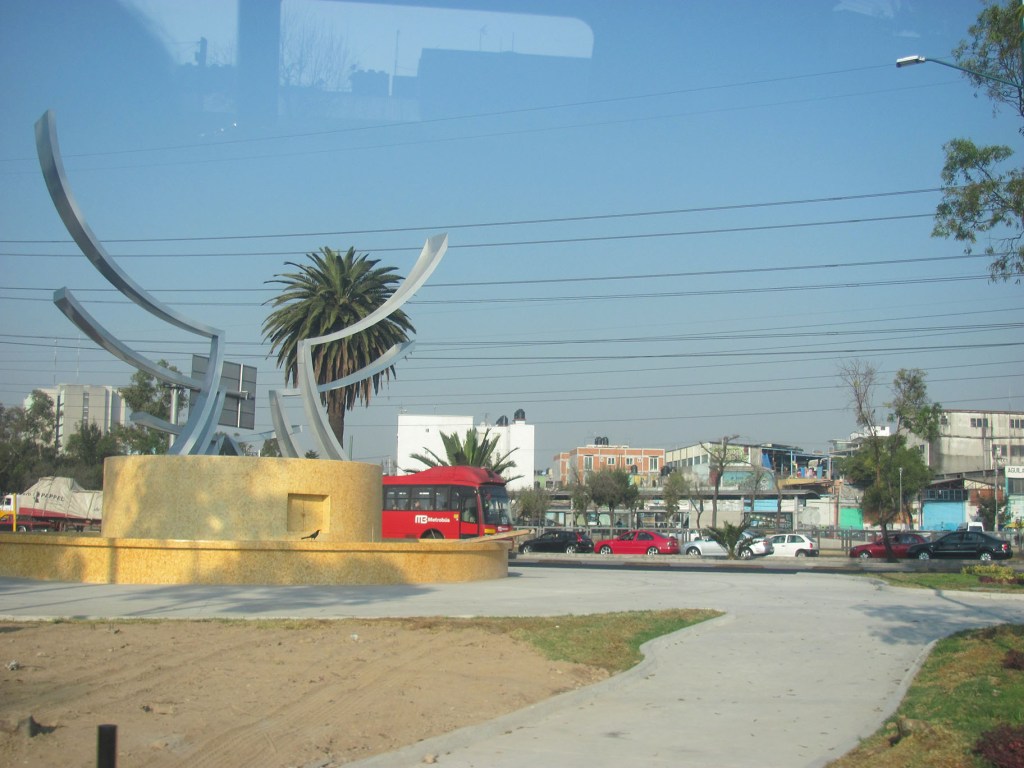

The mixture of Aztecs, colonial era and modernity could be found at our next stop – at the sacred church of Guadeloupe, where a huge Aztec clock was erected, the old colonial cathedral aroused admiration, and the new temple was filled with positive energy. The Basilica de Guadalupe was the richest and most visited Catholic church in America. According to legend, it was here in 1531. the dark-skinned Virgin appeared before the Indian Juan Diego. She was named after the Virgin of Guadalupe. The old basilica was erected in the 18th century, with the two twin towers having baroque facades, with reliefs of the Virgin, with the circular church dominating between them. The new church could accommodate 10,000 worshippers. It was believed that Virgo appeared here 4 times. Every year on December 12, about 50,000 people gathered here and celebrated the anniversary of the appearance of the Virgin
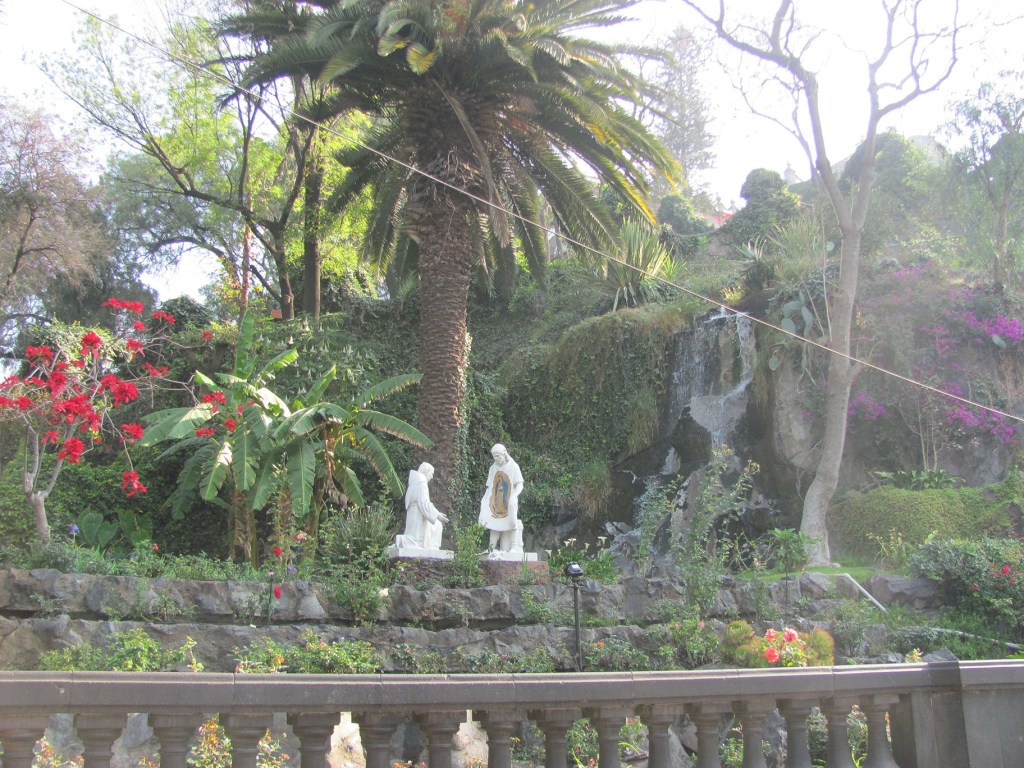
Our tour of the temple complex started from the beautiful gardens. There was a variety of flowers, trees, fountains and waterfalls, all of them perfectly maintained and creating complete harmony. It was morning, the gardens were still empty on the part of visitors, but not on the side of plants. Walking along the beautiful alleys, we passed by corners with cacti and others decorated with roses, and it was as if we were in a botanical garden, or more precisely – this is how I imagined paradise – not with dry sands and sea, but with beautifully maintained greenery, among which waterfalls descended.
There was also a variety of statues, among which the most impressive were collected under the name of La ofrenda / Giving and showed the Virgin of Guadalupe receiving gifts from the local population. We were in Tepeyac Park, where the sacred temple of the Aztecs dedicated to the mother goddess Tonatzin was once built, after which it was destroyed by the Spanish conquerors. However, the sanctity of the earth remained, and not long after, a chapel was erected in the same place, which grew into a basilica. As Mexico City was built on an ancient lake, the earth gradually began to sink, and with it the old basilica. Therefore, a new, even more spacious cathedral was built, in which several liturgies were celebrated daily and attracted more than a million visitors all year round.
The alleys in the park led us to the Aztec Clock, a massive modern sculpture erected in the square opposite the Basilica of Our Lady of Guadalupe, which showed how the Aztecs counted down the days and hours. There was a sundial here, the Aztec calendar was depicted in a large circle, there was an astronomical clock, etc.




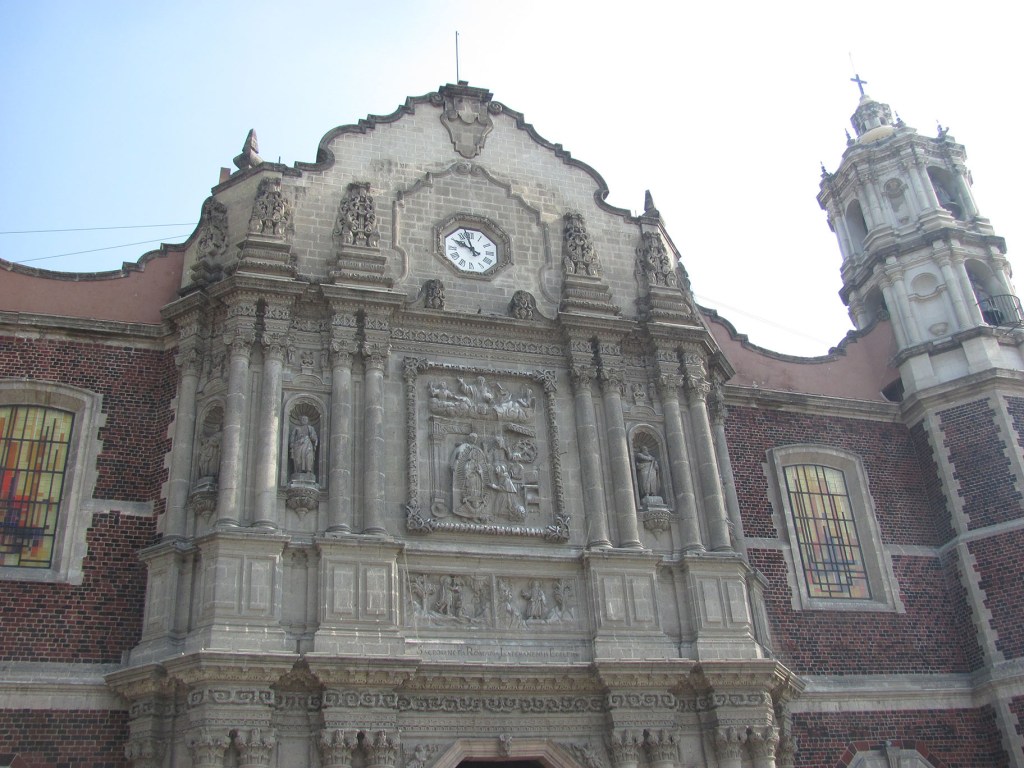


Music was playing in the square, coming from the new building of the basilica, where there was a mass. However, we headed to the old colonial basilica, the construction of which had begun as early as 1531, additional elements were placed in the 16th and 17th centuries, and it was not fully completed until 1709. From then until 1974. the church kept the mantle that the peasant Juan Diego wore when he saw the Virgin of Guadalupe. In 1921. A bomb was brought into the church hidden in a flower pot, which caused serious damage to the interior, but not Juan Diego’s mantle.
Due to the sinking of the foundations of the Old Basilica, the construction of a new modern building began, in which the miraculous icon of the Virgin of Guadalupe was brought and is kept here to this day. The new basilica was built between 1974 and 1976, and has a circular shape so that the icon of Guadalupe can be seen from anywhere in the church. The diameter of the basilica is 100 meters and can accommodate 50,000 people.
On our sunny day, although there were not so many people, we could still say that the church was full. The liturgy had just ended, and prayers were heard in different languages. I wasn’t a big fan of modern art and I didn’t expect this modern building to impress me with anything, especially after I had seen the beautiful altars in the old basilica, but this time I was wrong. As soon as I entered, I felt some warmth and the scent of candles and prayer. Above the altar there were lamps resembling beehives, and below them, in the valley under the icon, there was a small moving path (like an escalator) that helped all people, even the disabled, to reach the holy icon of the Virgin of Guadalupe and pray to her. I came out of the temple purified and full of faith. It is no coincidence that Catholics said that every believer had to enter this temple at least once in his life and pray. It was an amazing feeling, and I felt blessed.
We got back on the bus and were transported back in time, heading to the ancient temples of the Aztecs. We were on our way to Teotihuacan, a name meaning “the place where people become gods.” It was one of the most impressive cities in the ancient world. It was created before the new era and even at that time the population here numbered 125,000 people. However, it was later destroyed (probably by its own people) and abandoned in 650. Temples, palaces and pyramids were erected here, which witnessed the splendor of the city, but are still mute, keeping their secrets. The way of life of these people and their origins was still a mystery. They were also a mystery to the Aztecs, who later came here and declared the place sacred.

The guide told us more about the Aztecs, who, however, before settling in these lands were called “mexicas” – a name from which the name Mexico later arose. The Aztecs believed in many gods and goddesses, each of whom had duties. For example. The sun god had the task of raising the sun into the sky every day. The Aztecs believed that it was very important for the sun god to be pleased, otherwise he could hide the sun and the world would end. That is why the Aztecs spent a lot of time trying to please and feed their gods. According to them, human sacrifice was the most expensive gift, and in addition to the Aztecs, they offered as a sacrifice mostly captives from neighboring tribes. However, this did not make them loved by their neighbors. Every time they tried to build a city of their own, neighboring tribes united and drove them out.
One day, their main god of the sun and war visited them and promised them that they would have their own city, they just had to find this special place. They would recognize it by the fact that an eagle would be perched on it, stepping on a cactus and holding a snake in its beak. When the Aztecs discovered this place, they should not make war with the neighboring tribes, not until they had gained sufficient strength and created a magnificent city in honor of their god. Over the next few hundred years, the Aztecs roamed the valley of Mexico (like Moses in the desert) and searched for their home without questioning the words of their god. Finally, the Aztecs found this place, seeing exactly the cactus described by the god with a stepped eagle and a snake in its mouth. This cactus was located on an island in the swampy land and the Aztecs named their home Tenochtitlan. Over time, Tenochtitlan grew with huge temples, squares, and a bustling market. In the mid-1400s, the population of the city numbered 300,000 people, which was believed to be the largest city in the world at that time! Today, Mexico City was located precisely on the site of the city of Mexico. Tenochtitlan and had actually stepped on the ancient lake, which today caused a lot of problems for the Mexican capital. Mexico City was experiencing the same problems as the Aztecs of the time: the city was slowly sinking and ways were being sought to preserve it. The Aztec tradition was also preserved in the coat of arms of the Mexican flag, which consisted of three vertical stripes of green, white and red, with an image of an eagle standing on a cactus and holding a snake in its beak.
The Aztecs knew that in order to build their new city, they needed many engineers, builders and traders. For this they created schools for their children. Going to school was compulsory for all children, including girls and slaves. The Aztecs were the only people in the world who at that time had free education for all children. The study was specialized, with girls learning religion and housework, which included spinning, cooking, sewing, embroidery, and childcare. Thus, they would be good wives and mothers. Boys could attend two schools: one for the sons of wealthy merchants and nobles, and the other for the rest of the population and slaves. In both schools, however, the children turned out to be specialists, they learned to be farmers, merchants, engineers, builders, astronomers and doctors.


The Aztecs had an emperor who lived in a huge palace in Tenochtitlan. The rest of the cities were ruled by noble families, who, although subordinate to the emperor, actually ruled independently over the entire city, which resembled the rule of the Mayans and the creation of city-states. The Aztecs also obeyed the laws, and their violation was severely punished. One of the biggest prohibitions was against drunkenness. Drunk people were punished with death. Thieves were also punished with death. These laws were written, as well as what consequences they entailed. Guilty people had the right, but only once in their lives, in case of a violation to confess to the priest, but this had to be done before they were caught. Then, regardless of the offense, their sin would be forgiven, but this right was given only once, and in the next offense, the punishment was death.
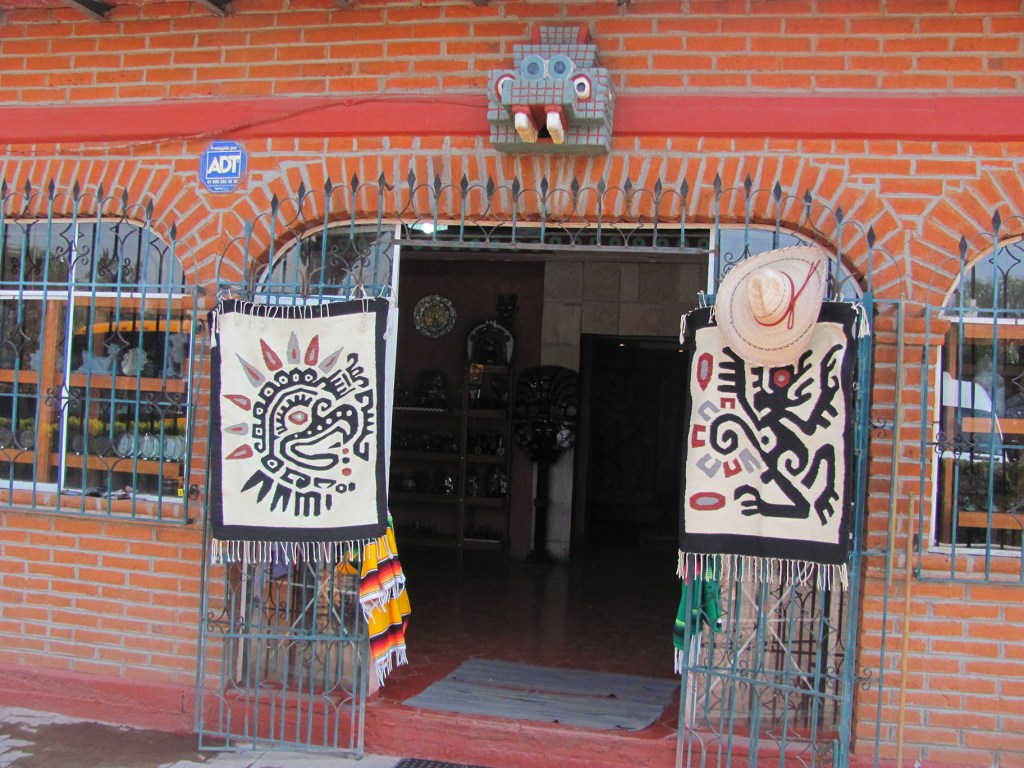
With so many executions and sacrifices, I wondered how this race had become so numerous, and still more pitiful how these hundreds of thousands of people had not been able to resist the onslaught of a thousand times fewer Spanish invaders. I didn’t find any answers, as the bus stopped us in the parking lot at the pyramid of the moon. There we entered a souvenir shop, where we were given a demonstration of how these products were made, as well as the important role of the cactus in the culture of the Aztecs. A representative of the store showed us a piece of a 15-year-old cactus, which when he cut and peeled it, it turned out to be a piece of paper – as fine as our tracing paper. Then he made a needle out of a large thistle, and from the thousands of threads that fell from the cactus he turned into a needle and thread, and showed us how the Aztecs sewed and then dyed the fabrics. The presentation was really interesting and then I was happy to get souvenirs from their store.
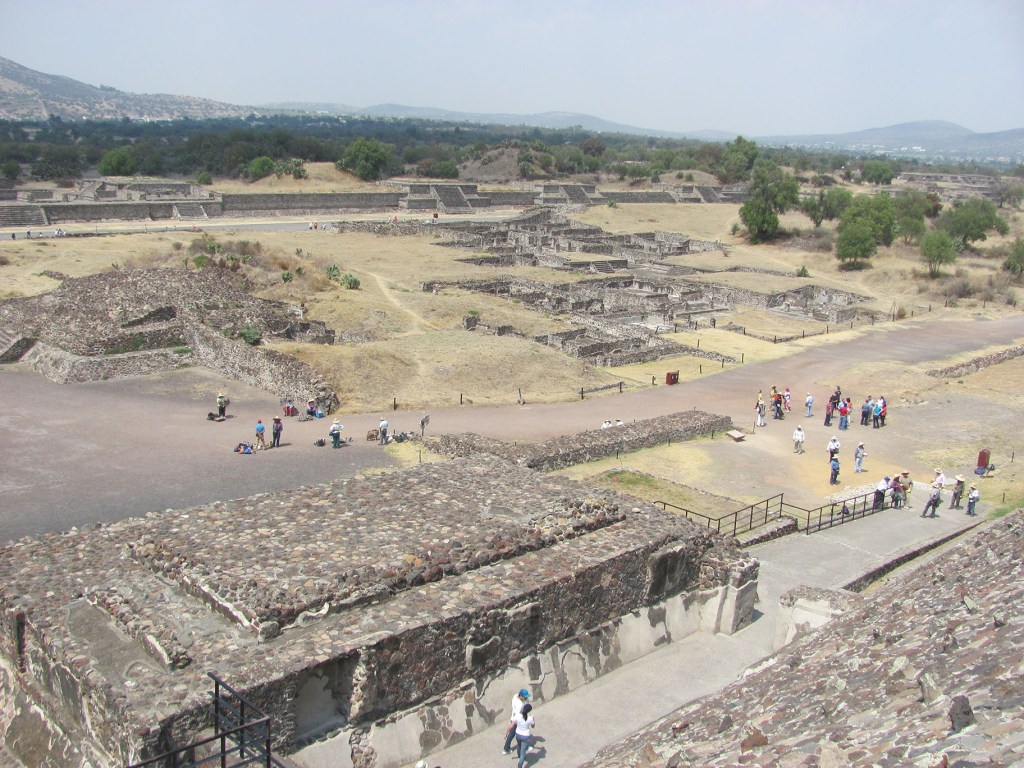
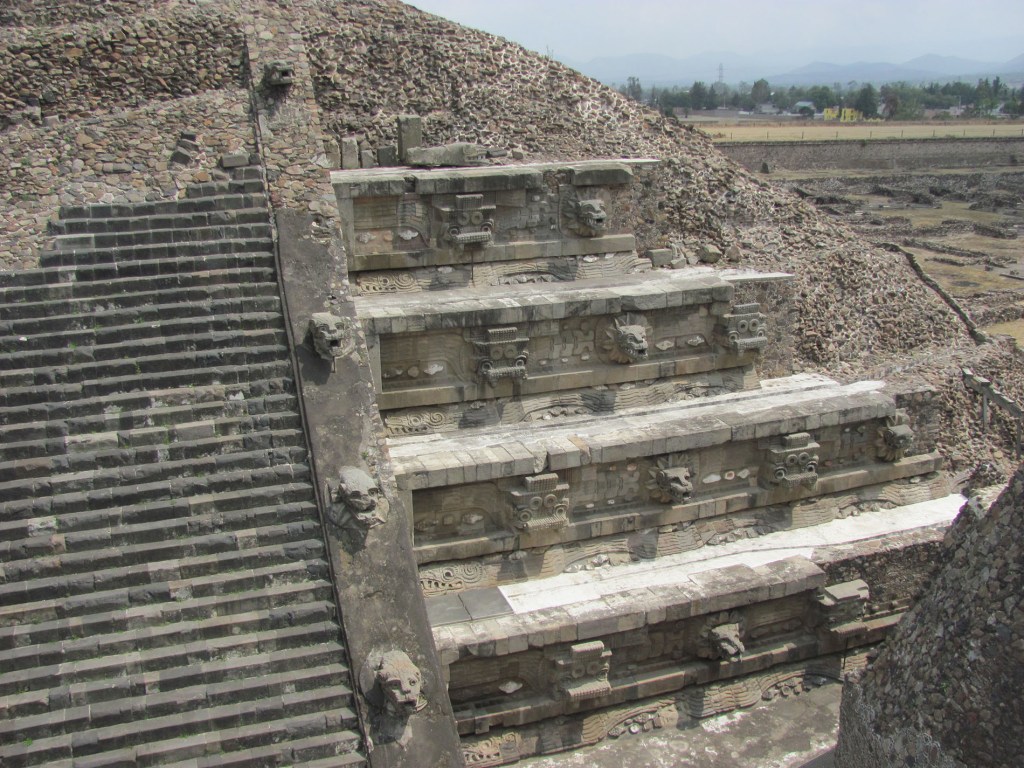
From there we went on foot to the temple of the jaguar. It was a labyrinth of buildings and temples erected over the centuries. Opened in 1962 the temple was completely reconstructed with local materials. The tour guide showed us how to distinguish the old from the new materials, pointing out to us the colorful frescoes of jaguars inside the temple, from where the name of the temple originated. Interestingly, 1,000 years after the fall of the empire that created Teotihuacan, the ruins remained hidden under a thick layer of earth and plants. Although the Aztecs worshipped Teotihuacan, the complex was not noticed by Cortés and his men when they passed by in 1520. The structures that were visible today were only a tenth of the entire city, with excavations having begun in 1864. and have continued to this day. In 1971 rooms were discovered under the pyramid of the sun, and in 1998 archaeologists had found human remains in the pyramid of the moon.
The tour guide gave us a little more than an hour of free time, during which we could first climb the pyramid of the moon, and then the pyramid of the sun, as the bus would be waiting for us back this time in the parking lot of the sun. The pyramids were huge and we quickly set out for the challenge of touring them all in the minimum time they had given us.
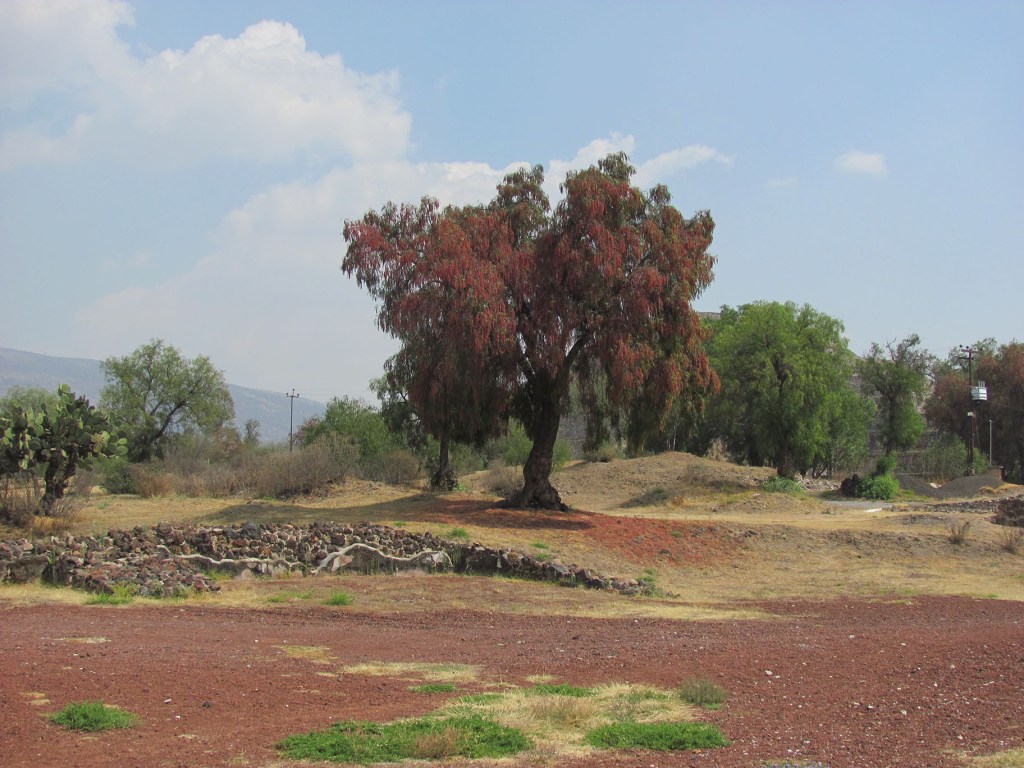


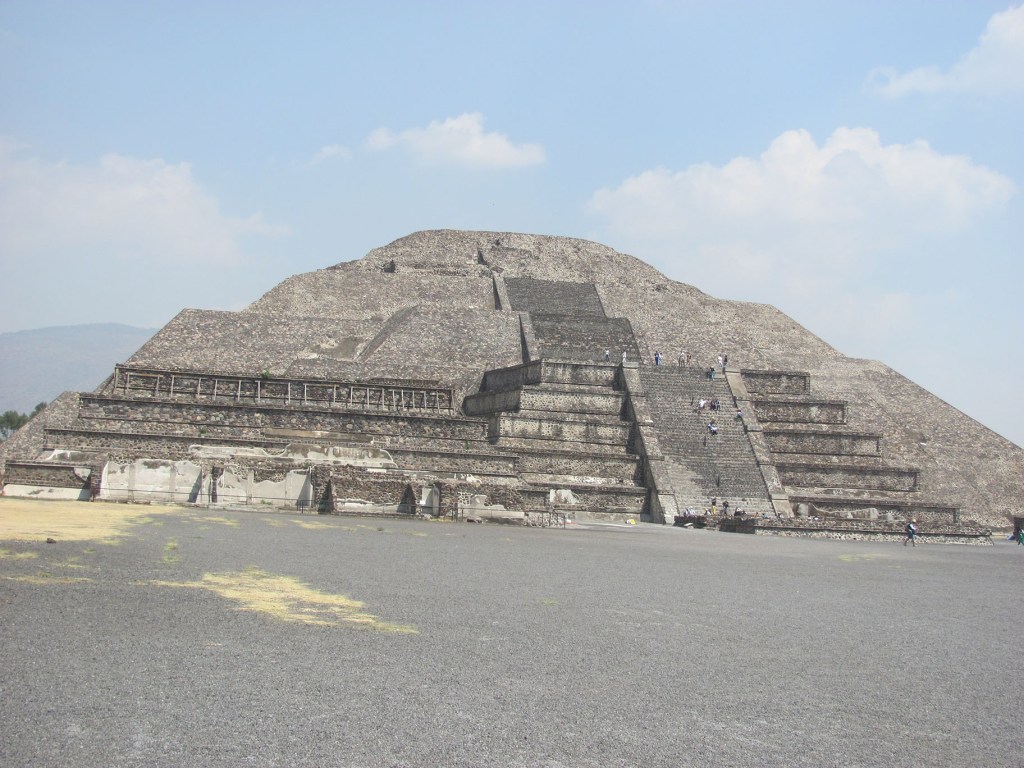
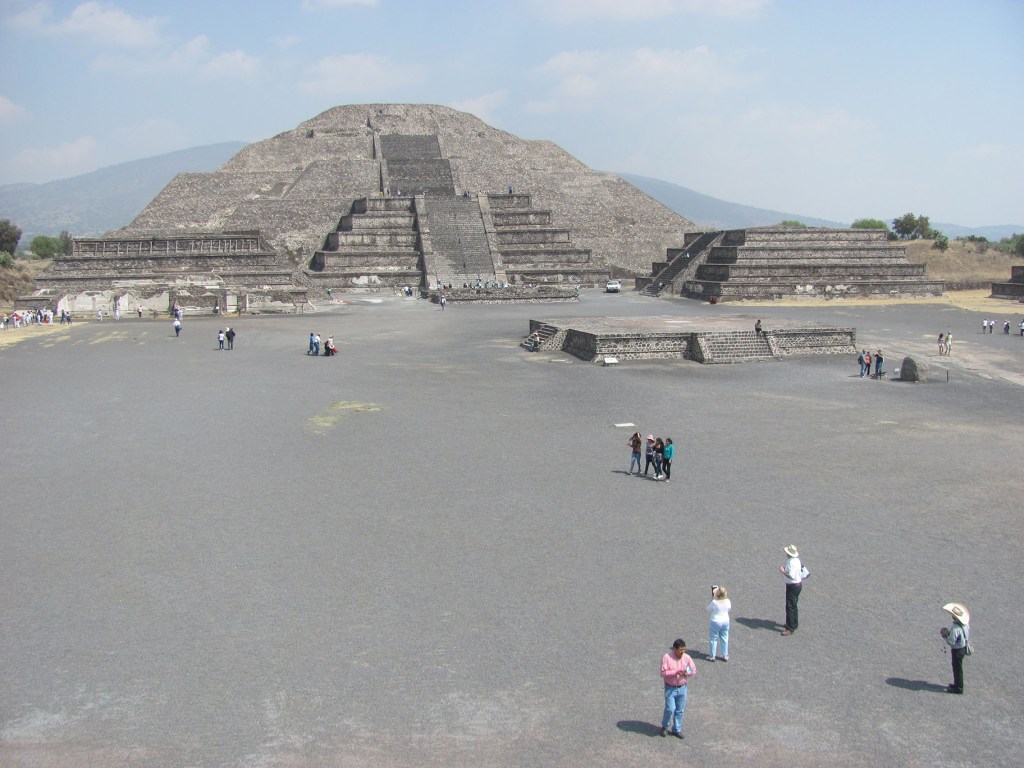
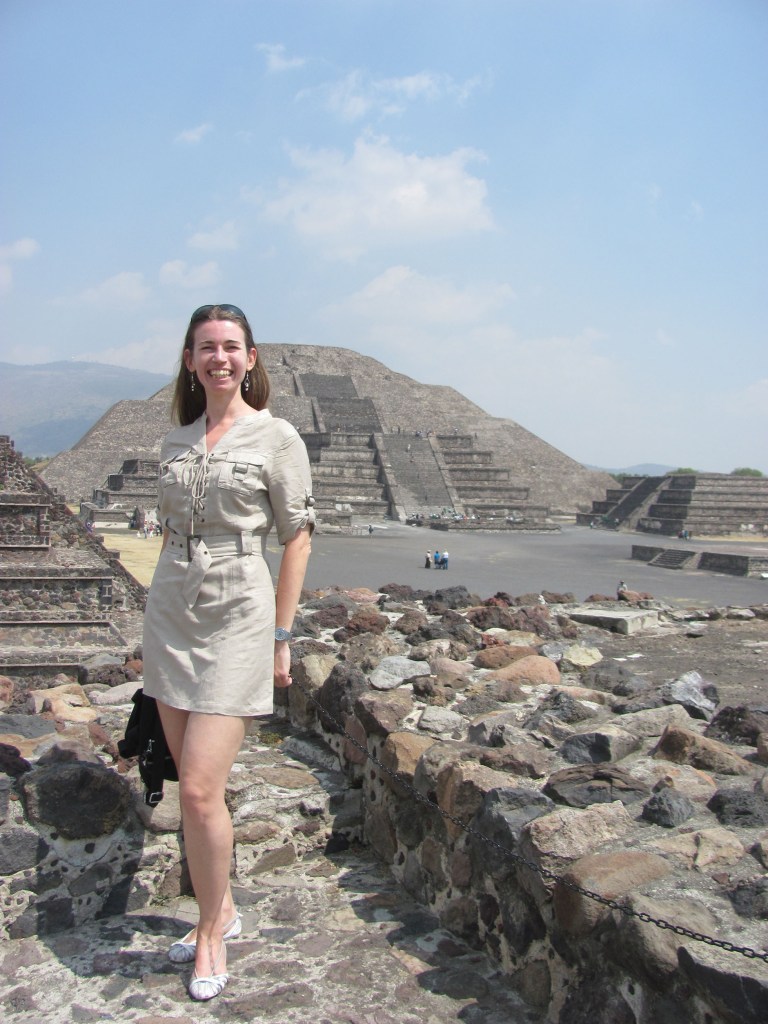
The pyramid of the sun and the moon resembled mountains towering over the valley. The pyramid of the sun was much higher and larger than that of the moon, but the one on the moon turned out to be older than that of the sun and built long before 200 years.B.C. Some even called the lunar pyramid Tenan, which translated as “mother or protective stone”. Stairs descended from the pyramid, which led to the huge ancient street, bearing the terrible name of the Road of Death. On the upper platform of the lunar pyramid, rituals were performed in honor of the Great Goddess of Teotihuacan – the goddess of water, fertility, earth and even creation.
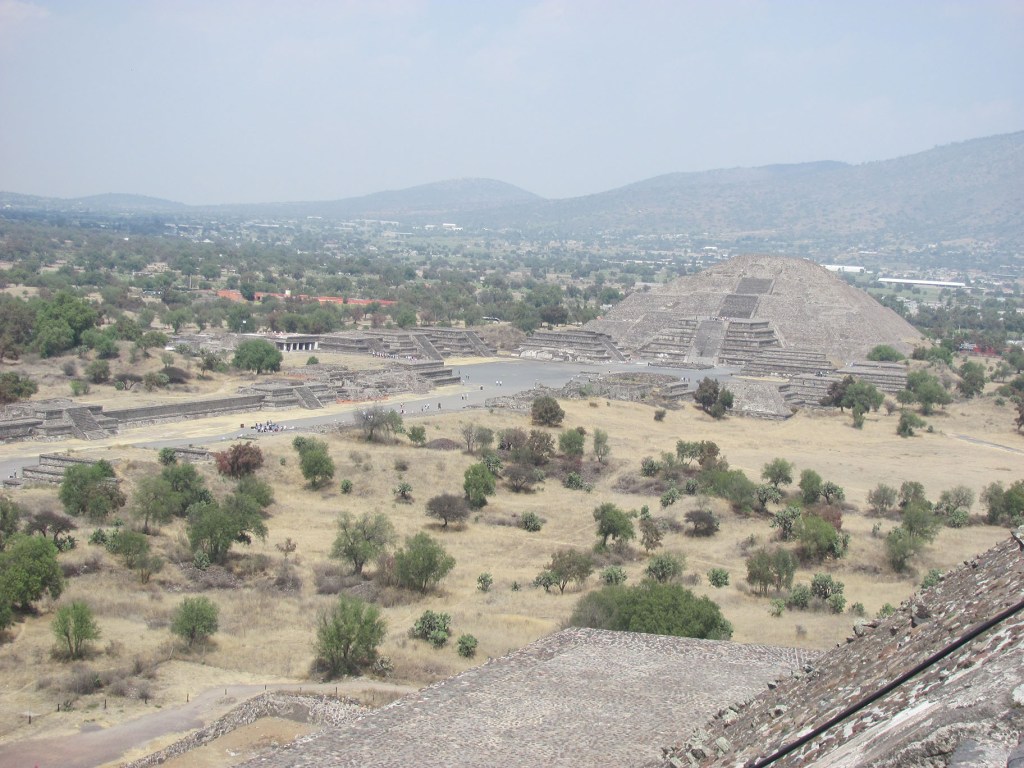
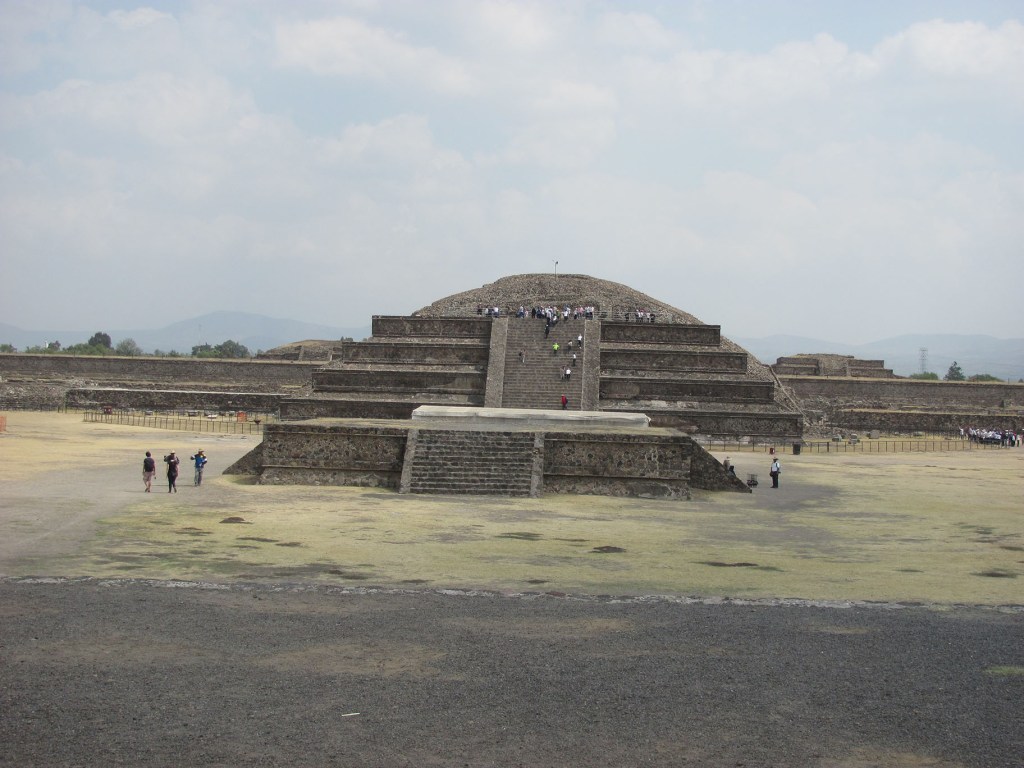
We passed through the square called the Valley of the Moon and climbed the Pyramid of the Moon, the steps of which were quite high and not so convenient for climbing and descending. However, the views, as well as the photos, were worth it, and we were happy to head to the next, even bigger solar pyramid. On the way we passed through various other smaller platforms and pyramids, again stopping for many photos. The streets/roads that connected the individual buildings were also interesting – they were all straight and respectively pointing either to the south-north or east-west, the intersection everywhere was 90 degrees perpendicular. This was very clearly visible from the top of the lunar pyramid, but as we walked forward to the solar pyramid, we felt it better. However, it still remained a mystery how ancient people knew the individual directions with such accuracy.


The Pyramid of the Sun was the largest in Teotihuacan and one of the largest in Mesoamerica (Mesoamerica was a region in the Americas encompassing central Mexico, Belize, Guatemala, El Salvador, Honduras, Nicaragua and northern Costa Rica. united with their culturally developed civilizations before the arrival of the Spaniards). Interestingly, the Pyramid of the Sun lay on the same foundation as the great Egyptian pyramids, but it was half its height – 65 meters (the Egyptian one was 144 meters). It consisted of 2.5 million tons of stones and earth, compared to the 6.5 million of the Egyptian pyramid. It was interesting how these ancient civilizations resembled each other, although they had no contact with each other, or at least not such as modern people could think of.
It was the Aztecs who gave the name Pyramid of the Sun, and it was not yet known what the people who lived there long before and created it had called. It was believed that it stood in the center of the big city and was the starting point of all roads here. It was located a little northwest of sunset, and it set just above the pyramid on August 12 and April 29. Subsequently, we saw on television crowds of people who visited this pyramid on March 21. In fact, whenever it was visited, there was something to see in it. The climb up the stairs was easier than that of the lunar pyramid, but here the steps were twice as long. From above there was an amazing view of the entire valley and it was easy to imagine what a big metropolis rose here. And if it was believed that there was a dense population then, the place should have been seen even now, when tourists were no less than hundreds of thousands a day.
According to legends, the pyramids were built by giants and gods who descended from the sky and created this city. The Mayans, like the Aztecs, also believed that they originally lived giants on the earth, resembling their god Itzamna – “the god who could fly”.
Under the pyramid of the sun, archaeologists had discovered a tunnel that led to four rooms arranged like a clover. At the top, it was believed that there was an altar, which was missing today. However, there was a small narrow hole through which it was believed that positive energy was coming out. We spun around it, as did the hundreds of other tourists who managed to conquer the top of the pyramid. However, it was difficult to say whether the positive energy came from this small hole or from the wonderful panorama that surrounded us. It was as if we had really stepped on the sun and enjoyed the ground below us.





Time seemed to have stopped, but not for our watches, which showed that we had to get off quickly and head directly to the parking lot, where the bus was waiting for us. This was not so easy, because in addition to the numerous steps on the ground, we also had to make our way among the many street vendors who offered us souvenirs at very reasonable prices.
The bus took us a little further down to another pyramid of the same complex, which the Spaniards named the Citadel. It was much smaller than that of the sun and moon, but it was worth climbing on it, because on the other side of it were preserved many reliefs, masks and images, which were not left on the other pyramids. It was believed that the citadel played an administrative role in the ancient world. To the west of it there was a large square, which was believed to have served as a market, and from this temple the view was clearest and they could keep track of who was selling what.
In addition to the pyramid, we also had to look at each other’s feet, where in some places there were small holes, and small animals climbed out of them. Of course, they were more afraid than we were, but the stalking was worth it and I managed to catch one with my camera (I would never try it with my hand) one of these animals, which looked like a mole, but fluffier and with much bigger eyes.


After a pleasant, but again quick walk, it was time for lunch. The bus took us to a restaurant, where we tried a delicious noodle soup with tomatoes and tacos with chicken, and a mango juice for a drink. After we ate, we could sleep in the bus dreaming and aware of all the beauty we saw during the day. The journey took about 2 hours, and the speed limits were also interesting, which were not 90 or 100 km/h, but 95 km/h. I thought it was miles, but again in places it was written km/h underneath.
Before returning to the hotel, we also visited the house museum of Frida Caillo. She was a famous Mexican artist, known for her rebellious spirit and style, both in her personal life and in art. She had lived with the famous Mexican muralist Diego Rivera, and had open love affairs with both men and women. Subsequently, I watched the biography film about her life, and her role is played by actress Salma Hayek.


The next day in the morning we visited the Museum of Archaeology and Anthropology, where we were able to summarize everything we have seen so far. The collection was very rich and excellently presented – it was definitely one of the best museums I had visited. At the very entrance there was a large inscribed column, which turned out to be a symbol of the tree of life. Once there was water under it, but that day there was none. On the other hand, there were many doors from the courtyard, each of which led to a different hall and took us back to different eras.
We headed to the farthest door that led us to the first settlers on the continent and it is not about the Toltecs, Mayans or Aztecs, but about the huge mammoths, the remains of which were found in some Mexican town of Santa Isabel Iztapan. They were very well preserved and dated back to 9000 B.C. Mammoths survived the Ice Age, but probably afterwards with the warming of the climate and changes in the environment, as well as due to hunting by humans, caused their extinction.
The tour guide showed us on a map the migration of people, and the belief that the first people started from Africa. It was assumed that the first settlers in North America came from Asia 20 thousand years ago, crossing the then icy Bering Strait, separating Asia from Alaska, and headed south. Nearly 1500 years before the new era, the first communities appeared in Mexico that made a living by agriculture, marking the beginning of the New Stone Age.


We passed by a display depicting various agricultural plants that were believed to originate from Mexico. Among them were, of course, corn, chili peppers, avocados, pumpkins, beans, etc. There were also those who had not yet reached Bulgaria. In glass display there were models of various ancient settlements of primitive people, whose life seemed very difficult. We headed to the next door with the inscription Preclasico Altiplano central or this was the preclassic period.
Various ceramic vessels and statuettes showing the way of life of people during that time. Gradually, people had mastered new techniques to increase agricultural yields, including terracing the land on the slopes of hilly areas and creating artificially irrigated vegetable gardens called chinampas. Over time, the priestly class acquired importance in their social structure. The first urban civilization in the lands of Mexico was that of the Olmecs, who inhabited the lands of the present-day states of Tabasco and Veracruz. The center of Olmec civilization was the city of La Venta, built in the moors of Tabasco. The Olmecs built more priestly and ceremonial centers than cities. The pyramids they erected showed a strong centralized power. The Olmecs mastered ceramics and jade figures, such as were exhibited in the museum. Around the middle of the first millennium BC, the Olmec civilization disappeared, and the reasons for this were still unclear.
There was a whole wall knocked down from a temple or a pyramid, with many images and reliefs of animal heads. It resembled the temple behind the Citadel at Teotihuacan, which we had visited the day before and seen for a short time. The museum preserved the greatest treasures of the country, and my admiration for this country grew, as did the number of my photos. All the artifacts that were found among the numerous ancient settlements in Mexico were located in the Museum of Anthropology, which we were looking at, and if until now we had only seen the outside of the pyramids and temples, now we could look from the inside what they had hidden and preserved.


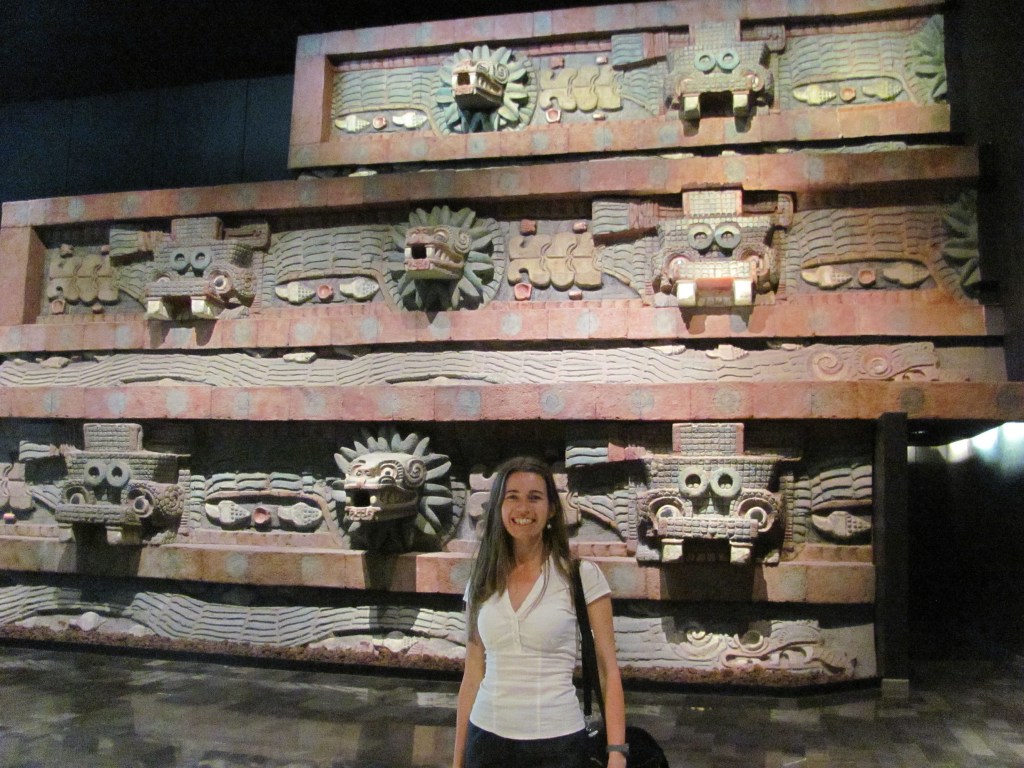
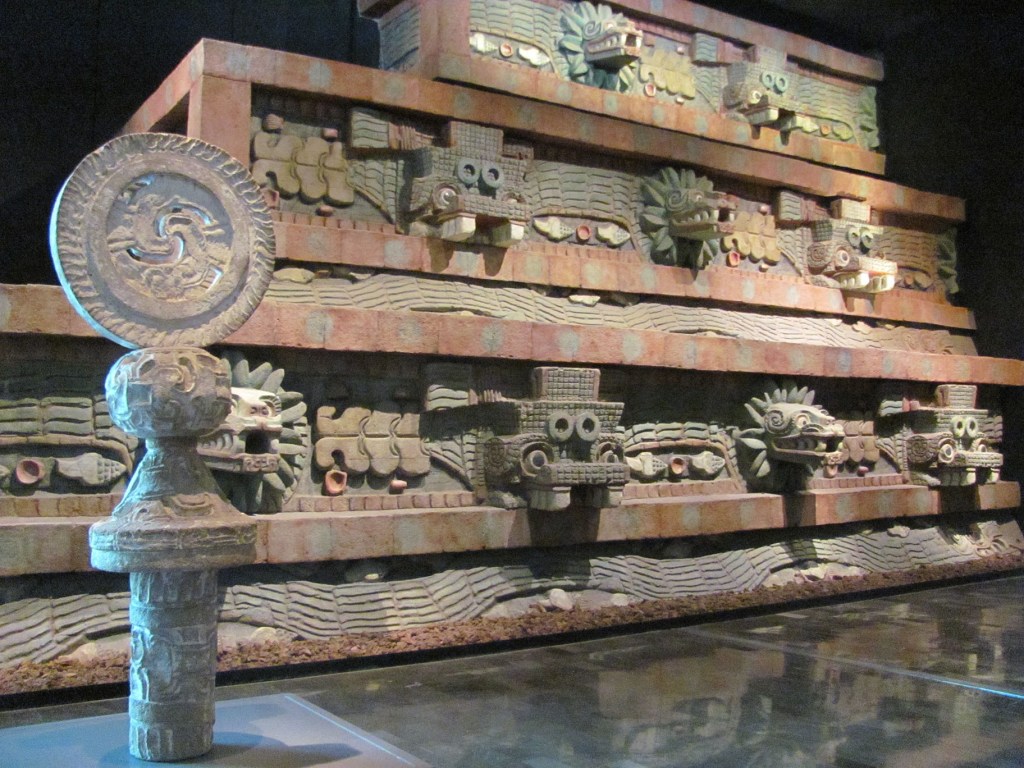


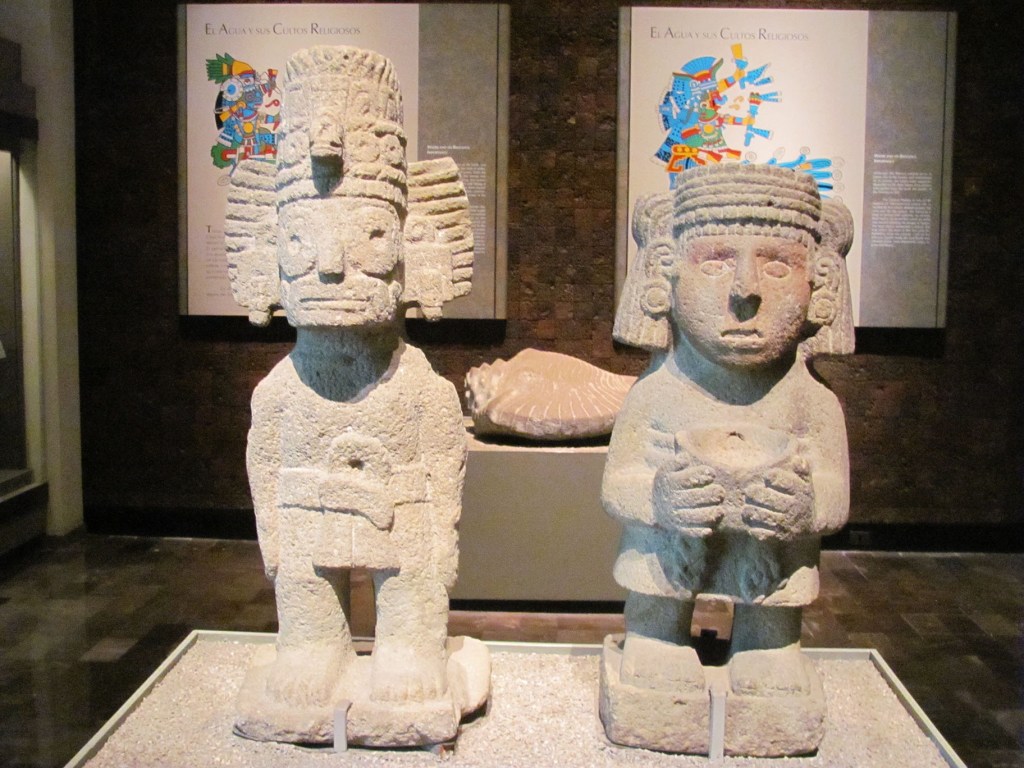

There were many small statuettes showing people in their everyday life and I wondered if they were used as a game or if this is how they were trained. The many masks and sculptures were also impressive, most of which were dedicated to the god of rain. There were even huge rapans, which were written to have been used for music during rituals. Especially impressive was a huge stone, like a wall, all painted with Mayan hieroglyphs. It turned out to be an exact replica of the stone found near Tikal, one of the largest Mayan cities, which was located in northern Guatemala and was discovered in 1979, today was part of the UNESCO World Heritage List. In 1979, apparently, many treasures had come to light (including me!).
Smoothly from one hall to another, we had passed into the birth of the Mayan culture. The Olmec culture was considered the “mother of other cultures”, with their followers in various tribes in the east and west. In the eastern lowlands, the Mayan culture was born, who also united around huge ceremonial centers. They shaped their cities by erecting residential buildings for the elite along the temples, and next to them vast agricultural lands. The Mayans strictly followed their rituals, developing art, mathematics and astronomy. They built excellent observatories with which they monitored the movement of the stars. Their ceramic vessels were much more exquisite than the ones we have seen so far, they could also weave a variety of clothes. The Mayans were also known for their dances, playing drums made from turtle shells.
The Mayan era still hid many mysteries, and this is what made their appliances and belongings so interesting. We passed through a corridor in which there were many large ball-playing rings, as well as a replica of such balls. From this so separate playground we entered the hall, which was called Sala Mexico. Here was presented the lifestyle of the Aztecs and their ritual masks. We learned that only nobles were allowed to wear feathers, and some of the priestly “hats” were huge and certainly difficult to wear. The most depicted deity among the Aztecs was the sun god.
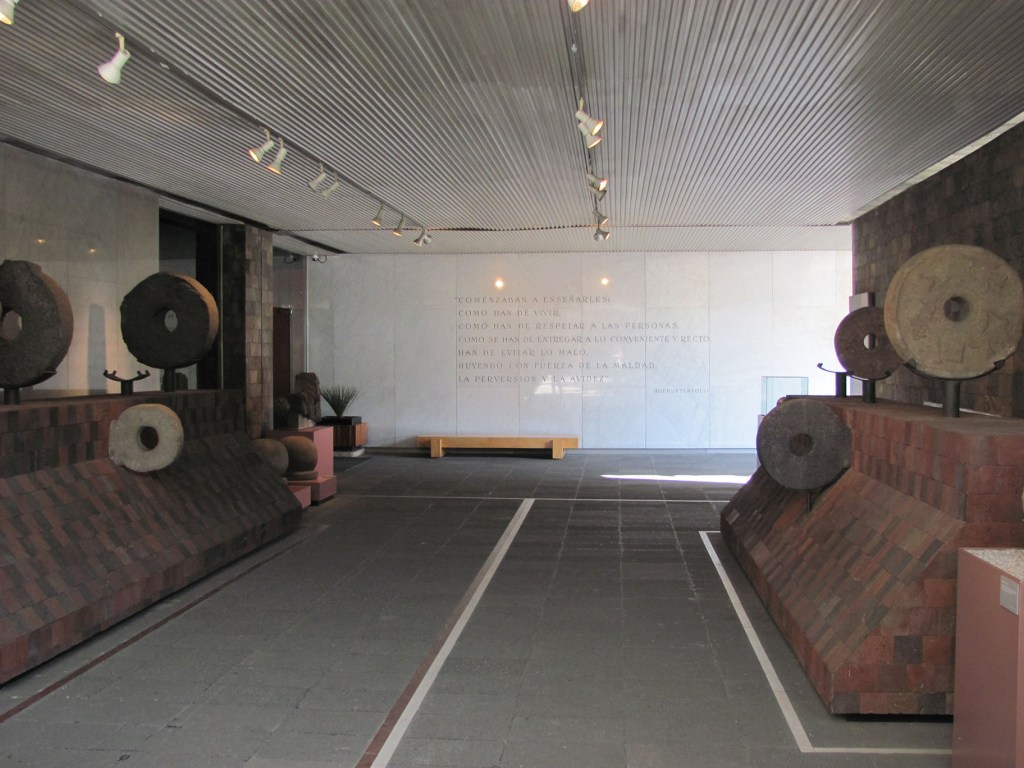

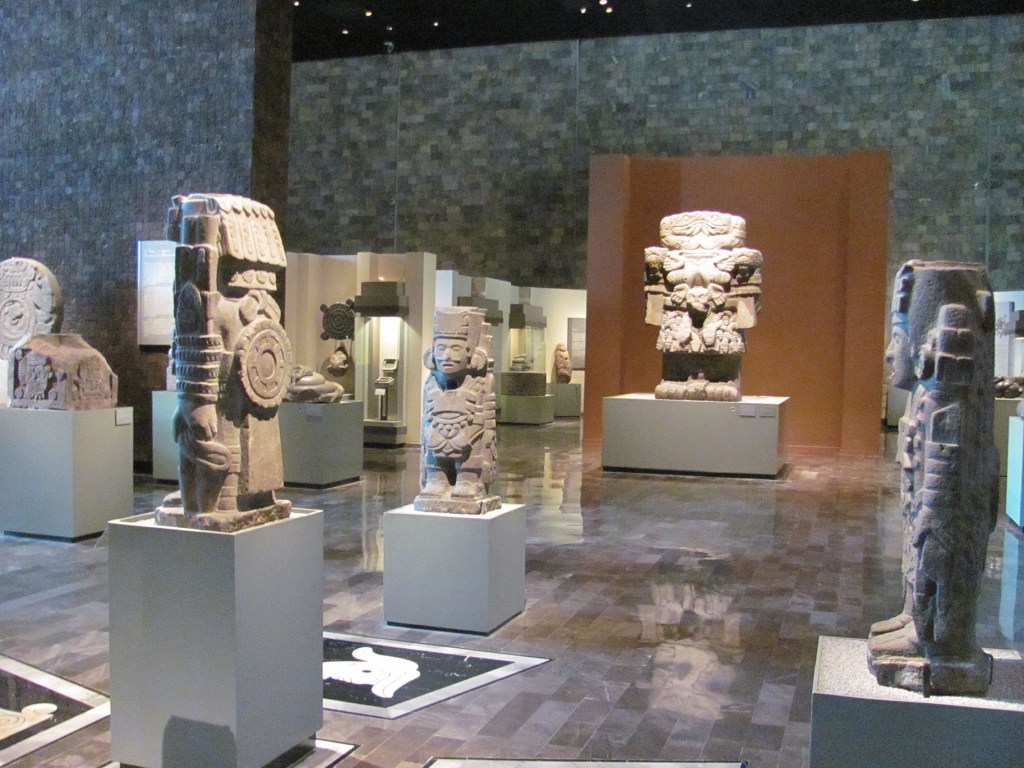


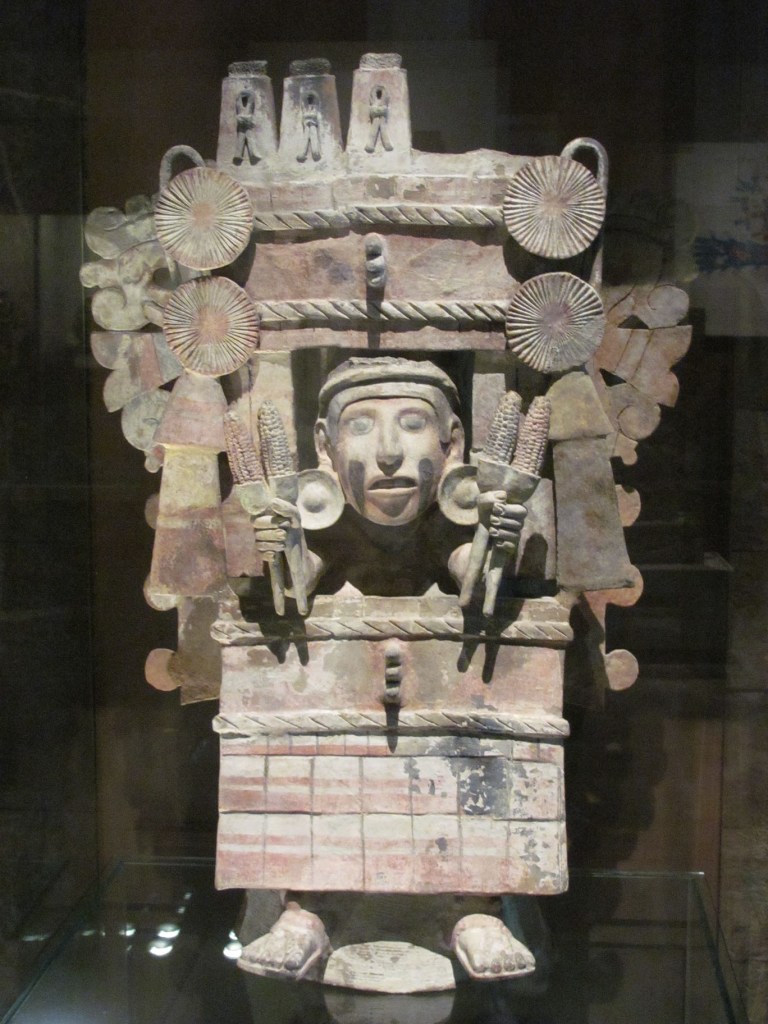

I was able to take a picture with the large and famous calendar of the Aztecs, in the center of which stood the sun god. The Aztec calendar, like other calendars in Mesoamerica, consisted of 365 days, describing the days and different rituals during the different seasons. The Aztecs called this calendar xiuhpohualli. Like the Mayans, they had another sacred calendar consisting of 260 days, which they called the tonalpohualli or day counter. The second calendar divided the days and rituals between the gods so that there was enough time for each god to worship. This calendar was actually a combination of two calendars: one with the numbers one through thirteen, and the second round with 20 sacred symbols. The circles were moved together every day, and after 210 days they returned to their original position. Each day in the sacred calendar was responsible for some animal and direction, i.e. the first day was personified by a crocodile and the direction of the east, two: wind and north, three: house and west, four: lizard and south; five: serpent and east; six: death and north; seven: roe deer and west; eight: the hare and the south; nine: water and east; ten: dog and north; eleven: monkey and west; twelve: grass and south, thirteen: reed and east; 14: jaguar/north; 15: eagle and west; 16: vulture and south; 17: earthquake and east; 18: knife and north; 19: rain and west; 20 flower/south. I learned all this from an interesting web page: www.azteccalendar.com, where I could also write my birthday and see what day I was born on: it turned out that June 11, 1979. was the day of the reeds and dedicated to the God of the night, and according to the 13-day period it was the day of the monkey. According to Aztec beliefs, this was a day when the arrows of fate fell like lightning from the sky and was an excellent day to seek justice. The fact is that when I was born, it rained with lightning so the Aztecs has guessed it right, even for the years after they disappeared.
In order to see the museum better, and to take more photos, we separated from the group and imperceptibly even lost it. This allowed us to tour both floors and see most, if not all, of the exhibits. We got information about the artefacts from the signs, all of which were in Spanish, and a separate part was translated into English. Especially interesting was a sign entitled “Water and its religious importance”. From it I learned that Tlaloc – the growl or voice of the earth, and Chalchiuhtlicue – the lady in the malanhit skirt, were the two guardians of the water. The first one was responsible for releasing the water from the high mountains in the form of rivers, and the second one guarded the lakes and seas. In a year of eighteen months of twenty days, six of them were dedicated to these gods, and sacred ceremonies and festivals were then performed.
Among the exhibits in this hall there were gold jewelry, but they were much thinner and smaller, compared to our Bulgarian massive Panagyurishte treasure. But again from the inscriptions on the walls, we understood that when Cortés conquered the new territories, he also discovered untold riches that he brought to Europe.
We headed to the next hall called Culturas de Oaxaca. Oaxaca was actually one of the 31 states of Mexico located in the southeast of the country. This state was known for its indigenous people and cultures, among which the most prominent Zapotecs and Mixtecs were found. Due to the remote areas in which they were located, these crops had survived and preserved the best. For our short visit to Mexico, we were not able to see them live, but they impressed us with the size of their sculptures. In this room, I took a picture with a carved head made of stone, the size of which exceeded my size. Their objects and statues were coarser than those of the Aztecs, but their size probably showed that they had lived before, in the time of the giant gods.
The next hall we visited was the Sala Maya or Mayan Hall. Because of the great cultural heritage that the Mayans had left, their people were called “the Greeks of America.” I could confirm this by admiring their beautifully painted cutlery and household appliances. Different cities were presented in the museum, as well as entire floors of pyramids and walls of temples were moved, some of which did not fit inside the museum, but were taken outside, to the courtyard.
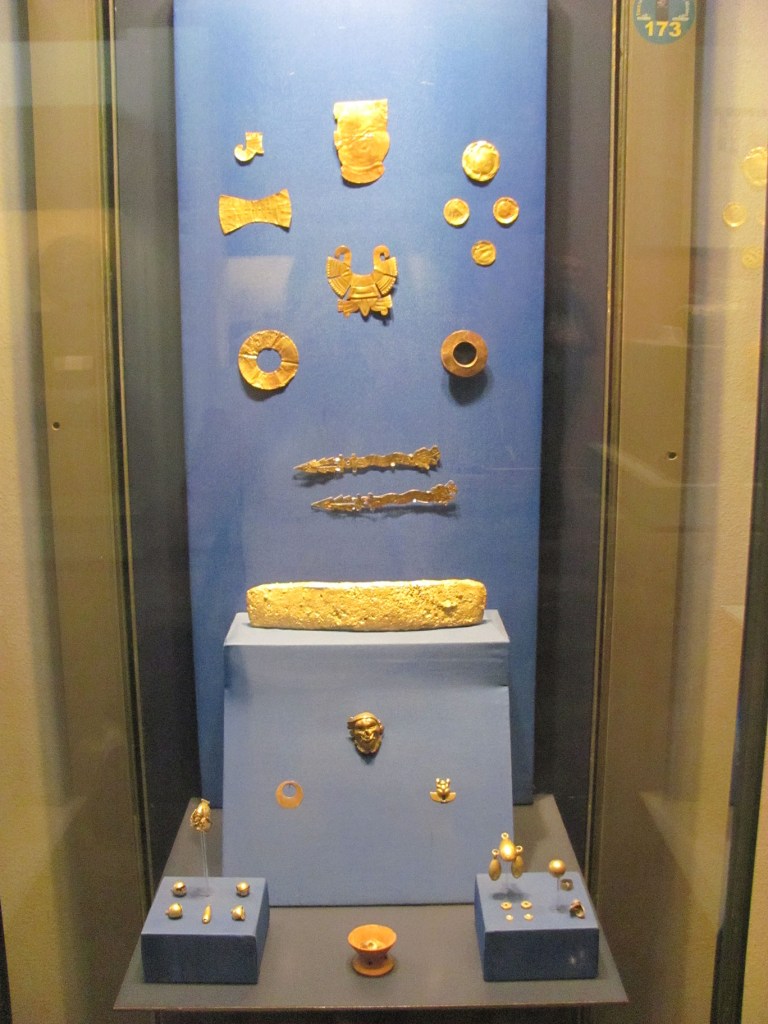


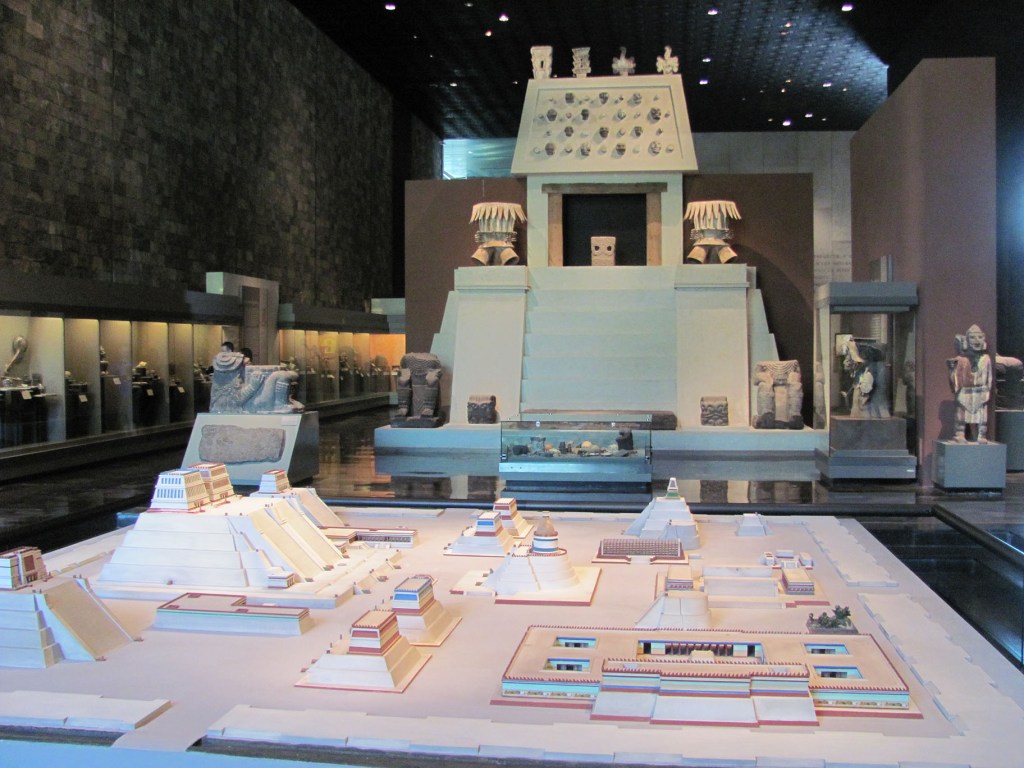


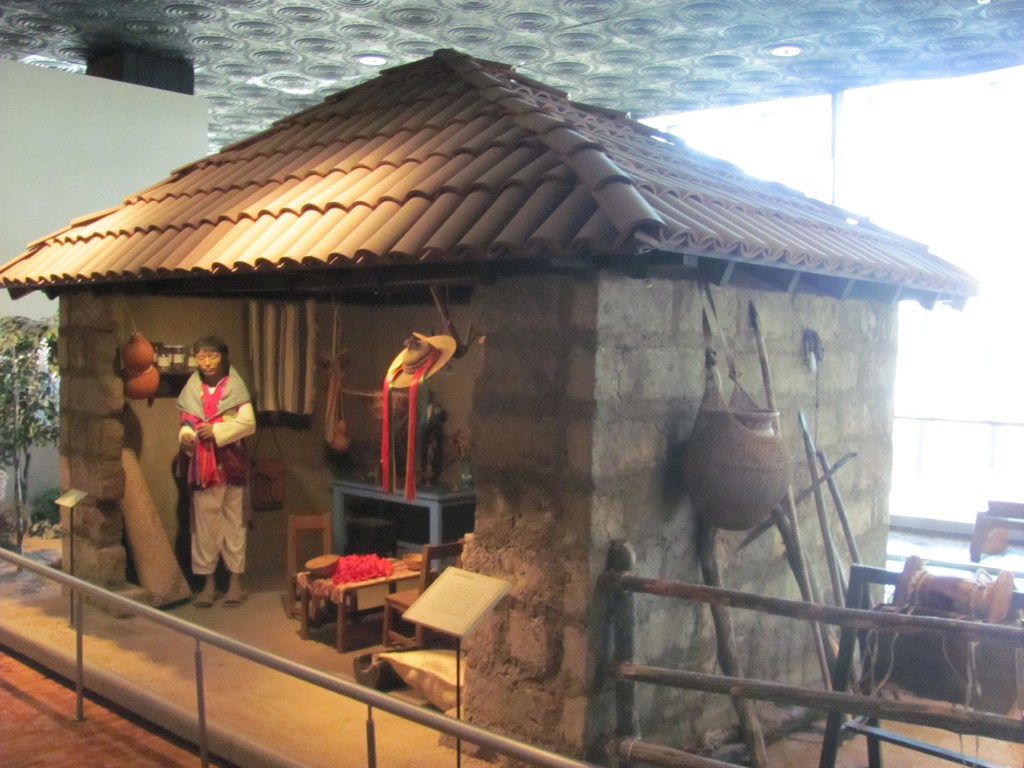
There were dungeons where we saw the famous tomb of Pakal I discovered in the temple of hieroglyphs in Palenque. He had a beautiful jade mask and numerous jade jewelry. However, the rooms downstairs were dark and it seemed as if we were really descending into the underworld, and this was not one of the places I wanted to see. I preferred sunlit halls, and the next one was called Culturas de occidente or Western cultures. Here the collection was not so rich – sculptures of people and clay vessels prevailed, and they were arranged in beautiful showcases, with regions inscribed where they were found, namely Sinaloa, Nayarit, Jalisco, Colima, etc.
Next was the Culturas del Norte hall / or northern cultures, where there were painted stones by primitive people, probably hidden and preserved in some cave. Stoneware was prevalent here, and there were also numerous photographs of various Native American tribes. Various rituals of North American communities were also made in real size. We went up to the second floor, where the lifestyle of the people, the home environment in the different village houses, musical initiatives and rituals, as well as many costumes from different parts of Mexico were presented. There was a beautiful wedding ceremony, as well as scary masks, very similar to our Bulgarian kukeri. From above, however, we saw again our group, which had gathered on the ground floor and was preparing to leave the museum. We had to join them, and get back to the present, after our wonderful walk through time.


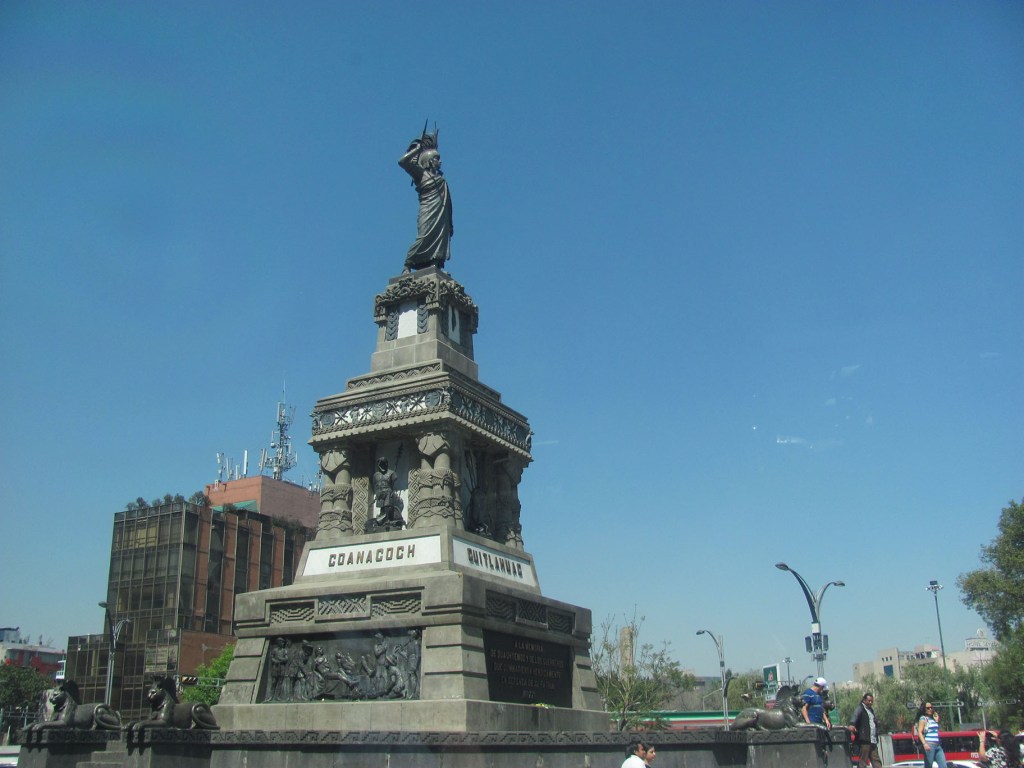
I definitely liked the museum and it left me many pleasant memories. Our walk continued back to Paseo de la Reforma, in front of the skyscraper with the two towers, called Coca Cola. I don’t know if the company really had its headquarters there, or if it was just that the buildings resembled bottles and were called that way. From there, among an alley of palm trees and skyscrapers, the bus took us to the center of Mexico City. Again we passed by the monument of Cuitlahuac, which formed a roundabout on the boulevard of the Reform. This was actually the 10th king of the Aztecs in Tenochtitlan. He was a ruler for 80 days. An interesting story was that when Hernán Cortez attacked and destroyed the temple of the Aztecs, the local people began to fight and make traps for the Spaniards. Cortés ordered the ruler Moctezuma to stop his men, but he told them that the people did not listen to him and had to release his brother Cuitlhuac, who alone could stop the Aztecs. Cortés obeyed him and freed Cuitlhuac, however, he led his men against the Spanish and managed to drive them out of Tenochtitlan on June 30, 1520. However, Cuitlhuac subsequently died of smallpox, which had recently been imported by Europeans. His elder brother Matlatzincatzin became the next king.
Our bus stopped right in front of the Memorial of Hemiciclo Juarez, located in the historic center of Mexico City, on Avenida Juarez Boulevard. This memorial was erected in 1910. in honor of former Mexican President Benito Juarez. It was a semicircle with twelve columns, in the center of which stood 3 figures – the seated Benito Juárez with two allegories: the Fatherland, which crowned Juárez with glory and the Law next to him. To me, the figures looked more like the Statue of Liberty and the goddess Nike, between which there was an elderly man sitting. In any case, with its sparkling whiteness, the monument was beautiful for photos and a popular tourist attraction.


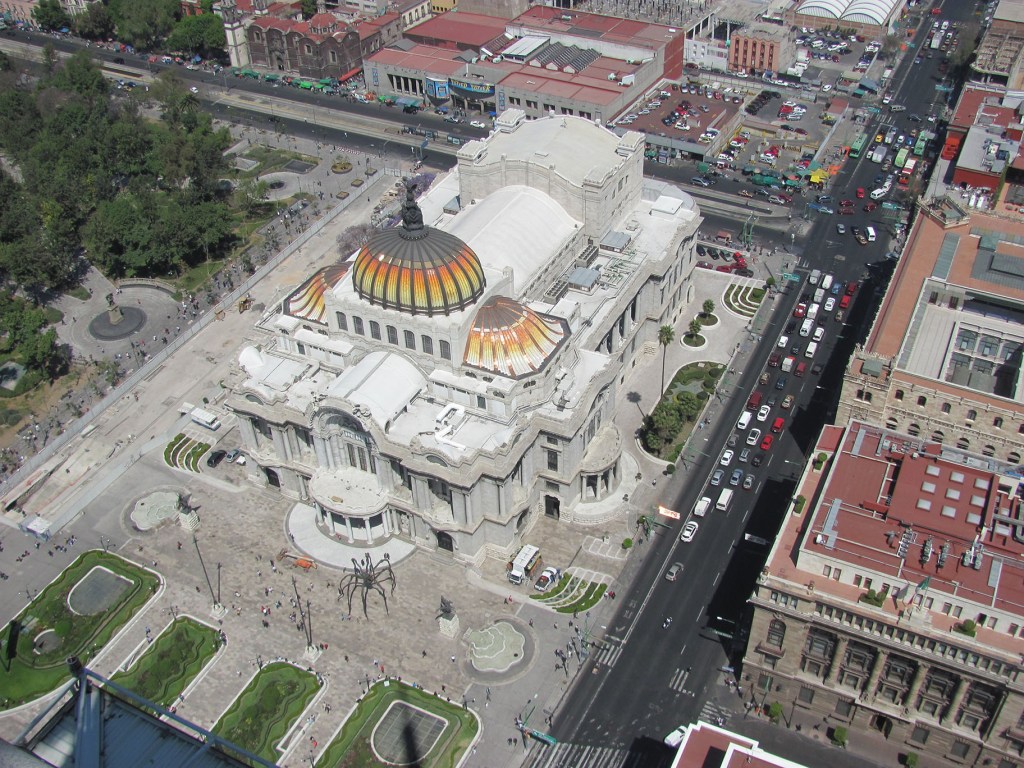
Next to the Memorial was the Palace of Fine Arts, whose building with a golden roof was more like our Alexander Nevsky Cathedral. Erected in 1905. as a national theater, the building became home to numerous productions of theater, opera, ballet and numerous exhibitions, and was also famous for the paintings of Diego Rivera in it. The neoclassical exterior structure was beautiful for photos from any angle, especially from above. On the opposite side of the street stood Torre Latinoamericana. This skyscraper rose to a height of 182 meters and had 44 floors. From here the best view of Mexico City was revealed. Construction was completed in 1956, and the steel structure had withstood several earthquakes, including a strong earthquake in 1985.
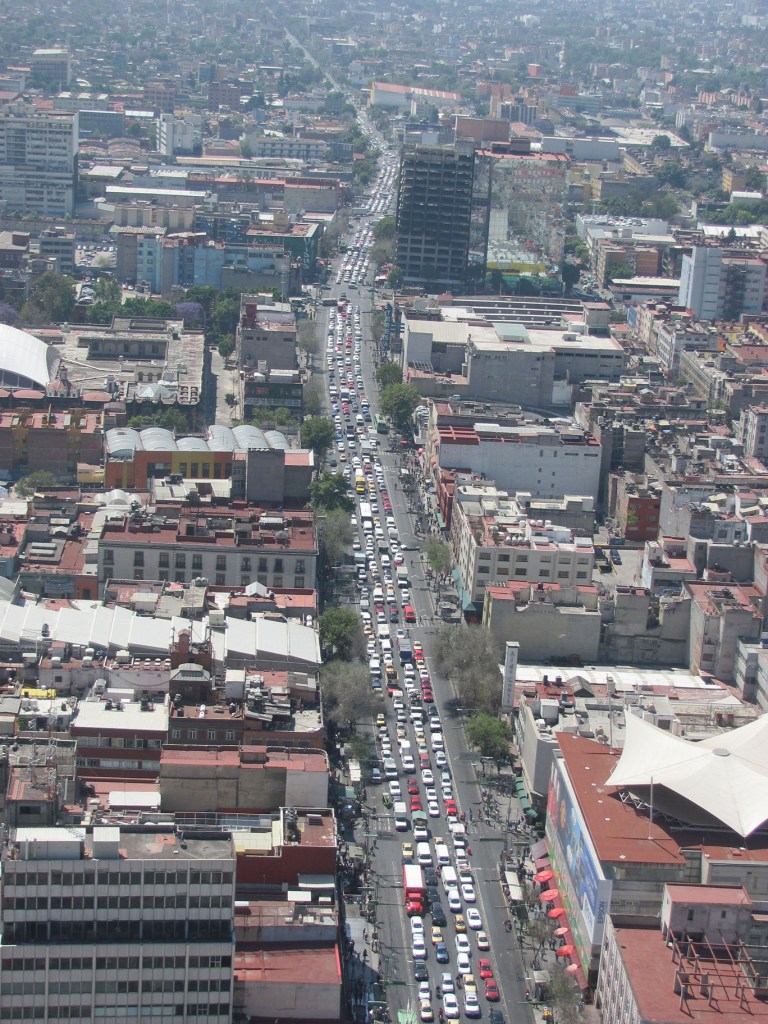
We took the fast elevator to the skyscraper, which took us to the 37th floor in 30 seconds. From there we went to another elevator that took us to the 42nd floor, from where there was an observation platform. Mexico City was huge and colorful. There were tall skyscrapers and many low buildings, there were green parks surrounded by asphalt boulevards. On one of the streets, we even saw a big traffic jam from above, but by the time we made the 360-degree tour of the panoramic platform, it had melted and the cars were moving normally. Mexico City was a truly dynamic city, with some calling it the “capital of movement.” The city was really moving, considering that, according to statistics, every year it sank by several cm. Elevated above Lake Texcoco, the city has sunk several meters over the past 100 years. There were no uneven terrains from above, nor did they have broken and patched asphalts like in Bulgaria, but according to the facts, the problem was really serious and different solutions were sought.


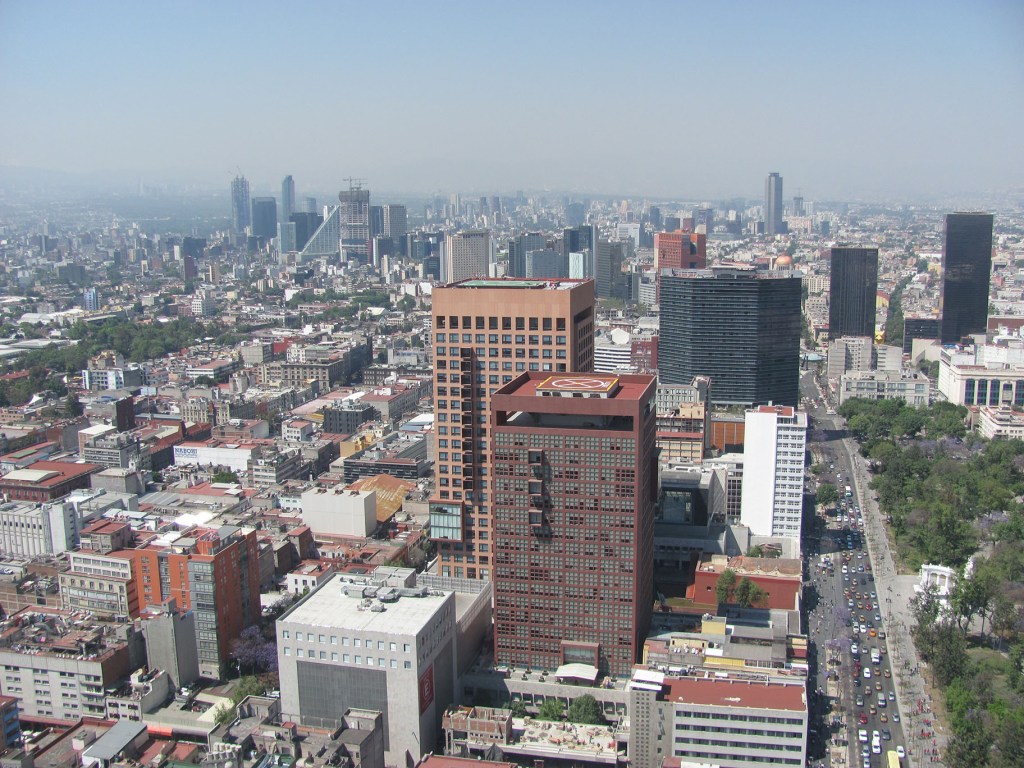
From above, we couldn’t recognize the individual buildings of Mexico City, even though we knew that it was the city with the most museums in the world – more than 160, most of which were free on Sundays. However, the day was Friday and we could only watch them for free from above.
Mexico City was also the fourth city in the world in terms of the number of theaters after New York, London and Toronto. It was also home to the largest amusement park in Latin America – Six Flags, which, however, we did not see, neither from above nor from close.
Mexico City was also known as the city with the most polluted air, but the fact that we stood so high and had such a nice view from afar showed that the smog over the city was not as thick as it was described. In fact, the city seemed to me much cleaner than Sofia. There was no waste on the ground, at least in the center where we walked. We never got down to see the subway, although Mexico City was famous for its largest network of metro lines in Latin America, as well as the cheapest metro in the world. The metro ticket cost only 5 pesos, which was equivalent to 50 stotinki.
After the numerous photos from the panoramic platform, and taking souvenirs from the shop in Torre Latinoamericana, we went back down and found ourselves on the shopping pedestrian street, crowded not only with shops, but also with crowds of people.
We passed by many beautiful buildings until we reached the cathedral in the central square in Mexico City – Zocalo. The Metropolitana Cathedral was the largest cathedral in Latin America, with its tower rising 67 meters. Its construction had taken almost three centuries from 1525. to 1813. The long period of construction necessitated a mixture of styles in architecture and interior decoration, from classical to baroque and neoclassical styles. The cathedral had five main altars, some more lavish than others, and 16 chapels containing a valuable collection of paintings, sculptures, and furniture. We took a quick look at the cathedral, knowing that it was also in danger of sinking, and an underground reconstruction was currently underway to prevent this.
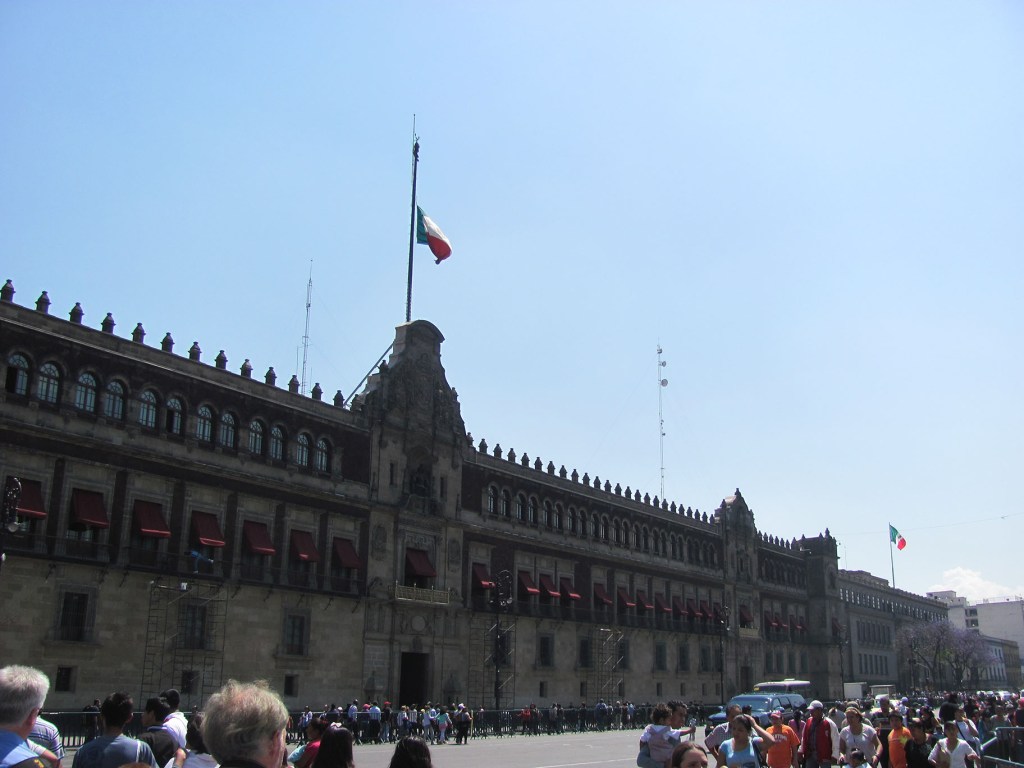
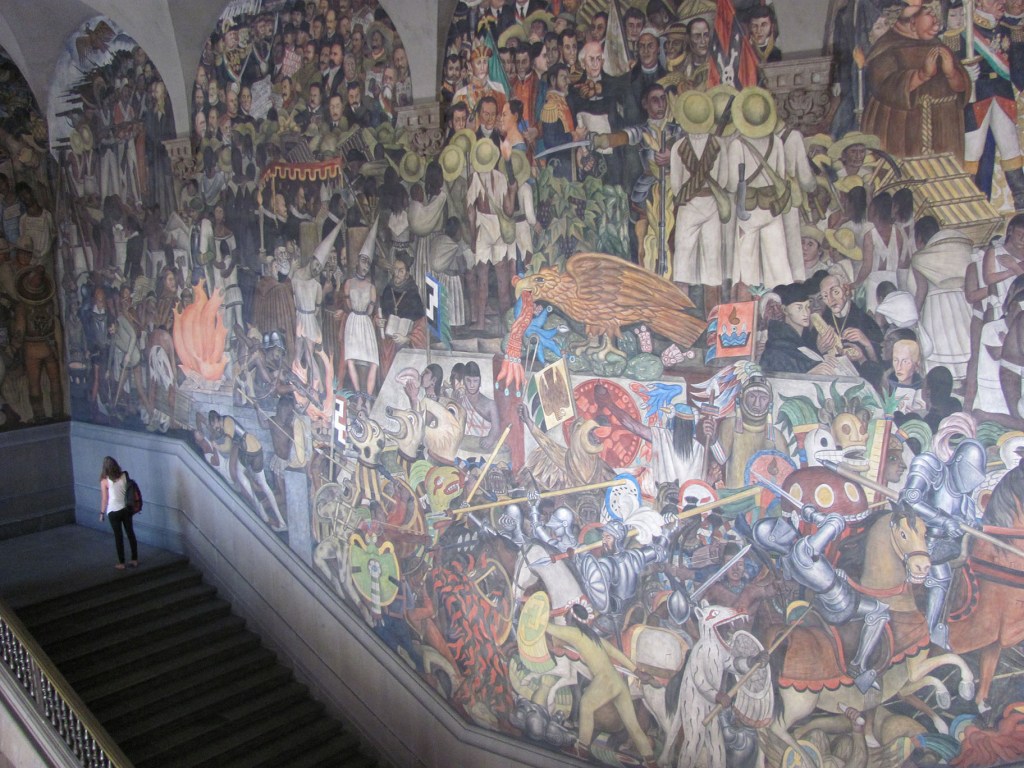
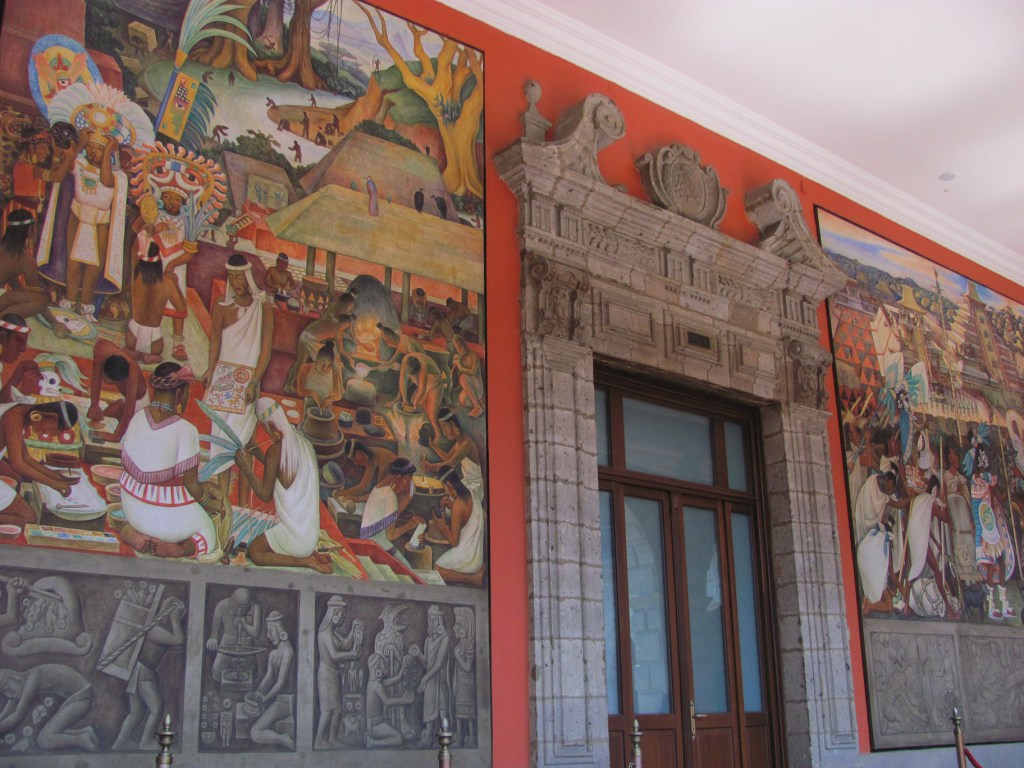
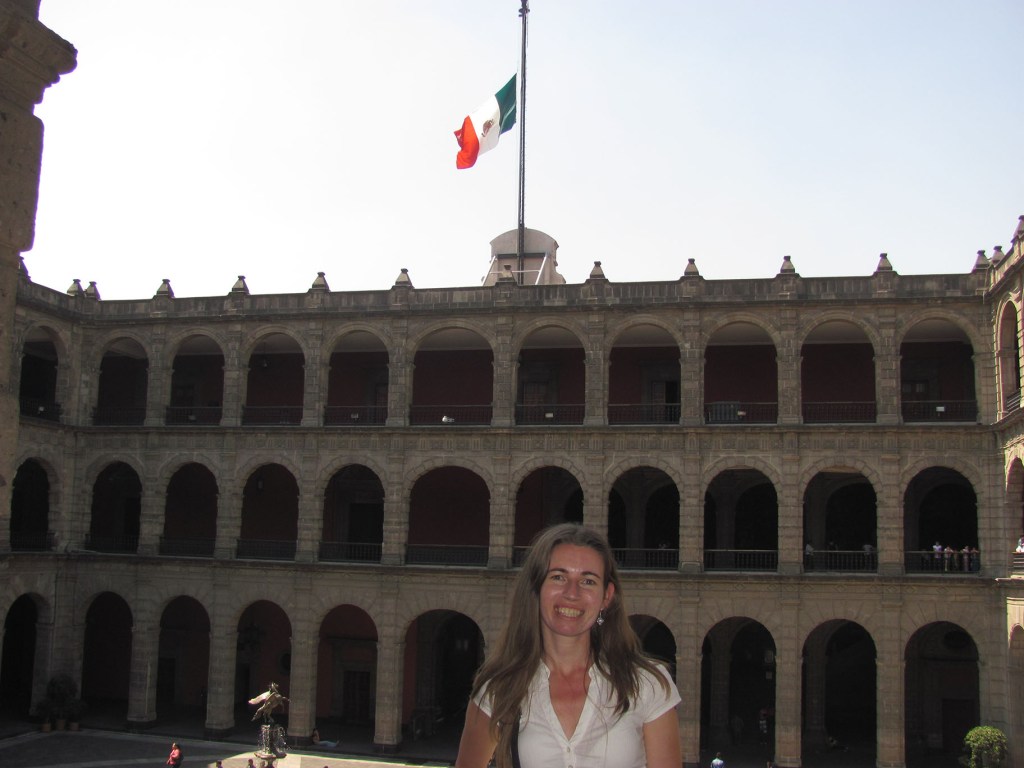
The central square opposite the cathedral was fenced off, it was expected that there would be some kind of concert or festival, with many people waiting in queues. We passed them heading to the opposite part of the square, where the National Palace / Palacio Nacional was rising. It was erected on the site of the palace of the Aztec emperor Moctezuma, and later the home of the conqueror Cortés. The construction of today’s building had begun in 1562. In the Baroque style, typical of Spanish architecture at the time, the building aimed to accommodate the main government in the country. After the declaration of independence in 1821. The president also settled here. Only in 1860. the building was open to the public, and today it continued to house the office of the President and the Minister of Finance. Especially beautiful here were the many paintings on the walls, which represented the life of the Mayans and other local folk people.
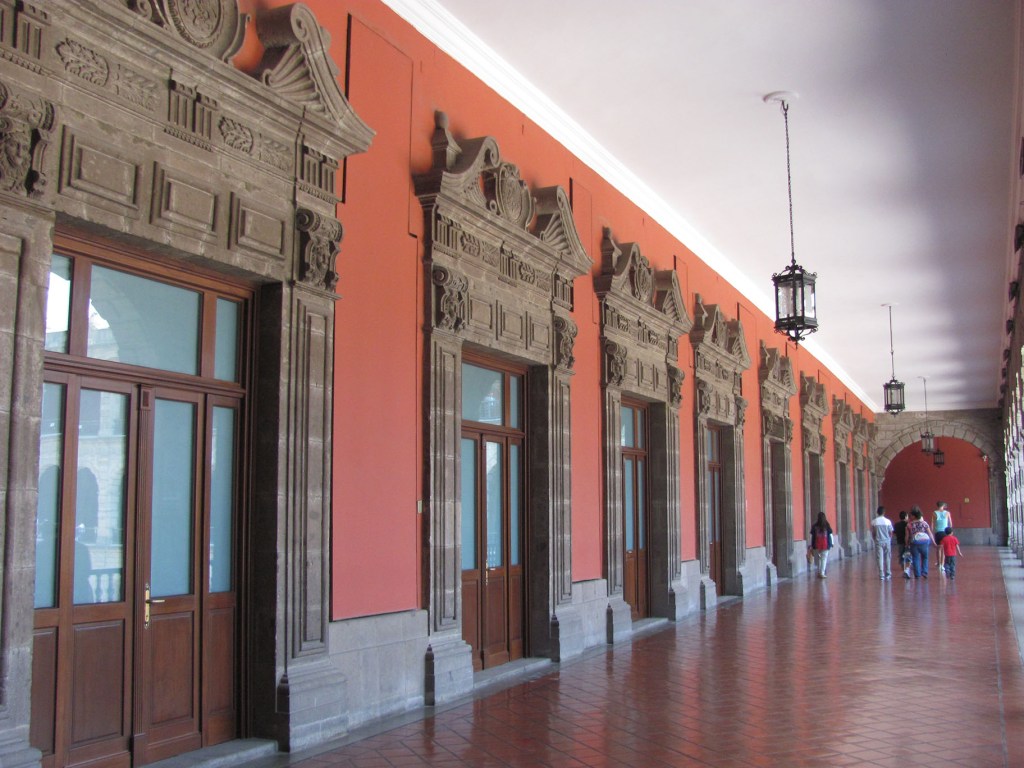
In a hurry, we passed beautifully painted corridors and went down to the courtyard, where there was a fountain. From there we headed back to the cathedral, where the bus was waiting for us in front to take us to the airport. As we ran between the National Palace and the Cathedral, I was again under the impression that only Europeans (and maybe Americans) were constantly rushing somewhere. The Mexicans, on the contrary, walked slowly and did not seem to rush anywhere. And we were constantly in a hurry, at work or, in vacation. We didn’t have enough time or we just didn’t use it properly. In any case, my time in Mexico was used and organized to the last minute in the best possible way, and I returned home enriched with many good impressions, memories and mindfullness.



GENERAL INFORMATION ABOUT MEXICO CITY:
Location: Mexico City (Spanish: Ciudad de Mexico) is the capital and largest city of the state of Mexico. It is also the largest city in South and North America and the third largest urban agglomeration in the world (after Tokyo and Seoul). The city is located in the very center of the country, in the Valley of Mexico. To the north is Mount Gadalupe, and to the east is Mount Santa Catarina, and to the south is Las Cruces and Ajusto.
Area: 1 485 sq. m.km
Altitude: 2,240 m
Population: 22,000,000 people
Official language: Spanish
Climate: subtropical climate, with the lowest temperatures in January and February, and the highest in late spring and summer, respectively. Precipitation is mainly in the summer (from June to September/October), and the rest of the year it hardly rains.
Time zone: UTC-8 to -5
Currency: Mexican peso (MXN)
Additional information: http://www.visitmexico.com/en/mexico-city

TRIP TIPS FOR MEXICO CITY:
Best time to visit: All year round, with probably November to May being the best months for sightseeing as it doesn’t rain.
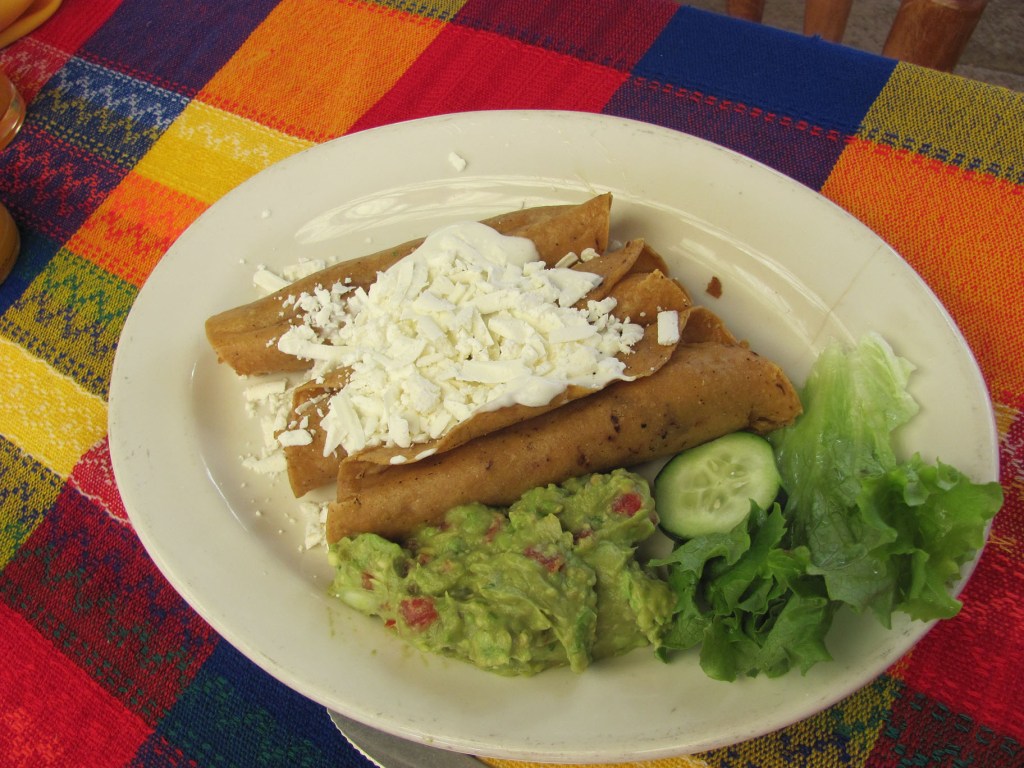
Typical foods and drinks: In addition to the famous Mexican tacos and boritos, while in Mexico City, try the local Enchiladas, which are corn tortillas served with meat, cheese, seafood, vegetables or beans, and topped with chili sauce, as well as the local Guacamole. whose sauce dates back to the time of the Aztecs and is made from ground avocado, tomatoes, lemon sauce and chili, and served with tortilla chips.
Places to visit: The city of Mexico is vast and offers many attractions, among which we highly recommend you: Basilica de Guadalupe (the most sacred Catholic place in America), La Catedral (the largest church in America), Constitution Square, the Palace of Fine Arts and the one rising next to it the Torre Latinoamericana skyscraper, the National Museum of Anthropology, and many more. Not far from the city is the unique ancient city of Teotihuacan.
 TripTips